Produced in rabbits immunized with E. coli-derived Human Cathepsin Z/CTSZ fragment, and purified by antigen affinity chromatography.
Source
Polyclonal Rabbit IgG
Purification
Protein A & Antigen Affinity
Formulation
PBS, pH7.0 with 0.03% Proclin300
Conjugate
Unconjugated
Form
Liquid
Shipping
This antibody is shipped as liquid solution at ambient temperature. Upon receipt, store it immediately at the temperature recommended below.
Storage
This antibody can be stored at 2℃-8℃ for one month without detectable loss of activity. Antibody products are stable for twelve months from date of receipt when stored at -20℃ to -80℃. Avoid repeated freeze-thaw cycles.
Synonyms: Anti-CTSX Antibody
Image / Experimental Information
Image 1 Description
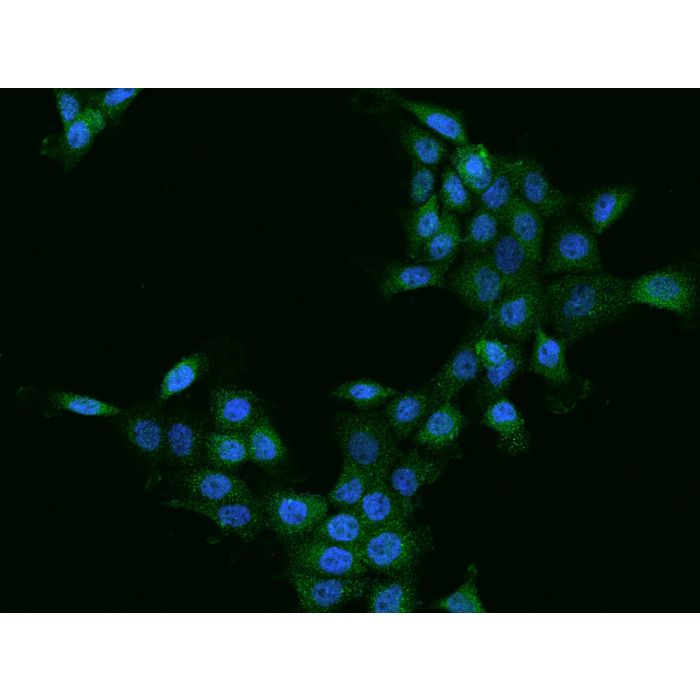
Immunofluorescence staining of CTSZ in A431 cells. Cells were fixed with 4% PFA, permeabilzed with 0.1% Triton X-100 in PBS,blocked with 10% serum, and incubated with rabbit anti-Human CTSZ polyclonal antibody (dilution ratio 1:200) at 4℃ overnight. Then cells were stained with the Alexa Fluor®488-conjugated Goat Anti-rabbit IgG secondary antibody (green) and counterstained with DAPI (blue).Positive staining was localized to Cytoplasm.
Cathepsin Z (CTSZ), also known as Cathepsin X or CATX, belongs to the C1 family of lysosomal cysteine proteases. Its gene structure and activity properties show several unique features that distinguish it clearly from other human cysteine proteases. It has a very short pro-region that shows no similarity to those of other cathepsins and a three-residue insertion motif that forms a characteristic ‘mini loop’. Cathepsin Z exhibits mono- and di-peptidase activity at its C-terminus, and in contrast to cathepsin B, it does not act as an endopeptidase. It is restricted to the cells of theimmune system, predominantly monocytes, macrophages and dendritic cells. Cathepsin Z is widely expressed in human tissues, suggesting that this enzyme could be involved in the normal intracellular protein degradation taking place in all cell types. It is capable to cleave regulatory motifs at C-terminus affecting the function of targeted molecules. Cathepsin X may regulate also the maturation of dendritic cells, a process, which is crucial in the initiation of adaptive immunity. Furthermore, higher levels of Cathepsin Z are also found in tumour and immune cells of prostate and gastric carcinomas and inmacrophages of gastric mucosa, especially after infection by Helicobacter pylori. Cathepsin Z is also ubiquitously distributed in cancer cell lines and in primary tumors from different sources, suggesting that this enzyme may participate in tumor progression.
References
Santamara I, et al. (1998) Cathepsin Z, a novel human cysteine proteinase with a short propeptide domain and a unique chromosomal location. J Biol Chem. 273(27): 16816-23.
Kos J, et al. (2009) The role of cathepsin X in cell signaling. Cell Adh Migr. 3(2): 164-6.
Sevenich L, et al. (2010) Synergistic antitumor effects of combined cathepsin B and cathepsin Z deficiencies on breast cancer progression and metastasis in mice. Proc Natl Acad Sci U S A. 107(6): 2497-502.

-HD12OC0879-200-A431-IF.png)