Produced in rabbits immunized with E. coli-derived Human CCDC141 fragment, and purified by antigen affinity chromatography.
Source
Polyclonal Rabbit IgG
Purification
Protein A & Antigen Affinity
Formulation
PBS, pH7.0 with 0.03% Proclin300
Conjugate
Unconjugated
Form
Liquid
Shipping
This antibody is shipped as liquid solution at ambient temperature. Upon receipt, store it immediately at the temperature recommended below.
Storage
This antibody can be stored at 2℃-8℃ for one month without detectable loss of activity. Antibody products are stable for twelve months from date of receipt when stored at -20℃ to -80℃. Avoid repeated freeze-thaw cycles.
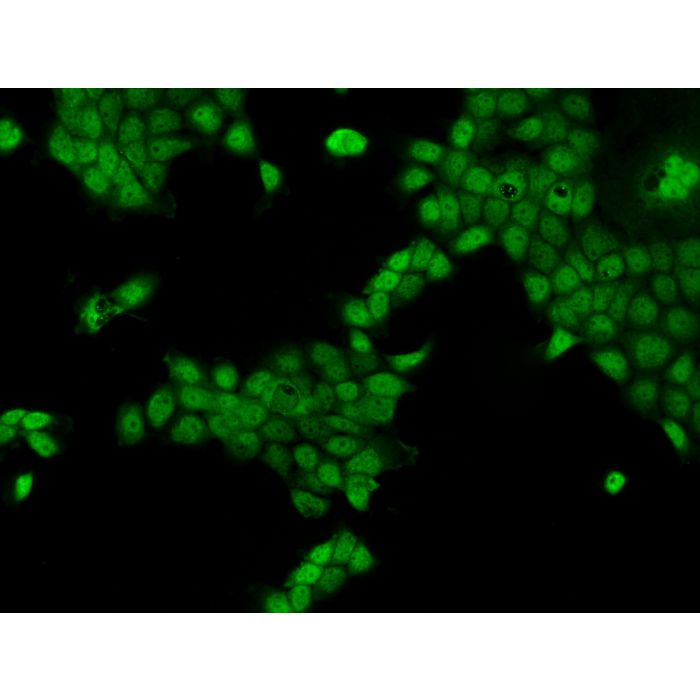
Immunofluorescence staining of CCDC141 in A431 cells. Cells were fixed with 4% PFA, permeabilzed with 0.1% Triton X-100 in PBS,blocked with 10% serum, and incubated with rabbit anti-Human CCDC141 polyclonal antibody (dilution ratio 1:200) at 4℃ overnight. Then cells were stained with the Alexa Fluor®488-conjugated Goat Anti-rabbit IgG secondary antibody (green). Positive staining was localized to Nucleus and Cytoplasm.
CCDC141 encodes a coiled-coil domain containing protein. Ccdc141 is expressed in GnRH neurons and olfactory fibers and that knockdown of Ccdc141 reduces GnRH neuronal migration. Ccdc141 is a cytoskeletal scaffolding protein that links cellular actin and microtubule components of the cytoskeleton, which underlie the shape and motility of a cell, with force-generating motor proteins. During migration of gonadotropin-releasing hormone (GnRH) neurons from nasal regions to the hypothalamus, the actin cytoskeleton and myosin motor proteins generate force to move the nucleus forward. This force generates tension on the microtubule cytoskeleton, which forms a cage around the nucleus and thereby pulls the nucleus forward. CCDC141, in association with disrupted in schizophrenia-1 (Disc1) and myosin II, has been implicated in cortical interneuron migration in mice.
References
Turan I, et al. (2017) Ccdc141 mutations in idiopathic hypogonadotropic hypogonadism. J Clin Endocrinol Metab 102 (6): 1816-1825.

-HD12DE1815-200-A431-IF.png)