Recombinant Mouse CD146 / MCAM Protein (Catalog#50794-M08H)
Preparation
This antibody was obtained from a rabbit immunized with purified, recombinant Mouse CD146 / MCAM (rM CD146 / MCAM; Catalog#50794-M08H; Q8R2Y2-1; Met1-Val563) and conjugated with APC under optimum conditions, the unreacted APC was removed.
Source
Monoclonal Rabbit IgG Clone #241
Purification
Protein A
Formulation
PBS solution containing 0.5% BSA and 0.03%ProClin300
Concentration
10 μl/Test, 0.1 mg/ml
Conjugate
APC
Form
Liquid
Shipping
This antibody is shipped as liquid solution at ambient temperature. Upon receipt, store it immediately at the temperature recommended below.
Storage
This antibody can be stored at 2℃-8℃ for twelve months without detectable loss of activity. Protected from prolonged exposure to light. Do not freeze !
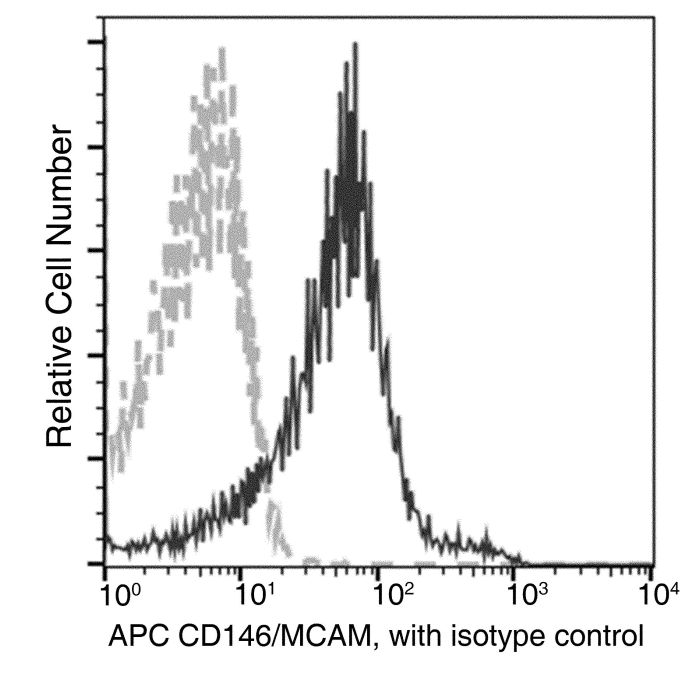
Flow cytometric analysis of Mouse MCAM(CD146) expression on BABL/c splenocytes. Cells were stained with APC-conjugated anti-Mouse MCAM(CD146). The fluorescence histograms were derived from gated events with the forward and side light-scatter characteristics of intact cells.
The CD146 antigen, also known as melanoma cell adhesion molecule (MCAM) and MUC18, is an integral membrane glycoprotein belonging to the immunoglobulin superfamily. CD146 contains the characteristic immunoglobulin-like domains (V-V-C2-C2-C2), a transmembrane region, and a short cytoplasmic tail. The CD146 expression is detected in endothelial cells in vascular tissue throughout the body and plays a role in cell adhesion, as well as in cohesion of the endothelial monolayer at intercellular junctions in vascular tissue. As a Ca2+-independent cell adhesion molecule involved in heterophilic cell to cell interactions and a surface receptor, CD146 triggers tyrosine phosphorylation of FYN and PTK2 and subsequently induced signal transduction, proteolysis, or immune recognition. This protein is also expressed predominantly on metastatic lesions and advanced primary tumors, and thus has been suggested to play an important role in tumor progression and the development of metastasis in certain human carcinomas.
References
Mills L, et al. (2002) Fully human antibodies to MCAM/MUC18 inhibit tumor growth and metastasis of human melanoma. Cancer Res. 62(17): 5106-14.
Taira E, et al. (2004) Characterization of Gicerin/MUC18/CD146 in the rat nervous system. J Cell Physiol. 198(3): 377-87.
Fritzsche FR, et al. (2008) CD146 protein in prostate cancer: revisited with two different antibodies. Pathology. 40(5): 457-64.
Bidlingmaier S, et al. (2009) Identification of MCAM/CD146 as the target antigen of a human monoclonal antibody that recognizes both epithelioid and sarcomatoid types of mesothelioma. Cancer Res. 69(4): 1570-7.
Boneberg EM, et al. (2009) Soluble CD146 is generated by ectodomain shedding of membrane CD146 in a calcium-induced, matrix metalloprotease-dependent process. Microvasc Res. 78(3): 325-31.