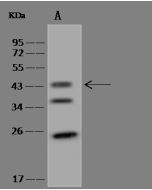
Recombinant Mouse FGFR1 / CD331 protein (Catalog#50186-M08H)
Preparation
This antibody was obtained from a rabbit immunized with purified, recombinant Mouse FGFR1 / CD331 (rM FGFR1 / CD331; Catalog#50186-M08H; P16092-1; Met 1-Glu 376).
Source
Monoclonal Rabbit IgG Clone #001
Purification
Protein A
Formulation
0.2 μm filtered solution in PBS
Conjugate
Unconjugated
Form
Liquid
Shipping
This antibody is shipped as liquid solution at ambient temperature. Upon receipt, store it immediately at the temperature recommended below.
Storage
This antibody can be stored at 2℃-8℃ for one month without detectable loss of activity. Antibody products are stable for twelve months from date of receipt when stored at -20℃ to -80℃. Preservative-Free. Avoid repeated freeze-thaw cycles.
FGFR1, also known as CD331, belongs to the fibroblast growth factor receptor subfamily where amino acid sequence is highly conserved between members and throughout evolution. FGFR family members differ from one another in their ligand affinities and tissue distribution. Fibroblast growth factors (FGFs) (FGF1 - 10 and 16 - 23) are mitogenic signaling molecules that have roles in angiogenesis, wound healing, cell migration, neural outgrowth and embryonic development. FGFs bind heparan sulfate glycosaminoglycans, which facilitates dimerization (activation) of FGF receptors. FGFR1 is a full-length representative protein consists of an extracellular region, composed of three immunoglobulin-like domains, a single hydrophobic membrane-spanning segment and a cytoplasmic tyrosine kinase domain. The extracellular portion of FGFR1 interacts with fibroblast growth factors, setting in motion a cascade of downstream signals, ultimately influencing mitogenesis and differentiation. This particular family member binds both acidic and basic fibroblast growth factors and is involved in limb induction. CD331 can be detected in astrocytoma, neuroblastoma and adrenal cortex cell lines. Some isoforms are detected in foreskin fibroblast cell lines, however isoform 17, isoform 18 and isoform 19 are not detected in these cells. Defects in FGFR1 are a cause of Pfeiffer syndrome ,idiopathic hypogonadotropic hypogonadism, Kallmann syndrome type 2, osteoglophonic dysplasia and trigonocephaly non-syndromic.
Research Areas
Cancer Drug Targets
Receptor Tyrosine Kinases (RTKs)
Tags
Cancer Immunotherapy
Immune Checkpoint
Immunotherapy
Targeted Therapy
References
Schlessinger J, et al. (2000) Crystal structure of a ternary FGF-FGFR-heparin complex reveals a dual role for heparin in FGFR binding and dimerization. Mol Cell. 6(3):743-50.
Dodé C, et al. (2007) Novel FGFR1 sequence variants in Kallmann syndrome, and genetic evidence that the FGFR1c isoform is required in olfactory bulb and palate morphogenesis. Hum Mutat. 28(1): 97-8.
Kim HG, et al. (2005) Hypogonadotropic hypogonadism and cleft lip and palate caused by a balanced translocation producing haploinsufficiency for FGFR1. J Med Genet. 42(8):666-72.