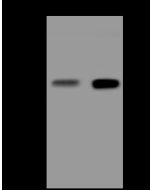
Mouse kynureninase/KYNU Has cross-reactivity in ELISA with Human KYNU
Immunogen
Recombinant Mouse KYNU protein (Catalog#50310-M08B)
Preparation
This antibody was obtained from a rabbit immunized with purified, recombinant Mouse KYNU (Catalog#50310-M08B; Q9CXF0; Met1-Ser464).
Source
Monoclonal Rabbit IgG Clone #015
Purification
Protein A
Formulation
0.2 μm filtered solution in PBS
Conjugate
Unconjugated
Form
Liquid
Shipping
This antibody is shipped as liquid solution at ambient temperature. Upon receipt, store it immediately at the temperature recommended below.
Storage
This antibody can be stored at 2℃-8℃ for one month without detectable loss of activity. Antibody products are stable for twelve months from date of receipt when stored at -20℃ to -80℃. Preservative-Free. Avoid repeated freeze-thaw cycles.
KYNU (Kynureninase) is a Protein Coding gene. KYNU is a pyridoxal-5'-phosphate (pyridoxal-P) dependent enzyme that catalyzes the cleavage of L-kynurenine and L-3-hydroxykynurenine into anthranilic and 3-hydroxyanthranilic acids, respectively. Genetic studies in the mouse and the human suggest that kynureninase activity may influence blood pressure and renal function. The gene coding kynureninase (KYNU) is also located on chromosome band 2q14-q23, where a linkage peak for essential hypertension was previously detected in the Chinese Han population. The results show that the rare KYNU variant Arg188Gln affects kynureninase activity and are consistent with the hypothesis that this mutation can predispose to essential hypertension. Diseases associated with KYNU include Hydroxykynureninuria and Vertebral, Cardiac, Renal, And Limb Defects Syndrome 2.
References
Lima S, et al. (2007) Crystal structure of Homo sapiens kynureninase. Biochemistry. 46(10): 2735-44.
Momany C, et al. (2004) Three-dimensional structure of kynureninase from Pseudomonas fluorescens. Biochemistry. 43(5): 1193-203.
Toma S, et al. (1997) Cloning and recombinant expression of rat and human kynureninase. FEBS Lett. 408(1): 5-10.