A synthetic peptide corresponding to the C-terminus of the Rat CD24
Preparation
Produced in rabbits immunized with a synthetic peptide corresponding to the C-terminus of the Rat CD24, and purified by antigen affinity chromatography.
Source
Polyclonal Rabbit IgG
Purification
Protein A & Antigen Affinity
Formulation
PBS, pH7.0 with 0.03% Proclin300
Conjugate
Unconjugated
Form
Liquid
Shipping
This antibody is shipped as liquid solution at ambient temperature. Upon receipt, store it immediately at the temperature recommended below.
Storage
This antibody can be stored at 2℃-8℃ for one month without detectable loss of activity. Antibody products are stable for twelve months from date of receipt when stored at -20℃ to -80℃. Avoid repeated freeze-thaw cycles.
Synonyms: Anti-Cd24 Antibody; Anti-Cd24a Antibody
Image / Experimental Information
Image 1 Description
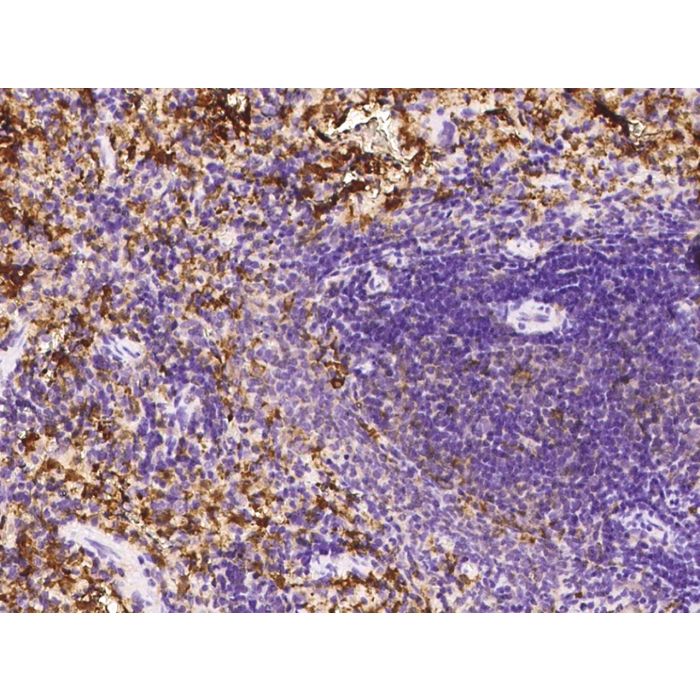
Immunochemical staining of rat CD24 in rat spleen with rabbit polyclonal antibody at 1:200 dilution, formalin-fixed paraffin embedded sections.
The cluster of differentiation (CD) system is commonly used as cell markers in Immunophenotyping. Different kinds of cells in the immune system can be identified through the surface CD molecules associating with the immune function of the cell. There are more than 320 CD unique clusters and subclusters have been identified. Some of the CD molecules serve as receptors or ligands important to the cell through initiating a signal cascade which then alter the behavior of the cell. Some CD proteins do not take part in cell signal process but have other functions such as cell adhesion. Cluster of differentiation 24, also known as signal transducer CD24 or heat stable antigen CD24 (HSA), is a mucin-type glycosylphosphatidylinositol-linked glycoprotein expressed on the surface of B-cells, differentiating neuroblasts and many tumors. It is involved in molecular adhesion and metastatic tumor spread and serve as a normal receptor for P-selectin. The CD24 / P-selectin pathway could be important in disseminating tumor cells by facilitating the interaction with platelet and endothelial cells. It has also been considered as a tumor marker. High rate of CD24 expressions have been found in epithelial ovarian cancer, breast cancer, non-small cell lung cancer, prostate cancer and pancreatic cancer.
Research Areas
Cancer Drug Targets
References
Zola H, et al. (2007) CD molecules 2006-human cell differentiation molecules. J Immunol Methods. 318 (1-2): 1-5.
Ho IC, et al. (2009) GATA3 and the T-cell lineage: essential functions before and after T-helper-2-cell differentiation. Nat Rev Immunol. 9 (2): 125-35.
Matesanz-Isabel J, et al. (2011) New B-cell CD molecules. Immunology Letters.134 (2): 104-12.
Kristiansen G, et al. (2003) Tumour biological aspects of CD24, a mucin-like adhesion molecule. Journal of molecular histology. 35 (3): 255-62.