Produced in rabbits immunized with E. coli-derived Human MTHFD2 fragment, and purified by antigen affinity chromatography.
Source
Polyclonal Rabbit IgG
Purification
Protein A & Antigen Affinity
Formulation
PBS, pH7.0 with 0.03% Proclin300
Conjugate
Unconjugated
Form
Liquid
Shipping
This antibody is shipped as liquid solution at ambient temperature. Upon receipt, store it immediately at the temperature recommended below.
Storage
This antibody can be stored at 2℃-8℃ for one month without detectable loss of activity. Antibody products are stable for twelve months from date of receipt when stored at -20℃ to -80℃. Avoid repeated freeze-thaw cycles.
Synonyms: Anti-NMDMC Antibody
Image / Experimental Information
Image 1 Description
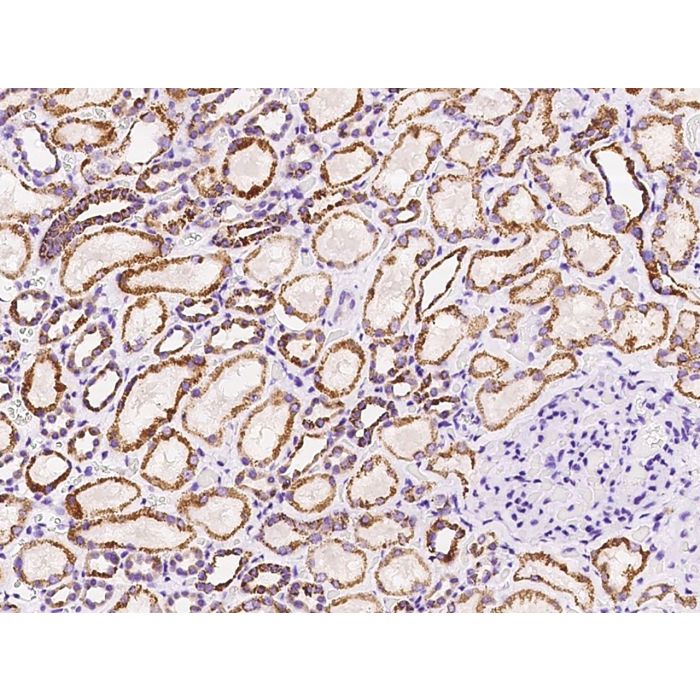
Immunochemical staining of human MTHFD2 in human kidney with rabbit polyclonal antibody at 1:100 dilution, formalin-fixed paraffin embedded sections.
Methylenetetrahydrofolate dehydrogenase (MTHFD2), a dual-functional metabolic enzyme, is a tetramethylfolate dehydrogenase enzyme involved in folate metabolism. The folate-coupled metabolic enzyme MTHFD2 is overexpressed in many tumor types and required for cancer cell proliferation and is therefore of interest as a potential cancer therapeutic target. However, recent evidence suggests that MTHFD2 has a non-enzymatic function which may underlie the dependence of cancer cells on this protein. Methylenetetrahydrofolate dehydrogenase 2 (MTHFD2) is specifically enhanced in cancer. MTHFD2 plays a key role in one-carbon (1C) metabolism in human mitochondria, and its high expression correlates with poor survival of patients with various types of cancer. An isozyme-selective MTHFD2 inhibitor is highly attractive for potential use in cancer treatment. MTHFD2 is a functional target gene of miR-33a-5p. miR-33a-5p inhibits the growth and migration of CRC by targeting MTHFD2.
References
Yan Y, et al. (2019) Microrna-33a-5p suppresses colorectal cancer cell growth by inhibiting mthfd2. Clin Exp Pharmacol Physiol 46 (10): 928-936.
Wei Y, et al. (2019) The effect of mthfd2 on the proliferation and migration of colorectal cancer cell lines. Onco Targets Ther 12 6361-6370.
Koufaris C, et al. (2018) Protein interaction and functional data indicate mthfd2 involvement in rna processing and translation. Cancer Metab 6 12.
Kawai J, et al. (2019) Structure-based design and synthesis of an isozyme-selective mthfd2 inhibitor with a tricyclic coumarin scaffold. ACS Med Chem Lett 10 (6): 893-898.


-HD12AU2126-100-human-kidney-IHC-P.png)