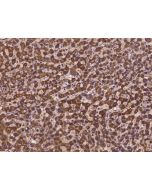
Recombinant Human Myelin Oligodendrocyte Glycoprotein Protein (Catalog#10364-H08E)
Preparation
Produced in rabbits immunized with purified, recombinant Human Myelin Oligodendrocyte Glycoprotein (rh Myelin Oligodendrocyte Glycoprotein; Catalog#10364-H08E; NP_996532.2; Gly30-Tyr149). Myelin Oligodendrocyte Glycoprotein specific IgG was purified by Human Myelin Oligodendrocyte Glycoprotein affinity chromatography.
Source
Polyclonal Rabbit IgG
Purification
Protein A & Antigen Affinity
Formulation
0.2 μm filtered solution in PBS
Conjugate
Unconjugated
Form
Liquid
Shipping
This antibody is shipped as liquid solution at ambient temperature. Upon receipt, store it immediately at the temperature recommended below.
Storage
This antibody can be stored at 2℃-8℃ for one month without detectable loss of activity. Antibody products are stable for twelve months from date of receipt when stored at -20℃ to -80℃. Preservative-Free. Avoid repeated freeze-thaw cycles.
Anti-MOG rabbit polyclonal antibody at 1:500 dilution Lane A: Mouse brain tissue lysate Lysates/proteins at 30 μg per lane. Secondary Goat Anti-Rabbit IgG (H+L)/HRP at 1/10000 dilution. Developed using the ECL technique. Performed under reducing conditions. Predicted band size:28 kDa
Image 1 Alt Text
Human Myelin Oligodendrocyte Glycoprotein Western blot (WB) 35304
Myelin oligodendrocyte glycoprotein (MOG) is a transmembrane protein belonging to the immunoglobulin superfamily and contains an Ig-like domain followed by two potential membrane-spanning regions. MOG is expressed only in the CNS with very low content (approximately 0.1% total proteins) in the oligodendrogliocyte membrane. Three possible functions for MOG were suggested: (a) a cellular adhesive molecule, (b) a regulator of oligodendrocyte microtubule stability, and (c) a mediator of interactions between myelin and the immune system, in particular, the complement cascade. A direct interaction might exist between the membrane-associated regions of MOG and the myelin-specific glycolipid galactocerebroside (Gal-C), and such an interaction may have important consequences regarding the membrane topology and function of both molecules. It is considered that MOG is an autoantigen capable to produce demyelinating multiple sclerosis-like diseases in experimental animals.
References
Chekhonin VP, et al. (2003) Myelin oligodendrogliocyte glycoprotein: the structure, functions, role in pathogenesis of demyelinating disorders. Biomed Khim. 49(5): 411-23.
Hilton AA, et al. (1995) Characterization of cDNA and Genomic Clones Encoding Human Myelin Oligodendrocyte Glycoprotein. J Neurochem. 65(1): 309-18.
Johns TG, et al. (1999) The Structure and Function of Myelin Oligodendrocyte Glycoprotein. J Neurochem. 72(1): 1-9.