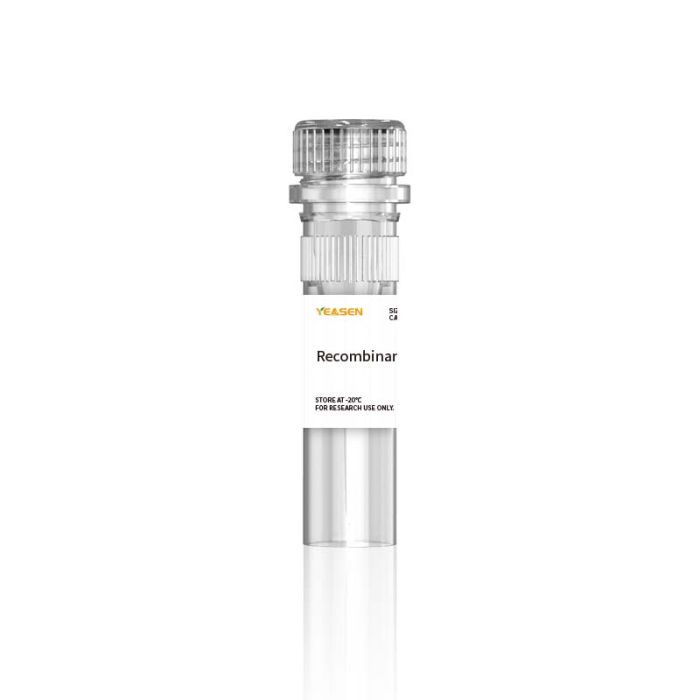
Human APOE/Apolipoprotein E (His Tag) yeasen
$179.00
In stock
SKU
93486ES20
Product Description
ApoE is a major protein component of serum LDL, VLDL, HDL, and chylomicrons. It is produced predominantly by hepatocytes, macrophages, and non-neuronal cells in the CNS. ApoE-containing particles transport triglycerides and cholesterol to peripheral tissues for cellular uptake and catabolism. Mature human ApoE is a 37 kDa glycoprotein. ApoE3 is the most abundant of the three common alleles in human; ApoE2 and ApoE4 differ by single aa substitutions. Mature human ApoE shares 71% aa sequence identity with mouse and rat ApoE. ApoE3 dampens the TNF-alpha induced inflammatory response in vascular endothelial cells.
Specifications
| Synonyms | Apolipoprotein E, Apo-E, APOE, apolipo E Uniprot No. P02649-1 |
| Source | Recombinant Human APOE / Apolipoprotein E Protein is expressed from HEK293 Cells with His tag at the N-terminal. It contains Lys19-His317. |
| Molecular Weight | Approximately 35.3 kDa. Due to glycosylation, the protein migrates to 35-40 kDa based on Tris-Bis PAGE result. Physical Appearance Sterile Filtered White lyophilized (freeze-dried) powder. |
| Purity | > 95% as determined by SDS-PAGE |
| Formulation | Lyophilized from 0.22 μm filtered solution in PBS (pH 7.4). Normally 5% trehalose is added as protectant before lyophilization. |
| Endotoxin | < 1.0 EU per 1μg of the protein by the LAL method. |
| Reconstitution | Centrifuge tubes before opening. Reconstituting to a concentration more than 100 μg/mL` is recommended (usually we use 1 mg/mL solution for lyophilization). Dissolve the lyophilized protein in distilled water. |
| Activity | 1. SPR Data : Human TREM2, hFc Tag captured on CM5 Chip via Protein A can bind Human APOE, His Tag with an affinity constant of 1.004 μM as determined in SPR assay (Biacore T200). 2. SPR Data : Human LILRB4, hFc Tag captured on CM5 Chip via Protein A can bind Human APOE, His Tag with an affinity constant of 115.9 nM as determined in SPR assay (Biacore T200). |
Storage
Transported with ice packs. Store at -20℃ to -80℃, valid for one year. After reconstitution, store unopened at -20 to -80°C for 3-6 months. After reconstitution, store at 2-8°C for 2-7 days. It is recommended to store in aliquots for first use to avoid repeated freezing and thawing.
Notes
1. Avoid repeated freezing and thawing. 2. For your safety and health, please wear a lab coat and disposable gloves when operating. 3. This product is for scientific research purposes only!