Hieff NGS™ OnePot Evo DNA Library Prep Kit (Enzymatic, For FFPE, V4) _ 12193ES yeasen
$135.00
In stock
SKU
12193ES08
Product Description
Hieff NGS™ OnePot Evo DNA Library Prep Kit is a next-generation enzymatic library preparation kit compatible with both Illumina and MGI high-throughput sequencing platforms. Compared to traditional library construction methods, this kit replaces time-consuming and instrument-dependent sonication with a high-quality, low-bias fragmentation enzyme. It uniquely integrates the fragmentation, end repair, and dA-tailing steps into a single reaction, significantly reducing hands-on time, cost, and workflow complexity. The ligation module features pre-mixed enzyme and buffer for streamlined operation, making the kit highly suitable for automation. Building upon the previous version, this updated formulation further reduces GC bias, enhances end-repair and dA-tailing efficiency, and improves reagent stability. It also incorporates a newly optimized ligase for superior adapter ligation performance. The kit is fully compatible with standard Illumina or MGI adapters and primers. Ideal for whole-genome sequencing of animals, plants, microbes, and challenging clinical samples.
Features
Specifications
Components
Storage
This product should be stored at -25~-15℃ for one year..
Applications
Figures
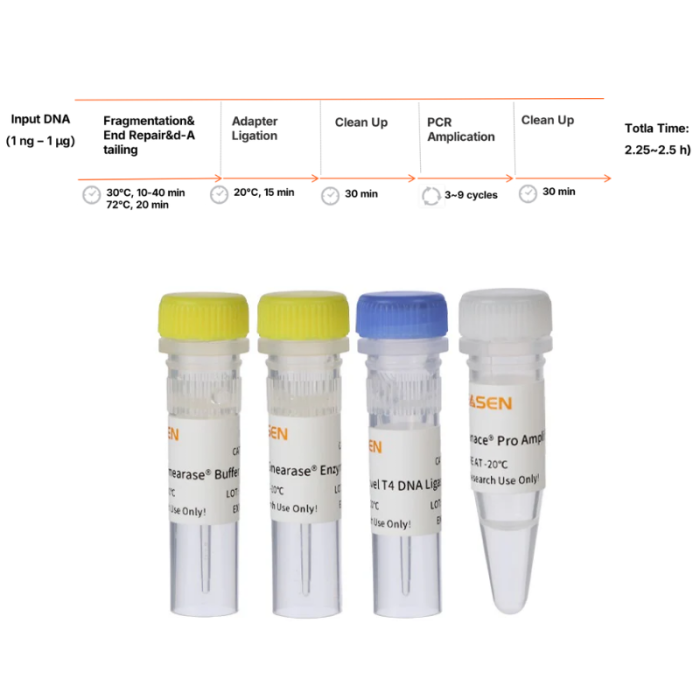
1. Workflow
Figure 1. The workflow of OnePot Pro DNA Library Prep Kit 2. Flexible and High-Efficiency Fragmentation
Figure 2. Fragment size distribution of 250 ng human gDNA using the 12193 fragmentation module. Calf gDNA (250 ng) was fragmented at 30°C ~ 35°C for 5 min, 10, 15, 20, 30. The distribution of recovered insert sizes is shown, demonstrating stable and uniform fragmentation across the 5 – 3 0 minute range. Different DNA samples were fragmented with 12 194 under identical conditions. The libraries showed consistent sizes (~450 bp / ~320 bp) with good uniformity across species.
Figure 3. Comparison of soft-clipping rates (%) and false chimeric read rates (%) across human gDNA, ctDNA, and FFPE DNA samples. The results show that 12194 exhibits lower or comparable soft-clipping rates (%) and false chimeric rates(%). 3. Strong Stability
Figure 4. Library yield stability after storage at 4 ° C and 25 ° C for 4 weeks. No decrease in library yield was observed after 4 weeks of storage at 4 ° C and 25 ° C, highlighting the kit ’ s suitability for automation.
Manuals