Hieff Unicon™ Universal Superfast qPCR Mix(One Tube, Low DNA, Fast 4G) _ 16924ES yeasen
$95.00
In stock
SKU
16924ES60
Product Description
Hieff Unicon TM Universal Superfast qPCR Mix (One Tube) is a fluorescent quantitative qPCR premix that employs the company's new-generation antibody-mediated hot-start Ta q DNA p olymerase. This product features broad applicability, supports fast protocols, and comes in a fully pre-mixed format.
Features
Components
Storage
This product should be stored at -25~-15℃ for 1 year.
Applications
Figures
1. Excellent Amplification Performance Across qPCR Platforms
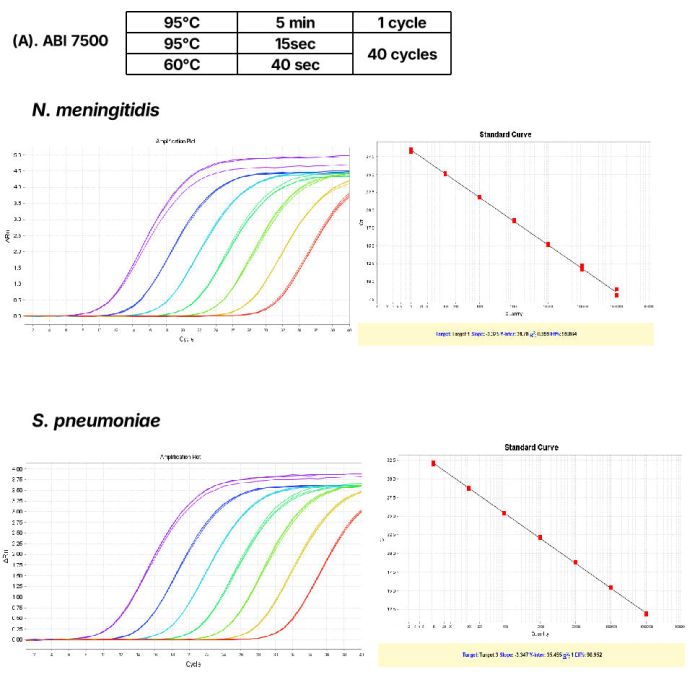
Figure 1. Amplification efficiency test of N. meningitidis and S. pneumoniae using fast cycling protocols. (A) ABI 7500 Fast Mode: N. meningitidis (R² = 0.999, Eff = 99.864%), S. pneumoniae (R² = 1.000, Eff = 98.952%) (B) ABI Q5 Fast Mode: N. meningitidis (R² = 0.999, Eff = 99.14%), S. pneumoniae (R² = 1.000, Eff = 99.756%) 2. Superior Amplification Performance Under Fast vs. Conventional qPCR Programs Instrument SLAN System 5 μL DNA (25 μL total volume) Template bacterial plasmid template (B-tube and P-tube). Template concentrations Ct 30-35 Progarm Conventional program (96S/48S): 95°C 5 min;40 cycles (95°C 15sec;60°C 30 sec)--50 min Fast program (48S Fast): 95°C 15 sec;40 cycles (95°C 2sec;60°C 8 sec)--20 min Table 1. Sensitivity Evaluation of 16924 Under Fast and Conventional Programs 16924 Group B Group P fluorescence channel FAM VIC ROX FAM VIC CY5 ROX 96S-Conventional program Mean Ct Value
36.16 36.13 33.23 35.61 38.81 36.03 Detection Rate 16/16 12/16 13/16 0 15/16 fluorescence channel FAM VIC ROX FAM VIC CY5 ROX 48S-Fast program Mean Ct Value 36.54 36.31 33.54 36.46 39.14 36.87 36.31 Detection Rate 16/16 14/16 11/16 2/16 13/16 fluorescence channel FAM VIC ROX FAM VIC CY5 ROX 48S-Conventional program Mean Ct Value 36.30 36.34 33.77 35.54 38.73 39.41 35.58 Detection Rate 16/16 14/16 9/16 10/16 14/16
Figure 2. Performance comparison of 16924 and Supplier A* using conventional and fast programs. Two sets of 4-plex plasmid templates (B-tube and P-tube) were tested using both 16924 and Supplier A* at relatively high template concentrations (Ct 30–35). Supplier A* showed over 1 cycle delay in Ct values under the fast program for P-tube templates, while 16924 showed no significant difference between programs. Some targets in 16924 amplified earlier in the fast protocol. 3. Strong stability
Figure 3. Stability testing of 16924 premix using ASFV nucleic acids extracted from real samples (singleplex). Thermal accelerated stability testing was performed by incubating the 16924 premix mixed with primers and probes at 37°C for 7 days. qPCR conditions: 95°C for 90 sec; 45 cycles of 95°C for 5 sec and 55°C for 30 sec. The results demonstrate that the premix maintained stable performance with consistent Ct values and amplification curves after incubation, indicating excellent thermal stability. 4. High inhibitor tolerance
Figure 4. Comparative performance of 16924 and a commercial product (Supplier A) using 4-plex plasmid templates diluted in different buffers. Templates diluted in various solutions, including TE buffer and saline, were tested with 16924 and Supplier A*. The results show that 16924 exhibits greater tolerance to diverse dilution buffers—particularly saline—providing more reliable detection in buffer-restricted or field-based settings.
Safety Data Sheet
Manuals
Related Blog