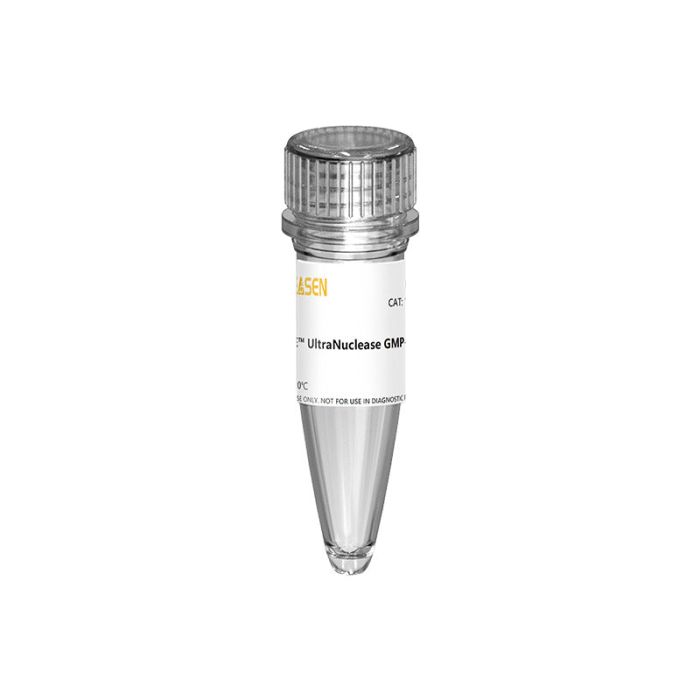
UCF.ME™ UltraNuclease GMP-grade (250 U/μL) _ 20157ES yeasen
$155.00
In stock
SKU
20157ES25
Product Description
UltraNuclease is a genetically engineered endonuclease from Serratia marcescens. The enzyme digests all forms of DNA/RNA moleculars into oligonucleotides of about 5 bp. The product is expressed in Escherichia coli (E. coli) and purified under the GMP environments. The nuclease is equivlent to benzonase in reducing host nucleic acid residues to pg-grade, improving the performance and safety of biological products of applications including virus purification, vaccine manufacturing, and protein/polysaccharide pharmaceutical manufacturing. It can also used in protein study to reduce the viscosity of cell supernatant and cell lysate, increase protein purification efficiency and enhance protein functional research. UltraNuclease is provided in the form of a sterilized reagent, eluted in buffer (20 mM Tris-HCl pH 8.0, 2 mM MgCl2, 20 mM NaCl, 50% glycerin), with the appearance of a colorless, transparent liquid. This product is produced by GMP process requirements and provided in a liquid form.
Features
Applications
Specifications
| Molecular Weight | 26.5 kDa Isoelectric point 6.85 |
| Purity | ≥ 99% (SDS-PAGE) |
| Storage Buffer | 20 mM Tris-HCl pH8.0, 2 mM MgCl 2 , 20 mM NaCl, 50% glycerin |
| Unit Definition | The definition of one Activity unit (U) is the amount of enzyme used to change the absorption value of △A260 by 1.0 in 30 minutes in a 2.625 mL reaction system at 37°C with a pH of 8.0 (equivalent to complete digestion of 37 μg salmon sperm DNA into oligonucleotides). |
Components
Shipping and Storage
The product is shipped with dry ice and can be stored at -15℃ ~ -25℃ for two years. If the product is opened and has been stored at 4℃ for more than a week, we recommend filtering the product to prevent microbial contamination.
Figures
Quality No. Test Items Competitor Yeasen 1 Source E. coli 2 Activity ≥ 250 units/μL 250-300 units/μL 3 Specific Activity ≥1.1×10 6 U/mg ≥1.5×10 6 U/mg 4 Purity ≥ 99%(SDS) ≥ 99%(HPLC) 5 Endotoxin < 0.25EU/1000U 6 Protease None Detected UltraNuclease Enzymatic Activity Under Different Conditions Temperature & pH
Figure 1. Effects of temperature and pH on enzyme activity. (A) Enzyme activity increases with temperature, with the optimum at 37 °C. (B) The enzyme is active within pH 4–10, with pH 8.0 as the optimum. Salt ion concentration 2 . Effects of salt ion concentration on enzyme activity. (A). Na⁺/K⁺ inhibit enzyme activity; activity is completely lost above 300 mM, while good activity is retained below 20 mM. (B). Maximum activity is observed with 5 mM Mg²⁺; in the absence of Mg²⁺, 1–2 mM Mn²⁺ can support activity. (C). Increasing PO₄³⁻ concentration significantly inhibits enzyme activity. Surfactants
Figure 3. Effects of surfactants on enzyme activity. (A) Triton® X-100 and (B) sodium deoxycholate reduce enzyme activity and should be maintained at low concentrations. Protein denaturants
Figure 4. Effect of protein denaturants on enzyme activity. SDS and urea reduce enzyme activity and should be maintained at low concentrations. Other commonly used reagents 5 . Effects of different inhibitors on UltraNuclease activity. ( A ) . Enzyme activity is strongly influenced by ammonium sulfate concentration. ( B ) . PMSF shows little effect on enzyme activity. ( C ) . At low EDTA concentrations (≤0.5 mM), enzyme activity is largely unaffected, whereas at 5 mM EDTA, activity is completely inhibited. Robust Performance
Figure 6. Single-factor test comparison with Supplier M*. No significant difference was observed between Yeasen UltraNuclease and supplier M*. Strong stability
Figure 7. Stability of UltraNuclease. (A) Enzyme activity remained unchanged after 4 weeks of storage at –20 °C and 4 °C, and after 2 weeks at 37 °C. (B) Enzyme activity was unaffected after 10 freeze–thaw cycles between –80 °C and –25 °C. Reaction conditions recommend Table 1. The optimal reaction conditions for UCF.ME™ UltraNuclease Factor Optimum Condition Effective condition Mg 2+ 1-5mM 0-10mM pH 8-9 6-10 Temperature 37℃ 0-42℃ Na+/K+ 0-20mM 0-150mM PO 4 3+ 0-10mM 0-100mM EDTA 0-0.5mM 0-5mM Triton®X-100 0%-0.4% 0%-1%
FAQ
Safety Data Sheet
Manuals
Related Blog