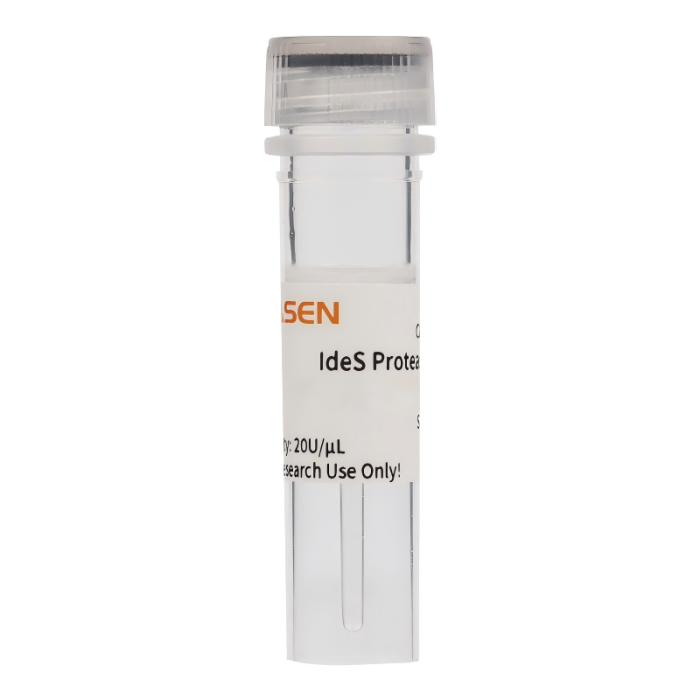
IdeS Protease (40U/μL) _ 20412ES yeasen
$385.00
In stock
SKU
20412ES84
Product Description
IdeS Protease, full name Immunoglobulin G-degrading enzyme of Streptococcus pyogenes, IdeS, is a cysteine protease produced and secreted extracellularly by the human pathogen Streptococcus pyogenes. This proteinase has extremely high substrate specificity, only recognizing IgG and cleaving at a specific site in the antibody's hinge region, resulting in the hydrolysis of IgG into intact F(ab’)2 fragments and Fc fragments. IdeS can recognize human and various other animal sources of IgG, such as human, rabbit, monkey, sheep, and human-animal chimeric IgG, etc. IdeS has unique substrate selectivity and can be used as a tool enzyme for structural characterization analysis of antibody drugs or antibody-fusion protein drugs. This product is recombinantly expressed in E. coli, with high purity and good enzymatic activity, making it a valuable tool for characterizing therapeutic antibodies, Fc fusion proteins, and antibody-drug conjugates.
Features
Applications
Specifications
| Source | E.coli recombinant expression Label N-terminal His Tag |
| Molecular Weight | 35.3 KDa |
| Purity | Purity is greater than 95% as analyzed by SDS-PAGE and HPLC |
| Storage Buffer | 50 mM sodium phosphate, 150 mM NaCl (pH 6.6), 50% glycerol Enzyme Concentration 40 U/ μL |
| Unit Definition | The amount of enzyme required to cleave more than 95% of 1 μg of recombinant monoclonal IgG in 30 minutes at 37°C is defined as one unit of activity. |
Components
Shipping and Storage
The products can be stored at - 1 5℃ ~ - 2 5℃ for one year.
Figures
Figure 1. A. The HPLC result of MAG3-Cet-F(ab′)2 and MAG3-Cet-Fc after digesting MAG3-Cet with IdeS protease. The HPLC result of the mixture from (A) but after reaction with protein A beads. The residual MAG3-Cet and most of the MAG3-Cet-Fc were removed by protein A beads.
Safety Data Sheet
Manuals
Citations & References