Product Information
| Product Name | C3a desArg Anaphylatoxin (Not Recombinant) |
| Source | Normal human serum (shown by certified tests to be negative for HBsAg, HTLV-I/II, STS and for antibodies to HCV, HIV-1 and HIV-II) |
| Form | Frozen liquid |
| Specifications & Purity | Moligand™,PBS Only,0.5 mg/mL,Presence of C3a: < 1 % |
Product Description
Extinction Coeff.
A276 nm = 0.41 at 1.0 mg/mL
Molecular Weight
8933 Da (single chain)
Protein Purity
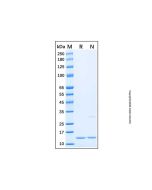
>97% by SDS-PAGE
General Description
Human C3a desArg is prepared from normal human serum after activation of C3 by human C3 convertase, followed by the removal of the C-terminal arginine by the natural
carboxypeptidase N (Hugli, T.E. et al. (1981); Meuller-Ortiz, S.L., et al. (2009)). C3a is amember of the anaphylatoxin family of three proteins (C3a, C4a and C5a) produced by the
activation of complement. The desArg form of C3a is an unglycosylated polypeptidecontaining 76 amino acids with a molecular mass of 8,933 daltons. C3a mediates many
inflammatory responses including smooth muscle contraction, vasodilation, increased vascular permeability, and release of histamine from mast cells and basophils (Law, S.K.A.
and Reid, K.B.M. (1995)). These activities of C3a are inactivated by removal of the Cterminal arginine and this is complete within minutes after formation in plasma. However, new activities have been identified for C3a desArg acting through the C5L2 receptor (Kalant, D. et al. (2005)). These activities were first assigned to ASP (acylation-stimulating protein),
but this was later shown to be identical to C3a desArg. C3a desArg binds to C5L2 with a Kd of approximately 70 nM. In adipocytes, macrophages, fibroblasts and may other cells
triglyceride synthesis, glucose transport, and fatty acid uptake are stimulated upon C3a desArg binding in both humans and mice. C3 knockout mice lack ASP function and
recombinant C3a desArg is fully functional while C5L2 knockout mice are unresponsive. Many of the biological functions of insulin are expressed by C3a desArg and it also
expresses endocrine effects on insulin secretion by pancreatic cells (Maslowska, M. et al (2005)).
Physical Characteristics & Structure
Molecular weight: 8,933 calculated molecular mass. Observed mass (MALDI-TOF) is 8,934 + 9 mass units.Amino acid sequence (76 amino acids): SVQLTEKRMD KVGKYPKELR
KCCEDGMREN PMRFSCQRRT RFISLGEACK KVFLDCCNYI TELRRQHARA SHLGLA
X-ray-derived crystal structure: Huber, R. et al. (1980) NMRderived structure: Nettesheim, D.G. et al. (1988); Murray, I. et al. (1999).
Function
See General Description above.
Assays
Many of the assays for C3a can be used for C3a desArg if 100- to 1000-fold higher concentrations are used, but in reality the desArg for is essentially inactive in such assays as
the contraction of guinea pig ileum, permeation of a dye such as trypan blue from the vasculature into skin, mast cell degranulation, (measured as histamine release), platelet aggregation, IL-1 release from monocytes and the release of prostaglandins and leukotrienes from many cells and tissues. Similarly, ATP release from guinea pig platelets, serotonin relaease from guinea pig platelets, N-acetyl-beta-D-glucosamidase release from differentiated U937 cells and calcium release from differentiated U937 cells (Dodds, A.W.
and Sim, R.B. (1997)) are all reduce to very low levels in the desArg form.The newly acquired functions of C3a desArg related to lipid metabolism detailed in the General Description section above may be assayed by any of a large number of assays detailed in the extensive literature on acylation-stimulating protein (ASP) (Kalant, D. et al.
(2005); Maslowska, M., et al. (2005); Murray, I., etaal. (1999)). ELISA kits for the assay of C3a desArg levels in blood and other fluids are sold by many companies. A radioimmunoassay for C3a/C3a desArg is also available. These measurements are useful for detecting complement activation in vivo, but the interpretation of their meaning is complicated by the fact that clearance of the anaphylatoxins is rapid.
In vivo
Freshly drawn normal human serum contains approximately 17 nM C3a desArg (corresponding to activation of about 0.3 % of the total C3). Although this may represent the
resting concentration in vivo it is difficult to draw or store blood without some C3 activation so a true in vivo concentration is difficult to determine. The presence of EDTA and Futhan in the collection tubes can minimize this background (Pfeifer, P.H. et al. (1999)). Full activation of all C3 in blood (1200 µg/mL) would result in ~6,600 nM C3a desArg (~60 µg/mL). Due to the sensitivity of the lipid metabolism stimulating functions of C3a desArgresponses can theoretically be initiated by activation of approximately 1/1,000 of the C3 in a
local area.
Regulation
C3a desArg levels are regulated by three processes: formation, inactivation and clearance. The enzymes that cleave C3 and release C3a (collectively called C3/C5 convertases) do so at a rate approximately 300-times the rate that these enzymes cleave C5(Pangburn, M.K. and Müller-Eberhard, H.J. (1986); Rawal, N. and Pangburn, M.K. (2001)). C3a is “inactivated” by removal of its C-terminal arginine amino acid. The product C3a desArg (or C3a without the C-terminal arginine) is produced by the action of the plasma enzyme carboxypeptidase N (Mueller-Ortiz S.L. et al. (2009)). The inactivation is rapid and most C3a is converted to C3a desArg within minutes of its formation. “Inactivated” C3a still
possesses some biological activities, but it is considered inactive for most C3a-specific functions. As described above C3a desArg does possess numerous activities of its own as the acylation-stimulaing protein (ASP) released by adipose tissue. Because of the large number of cells bearing C3a and C3a desArg receptors (endothelial, immune, adipose, smooth muscle, neuronal, etc.) the capture, internalization and digestion of C3a and C3a desArg results in its rapid removal from circulation.
Deficiencies
A deficiency of C3 or a deficiency of the enzymes that cleave C3 to generate C3a result in the absence of C3a desArg. There are no known complete deficiencies of all of the
C3 convertases. Examples of C3 deficient humans (Ghannam A, et al. (2008)) and mice (Wessels, M.R. et al. (1995)) exist, but the degree to which pathologies associated with C3
deficiency are due to the lack of C3 or the absence of C3a is unclear. Information on this has been acquired from C3aR and C5L2 receptor knock-out animals (Singer, L. et al. (1994);MacLaren, R. et al. (2008); Maslowska, M. et al. (2005)).
Diseases
See sections above for many biological effects of C3a and C3a desArg connected with inflammatory reactions in many diseases and lipid metabolism. In addition, a role for
C3a in asthma has been well documented (Zhang, X. and Kohl, J. (2010); Wills-Karp, M. (2007)). Diseases related to C3a desArg regulation of the triglyceride synthesis, glucose
transport, insulin regulation and fatty acid uptake have not yet been described.
Precautions/Toxicity/Hazards
This protein is purified from human serum and therefore precautions appropriate for handling any blood-derived product must be used even though the source was shown by
certified tests to be negative for HBsAg, HTLV-I/II, STS, and for antibodies to HCV, HIV-1 and HIV-II.
Hazard Code: B WGK Germany 3
Storage and Shipping
| Shipped In | Dry ice packs + Cold packs |
| Storage Temp | Store at -80°C,Avoid repeated freezing and thawing |
Additional Information
| Concentration | 0.5 mg/mL,Presence of C3a: < 1 % |