CD54 Polyclonal Antibody (E-AB-70046) elabscience
$410.00
In stock
SKU
E-AB-70046
| Size | Price (USD) |
| 200μL | $410.00 |
| 120μL | $260.00 |
| 60μL | $160.00 |
| Size | Price (USD) |
| 200μL | $410.00 |
| 120μL | $260.00 |
| 60μL | $160.00 |
Product Details
| Abbre | CD54 |
| Synonyms | Antigen identified by monoclonal BB2, BB 2, BB2, CD 54, CD54, CD_antigen=CD54, Cell surface glycoprotein P3.58, Human rhinovirus receptor, ICAM 1, ICAM-1, ICAM1, Intercellular adhesion molecule, human rhinovirus receptor, intercellular adhesion molecule 1 (CD54) |
| Swissprot | P05362 Q00238 P13597 |
| Reactivity | Mouse, Rat |
| Host | Rabbit |
| Clonality | Polyclonal |
| Isotype | IgG |
| Applications | WB, IHC, IF |
| Conjugation | Unconjugated |
| Concentration | 0.84 mg/mL |
| Buffer | Phosphate buffered solution, pH 7.4, containing 0.05% stabilizer, 1% protein protectant and 50% glycerol. |
| Purification Method | Affinity purification |
| Immunogen | KLH conjugated Synthetic peptide corresponding to Mouse ICAM-1 |
| Calculated MW | 58 kDa |
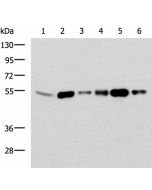
| Observed MW | 58 kDa Western blotting is a method for detecting a certain protein in a complex sample based on the specific binding of antigen and antibody. Different proteins can be divided into bands based on different mobility rates. The mobility is affected by many factors, which may cause the observed band size to be inconsistent with the expected size. The common factors include: 1. Post-translational modifications: For example, modifications such as glycosylation, phosphorylation, methylation, and acetylation will increase the molecular weight of the protein. 2. Splicing variants: Different expression patterns of various mRNA splicing bodies may produce proteins of different sizes. 3. Post-translational cleavage: Many proteins are first synthesized into precursor proteins and then cleaved to form active forms, such as COL1A1. 4. Relative charge: the composition of amino acids (the proportion of charged amino acids and uncharged amino acids). 5. Formation of multimers: For example, in protein dimer, strong interactions between proteins can cause the bands to be larger. However, the use of reducing conditions can usually avoid the formation of multimers. If a protein in a sample has different modified forms at the same time, multiple bands may be detected on the membrane. |
| Research Areas | Cancer, Cardiovascular, Immunology, Stem Cells |
| Cellular Localization | Membrane |
Product Description
Background: ICAM-1 (CD54) is a 90-kDa transmembrane glycoprotein of the immunoglobulin superfamily and is critical for the firm attachment and transmigration of leukocytes out of blood vessels and into tissues . ICAM-1 is expressed by several cell types,typically on endothelial cells and cells of the immune system,and its expression can be up-regulated by various stimuli,including TNF-α,INF-γ,IL-1 and thrombin . It is a ligand for LFA-1 and Mac-1,serves as a receptor for rhinovirus,and is one of several receptors used by Plasmodium falciparum .
Storage and Shipping
| Storage | Store at -20°C Valid for 12 months. Avoid freeze / thaw cycles. |
| Shipping | The product is shipped with ice pack,upon receipt,store it immediately at the temperature recommended. |
Additional Information
| Verified Samples | Verified Samples in WB: Mouse liver, Mouse lung+LPS, Mouse kidney Verified Samples in IHC: Mouse kidney, Mouse liver Verified Samples in IF: Mouse lung |
| Dilution | WB 1:1000-1:3000, IHC 1:500-1:1000, IF 1:200-1:800 |