Recombinant Mouse ANG2 (C-Fc)(Cat. No.:C01U) novoprotein
$75.00
In stock
SKU
C01U
10μg: $75
50μg: $225
500μg: $1688
1mg: $2531
Description
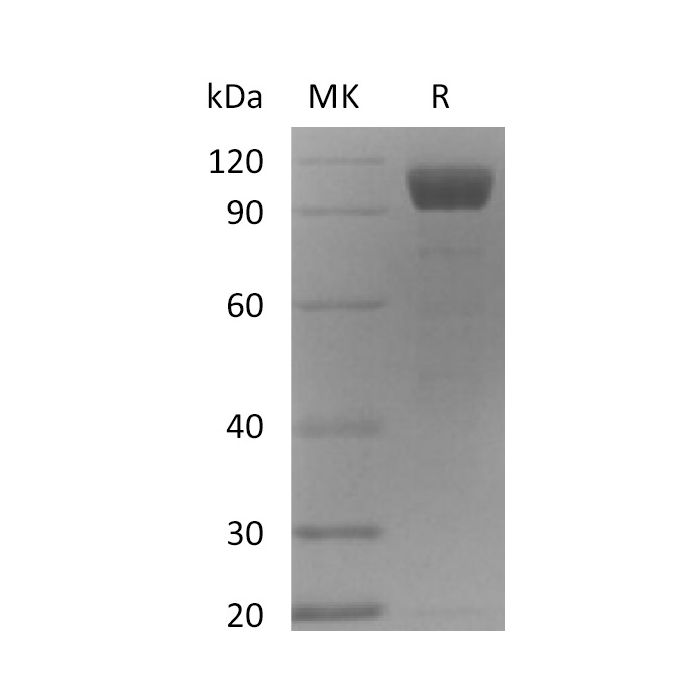
Recombinant Mouse Angiopoietin-2 is produced by our Mammalian expression system and the target gene encoding Tyr19-Phe496 is expressed with a human IgG1 Fc tag at the C-terminus.
Product Details
| Item | Details |
| Known As | AGPT2; ANG2; ANG-2; angiopoietin 2; Angiopoietin-2; angiopoietin-2a; angiopoietin-2B; angiopoitin 2; ANGPT2; Tie2-ligand |
| Mol Mass | 81.4 KDa |
| APMol Mass | 90-120 KDa, reducing conditions |
| Formulation Description | Lyophilized from a 0.2 μm filtered solution of PBS, pH 7.4. |
| Endotoxin | < 1 EU/µg as determined by LAL test. |
| Reconstitution | Always centrifuge tubes before opening.Do not mix by vortex or pipetting. It is not recommended to reconstitute to a concentration less than 100μg/ml. Dissolve the lyophilized protein in distilled water. Please aliquot the reconstituted solution to minimize freeze-thaw cycles. |
| Storage | Lyophilized protein should be stored at ≤ -20°C, stable for one year after receipt. Reconstituted protein solution can be stored at 2-8°C for 2-7 days. Aliquots of reconstituted samples are stable at ≤ -20°C for 3 months. |
| Shipping | The product is shipped at ambient temperature. Upon receipt, store it immediately at the temperature listed below. |
Background
Angiopoietin-2 (Ang-2; also ANGPT2) is a secreted glycoprotein that plays a complex role in angiogenesis and inflammation. Both Ang-2 and the related Angiopoietin-1 (Ang-1) are ligands for the receptor tyrosine kinase Tie-2. While Ang-1 is a potent Tie 2 agonist, Ang-2 may act as either a Tie-2 antagonist or agonist, depending upon its state of multimerization. The higher the order of oligomer, the more effective Ang-2 becomes as a Tie-2 agonist. The short isoform appears to block the binding of either Ang-1 or full-length Ang-2 to Tie-2. Ang-2 functions as a pro-angiogenic factor, although it can also induce EC death and vessel regression. Upon its release from quiescent EC, it regulates vascular remodeling by promoting EC survival, proliferation, and migration and destabilizing the interaction between EC and perivascular cells. In addition, ANG-2 is strongly expressed in the vasculature of many tumors and it has been suggested that ANG-2 may act synergistically with other cytokines such as vascular endothelial growth factor to promote tumor-associated Angiogenesis and tumor progression.
title: Endothelial ANGPT2 impairs cardiomyocyte calcium homeostasis via ITGB3 receptor in murine sepsis-related cardiomyopathy
authors: Yi-Ni Lu, Wen-Xue Liu, Xiao-Han Wang, Xiong Zhang, Yu-Fen Zheng, Tian-Yin Wang, Feng Chen, Feng Yu
date: 2025/11/04
journal: BIOCHIMICA ET BIOPHYSICA ACTA-MOLECULAR CELL RESEARCH
MDSD