SMAD9 Polyclonal antibody 16397-1-AP proteintech
$149.00
In stock
SKU
16397-1-AP
| Catalog Number | 16397-1-AP |
| Synonyms | MAD homolog 9, MADH6, MADH9, Mothers against DPP homolog 9, SMAD 9 |
| Host | Rabbit |
| Reactivity | human, mouse, rat |
| Form | Liquid |
| Formulation | PBS, Azide, Glycerol |
| Applications | WB, IHC, ELISA |
| Host / Isotype | Rabbit / IgG |
| Tested Applications — Positive WB detected in | HeLa cells, A549 cells, HEK-293 cells, HepG2 cells, mouse lung tissue |
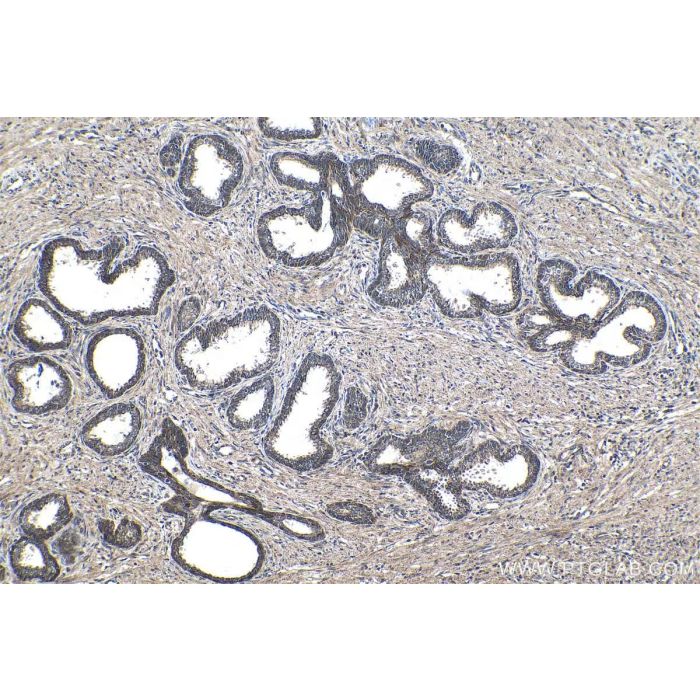
| Tested Applications — Positive IHC detected in | human prostate cancer tissue, human urothelial carcinoma tissue, mouse heart tissue, rat heart tissue Note: suggested antigen retrieval with TE buffer pH 9.0; (*) Alternatively, antigen retrieval may be performed with citrate buffer pH 6.0 |
| Recommended Dilutions — Western Blot (WB) | WB : 1:500-1:2000 |
| Recommended Dilutions — Immunohistochemistry (IHC) | IHC : 1:50-1:500 |
| Positive WB detected in | HeLa cells, A549 cells, HEK-293 cells, HepG2 cells, mouse lung tissue |
| Positive IHC detected in | human prostate cancer tissue, human urothelial carcinoma tissue, mouse heart tissue, rat heart tissue Note: suggested antigen retrieval with TE buffer pH 9.0; (*) Alternatively, antigen retrieval may be performed with citrate buffer pH 6.0 |
| Western Blot (WB) | WB : 1:500-1:2000 |
| Immunohistochemistry (IHC) | IHC : 1:50-1:500 |
| Tested Reactivity | human, mouse, rat |
| Cited Reactivity | human, mouse, rat |
| Class | Polyclonal |
| Type | Antibody |
| Immunogen | CatNo: Ag9490 Product name: Recombinant human SMAD9 protein Source: e coli. -derived, PGEX-4T Tag: GST Domain: 1-352 aa of BC011559 Sequence: MHSTTPISSLFSFTSPAVKRLLGWKQGDEEEKWAEKAVDSLVKKLKKKKGAMDELERALSCPGQPSKCVTIPRSLDGRLQVSHRKGLPHVIYCRVWRWPDLQSHHELKPLECCEFPFGSKQKEVCINPYHYRRVETPVLPPVLVPRHSEYNPQLSLLAKFRSASLHSEPLMPHNATYPDSFQQPPCSALPPSPSHAFSQSPCTASYPHSPGSPSEPESPYQHSDFRPVCYEEPQHWCSVAYYELNNRVGETFQASSRSVLIDGFTDPSNNRNRFCLGLLSNVNRNSTIENTRRHIGKGVHLYYVGGEVYAECVSDSSIFVQSRNCNYQHGFHPATVCKIPSGCSLKVFNNQL Predict reactive species |
| Full Name | SMAD family member 9 |
| Calculated Molecular Weight | 430 aa, 49 kDa |
| Observed Molecular Weight | 49-55 kDa |
| GenBank Accession Number | BC011559 |
| Gene Symbol | SMAD9 |
| Gene ID (NCBI) | 4093 |
| RRID | AB_2270847 |
| Conjugate | Unconjugated |
| Purification Method | Antigen affinity purification |
| UNIPROT ID | O15198 |
| Storage Buffer | PBS with 0.02% sodium azide and 50% glycerol, pH 7.3. |
| Storage Conditions | Store at -20°C. Stable for one year after shipment. Aliquoting is unnecessary for -20 o C storage. 20ul sizes contain 0.1% BSA. |
| IHC protocol for SMAD9 antibody 16397-1-AP | Download protocol |
| WB protocol for SMAD9 antibody 16397-1-AP | Download protocol |
| human | WB Cancer Cell Paneth-like transition drives resistance to dual targeting of KRAS and EGFR in colorectal cancer. Authors - Yuetong Zhang View Article |
| mouse | WB Cell Death Discov Gsα deficiency facilitates cardiac remodeling via CREB/ Bmp10-mediated signaling Authors - Ping Yin View Article |
| mouse, rat | WB Int J Biol Macromol Near-infrared responsive nanozyme-carboxymethyl chitosan/chondroitin sulfate composite hydrogel: Multicomponent synergy optimizes bone defect microenvironment to enhance repair. Authors - Dan Sun View Article |
| Nadia (Verified Customer) (09-15-2025) | We used this SMAD9 antibody for both Western blot and immunofluorescence applications. The antibody produced a clear, specific band with minimal background. Applications: Western Blot, Immunohistochemistry |
| Citations | 6 |
| Dilutions | WB : 1:500-1:2000 IHC : 1:50-1:500 |
| Isotype | IgG |
| Clonality | Polyclonal |
| Clone Number | - |
| Conjugation | Unconjugated |
SMAD9 (also known as MADH9 or MAD homolog 9) is a key signaling molecule in the transforming growth factor-β (TGF-β) superfamily signaling pathway and belongs to the SMAD1/5/9 subgroup of receptor-regulated SMADs (R-SMADs). It is primarily activated and phosphorylated by BMP (bone morphogenetic protein) type I receptors. Once activated, SMAD9 forms a complex with the common SMAD4 (Co-SMAD), translocates into the nucleus, and acts as a transcription factor to regulate the expression of specific target genes. This process is involved in modulating a variety of critical biological processes, including cell proliferation, differentiation, apoptosis, and embryonic development. Mutations or abnormal expression of SMAD9 are associated with several diseases, particularly in pulmonary arterial hypertension, certain cancers, and vascular diseases, where it plays a significant role. Protocols Product Specific Protocols IHC protocol for SMAD9 antibody 16397-1-AP Download protocol WB protocol for SMAD9 antibody 16397-1-AP Download protocol Standard Protocols Click here to view our Standard Protocols
Publications