TMEM119 Polyclonal antibody 27585-1-AP proteintech

$149.00
In stock
SKU
27585-1-AP
Catalog No.SizePrice (USD)
27585-1-AP-20UL20 μL$149.00
27585-1-AP-150UL150 μL$449.00
Catalog Number27585-1-AP
SynonymsOBIF, Osteoblast induction factor, transmembrane protein 119, UNQ731/PRO1415
HostRabbit
Reactivityhuman, mouse
FormLiquid
FormulationPBS, Azide, Glycerol
ApplicationsWB, IHC, IF, FC (Intra), ELISA
ApplicationsIHC, FC (Intra), ELISA
Host / IsotypeRabbit / IgG
Tested Applications — Positive IHC detected inmouse brain tissue Note: suggested antigen retrieval with TE buffer pH 9.0; (*) Alternatively, antigen retrieval may be performed with citrate buffer pH 6.0
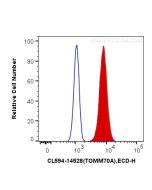
Tested Applications — Positive FC (Intra) detected inHEK-293 cells
Recommended Dilutions — Immunohistochemistry (IHC)IHC : 1:250-1:1000
Recommended Dilutions — Flow Cytometry (FC) (INTRA)FC (INTRA) : 0.40 ug per 10^6 cells in a 100 µl suspension
Positive IHC detected inmouse brain tissue Note: suggested antigen retrieval with TE buffer pH 9.0; (*) Alternatively, antigen retrieval may be performed with citrate buffer pH 6.0
Positive FC (Intra) detected inHEK-293 cells
Immunohistochemistry (IHC)IHC : 1:250-1:1000
Flow Cytometry (FC) (INTRA)FC (INTRA) : 0.40 ug per 10^6 cells in a 100 µl suspension
Tested Reactivityhuman, mouse
Cited Reactivityhuman, mouse
ClassPolyclonal
TypeAntibody
ImmunogenCatNo: Ag26269 Product name: Recombinant human TMEM119 protein Source: e coli. -derived, PGEX-4T Tag: GST Domain: 119-218 aa of NM_181724 Sequence: MRQKQKASAYYPSSFPKKKYVDQSDRAGGPRAFSEVPDRAPDSRPEEALDSSRQLQADILAATQNLKSPTRAALGGGDGARMVEGRGAEEEEKGSQEGDQE Predict reactive species
Full Nametransmembrane protein 119
Calculated Molecular Weight29 kDa
Observed Molecular Weight45 kDa
GenBank Accession NumberNM_181724
Gene SymbolTMEM119
Gene ID (NCBI)338773
RRIDAB_2880915
ConjugateUnconjugated
Purification MethodAntigen affinity purification
UNIPROT IDQ4V9L6
Storage BufferPBS with 0.02% sodium azide and 50% glycerol, pH 7.3.
Storage ConditionsStore at -20°C. Stable for one year after shipment. Aliquoting is unnecessary for -20 o C storage. 20ul sizes contain 0.1% BSA.
FC protocol for TMEM119 antibody 27585-1-APDownload protocol
IHC protocol for TMEM119 antibody 27585-1-APDownload protocol
humanNeurochem Res BMP7 Attenuates Neuroinflammation after Spinal Cord Injury by Suppressing the Microglia Activation and Inducing Microglial Polarization Via the STAT3 Pathway Authors - Xiaojin Wei View Article
mouse,humanNat Commun P-selectin axis plays a key role in microglia immunophenotype and glioblastoma progression. Authors - Eilam Yeini View Article
mouseIF Front Immunol Didymin Suppresses Microglia Pyroptosis and Neuroinflammation Through the Asc/Caspase-1/GSDMD Pathway Following Experimental Intracerebral Hemorrhage. Authors - Lingui Gu View Article
Marion (Verified Customer) (07-15-2025)Immunohistofluorescence (PFA-fixed cryosections) image of TMEM119 stained murine brain. Blocking step : 10 % Donkey Serum + 1% BSA + 0.02% Triton as blocking agent for 2 hours at RT Primary antiboby incubation time : 1 night / 4°C Secondary antibody : AlexaFluor 568 (ab175470 ; Abcam) ; 1/200 This antibody does not seem to work under these conditions. Applications: Immunofluorescence Primary Antibody Dilution: 1/200 (Also tested at 1/100; 1/400; 1/600 and 1/800) Cell Tissue Type: Mouse Brain TMEM119 Antibody Immunofluorescence validation (1/200 (Also tested at 1/100; 1/400; 1/600 and 1/800) dilution) in Mouse Brain (Cat no:27585-1-AP)
Hannes (Verified Customer) (07-27-2020)Immunohistochemistry (Formalin/PFA-fixed paraffin-embedded sections)IHC-P image of anti-TMEM119 (27585-1-AP) stained murine and human brain. The tissue was paraffin-embedded, formalin fixed. The tissue was then incubated with EnVision+ Single Reagents (HRP. Rabbit), undiluted for 1 hour at room temperature. Applications: Immunohistochemistry Primary Antibody Dilution: 1:500 Cell Tissue Type: Murine and human brain tissue TMEM119 Antibody Immunohistochemistry validation (1:500 dilution) in Murine and human brain tissue (Cat no:27585-1-AP)
Citations32
DilutionsIHC : 1:250-1:1000 FC (INTRA) : 0.40 ug per 10^6 cells in a 100 µl suspension
IsotypeIgG
ClonalityPolyclonal
Clone Number-
ConjugationUnconjugated

TMEM119 immunohistochemistry might provide a useful tool for investigating the biology and pathology of human microglia(PMID: 26250788). Microglia can be detected clearly using Catalog#27585-1-AP. Protocols Product Specific Protocols FC protocol for TMEM119 antibody 27585-1-AP Download protocol IHC protocol for TMEM119 antibody 27585-1-AP Download protocol Standard Protocols Click here to view our Standard Protocols

Publications

  1. Single-cell analysis of human basal cell carcinoma reveals novel regulators of tumor growth and the tumor microenvironment.
    Journal: Sci Adv | Authors: Christian F Guerrero-Juarez | Species: human | Application: IHC
  2. P-selectin axis plays a key role in microglia immunophenotype and glioblastoma progression.
    Journal: Nat Commun | Authors: Eilam Yeini | Species: mouse,human
  3. Transmembrane protein 119 is neither a specific nor a reliable marker for microglia.
    Journal: Glia | Authors: Elise Vankriekelsvenne | Species: human | Application: IF
  4. MSCs-extracellular vesicles attenuated neuroinflammation, synapse damage and microglial phagocytosis after hypoxia-ischemia injury by preventing osteopontin expression.
    Journal: Pharmacol Res | Authors: Danqing Xin | Species: mouse | Application: IF
  5. Didymin Suppresses Microglia Pyroptosis and Neuroinflammation Through the Asc/Caspase-1/GSDMD Pathway Following Experimental Intracerebral Hemorrhage.
    Journal: Front Immunol | Authors: Lingui Gu | Species: mouse | Application: IF
  6. BMP7 Attenuates Neuroinflammation after Spinal Cord Injury by Suppressing the Microglia Activation and Inducing Microglial Polarization Via the STAT3 Pathway
    Journal: Neurochem Res | Authors: Xiaojin Wei | Species: human
  7. GSDME-mediated pyroptosis in microglia exacerbates demyelination and neuroinflammation in multiple sclerosis: insights from humans and cuprizone-induced demyelination model mice
    Journal: Cell Death Differ | Authors: Danjie Wang
  8. MSCs-extracellular vesicles attenuated neuroinflammation, synapse damage and microglial phagocytosis after hypoxia-ischemia injury by preventing osteopontin expression.
    Journal: Pharmacol Res | Authors: Danqing Xin | Species: mouse | Application: IF
  9. NLRC5 restricts Japanese encephalitis virus replication and neuroinflammation by interacting with the viral NS3 protein in an IFN-γ-dependent manner.
    Journal: J Neuroinflammation | Authors: Prasanjit Jena
  10. Hyperphosphorylated tau mediates neuronal death by inducing necroptosis and inflammation in Alzheimer's disease
    Journal: J Neuroinflammation | Authors: Yue Dong | Species: human | Application: WB
  11. miR-223 accelerates lipid droplets clearance in microglia following spinal cord injury by upregulating ABCA1
    Journal: J Transl Med | Authors: Zhilin Ou | Species: mouse | Application: IF
  12. The DRP1 inhibitory peptide P110 provides neuroprotection after subarachnoid hemorrhage by suppressing neuronal apoptosis and stabilizing the blood-brain barrier.
    Journal: Free Radic Biol Med | Authors: Shuangying Hao | Species: mouse | Application: WB,IHC,IF
  13. CXCL1-CXCR2 signaling mediates the activation of microglia in the nucleus tractus solitarii to promote pancreatic cancer-induced pain
    Journal: Brain Behav Immun | Authors: Kang Chen | Species: mouse | Application: WB
  14. Didymin Suppresses Microglia Pyroptosis and Neuroinflammation Through the Asc/Caspase-1/GSDMD Pathway Following Experimental Intracerebral Hemorrhage.
    Journal: Front Immunol | Authors: Lingui Gu | Species: mouse | Application: IF
  15. Tetramerization of PKM2 Alleviates Traumatic Brain Injury by Ameliorating Mitochondrial Damage in Microglia
    Journal: J Neuroimmune Pharmacol | Authors: Haiyan Zhu | Species: mouse | Application: IF
  16. Expression of anti-amyloid CARs in microglia promotes efficient and selective phagocytosis of Aβ1‒42
    Journal: Gene Ther | Authors: Christina N Heiss | Species: human | Application: IF
  17. Integrative analysis of single-cell and bulk transcriptome data reveals age-related immune cell alterations in primary glioblastoma associated with prognosis.
    Journal: Cancer Immunol Immunother | Authors: Zefan Jing | Species: mouse | Application: IF
  18. Extracellular Vesicle-Liposome-Darunavir Formulation for the Treatment of HIV Neuropathogenesis
    Journal: ACS Appl Nano Mater | Authors: Lina Zhou | Application: WB
  19. Esketamine improves cognitive function in sepsis-associated encephalopathy by inhibiting microglia-mediated neuroinflammation
    Journal: Eur J Pharmacol | Authors: Hui Li | Species: mouse | Application: WB
  20. Transmembrane protein 119 is neither a specific nor a reliable marker for microglia.
    Journal: Glia | Authors: Elise Vankriekelsvenne | Species: human | Application: IF
  21. Changes in the microglial phenotype drive neuroinflammation independent of systemic inflammation in the acute stage of heatstroke.
    Journal: iScience | Authors: Ping Li | Species: mouse | Application: IF
  22. BMP7 Attenuates Neuroinflammation after Spinal Cord Injury by Suppressing the Microglia Activation and Inducing Microglial Polarization Via the STAT3 Pathway
    Journal: Neurochem Res | Authors: Xiaojin Wei | Species: human
  23. Validation of Induced Microglia-Like Cells (iMG Cells) for Future Studies of Brain Diseases.
    Journal: Front Cell Neurosci | Authors: Atoshi Banerjee | Species: human | Application: IHC
  24. Deacetylase SIRT2 Inhibition Promotes Microglial M2 Polarization Through Axl/PI3K/AKT to Alleviate White Matter Injury After Subarachnoid Hemorrhage
    Journal: Transl Stroke Res | Authors: Kaikun Yuan
  25. Attenuation of Blood-Brain Barrier Disruption in Traumatic Brain Injury via Inhibition of NKCC1 Cotransporter: Insights into the NF-κB/NLRP3 Signaling Pathway
    Journal: J Neurotrauma | Authors: Zehan Zhang | Species: mouse | Application: IF
  26. Toll-like receptor-9 (TLR-9) deficiency alleviates optic nerve injury (ONI) by inhibiting inflammatory response in vivo and in vitro.
    Journal: Exp Cell Res | Authors: Lu Zhang | Species: mouse | Application: WB,IF
  27. TMEM119 links to ovarian endometriosis progression via MAPK-mediated suppression of ectopic endometrial stromal cell senescence.
    Journal: Reproduction | Authors: Liansuo Zhang | Species: human | Application: WB,IHC
  28. Early Histone Deacetylase Inhibition Mitigates Ischemia/Reperfusion Brain Injury by Reducing Microglia Activation and Modulating Their Phenotype.
    Journal: Front Neurol | Authors: Shuyuan Li | Species: mouse | Application: IF
  29. IL-6 mediates olfactory dysfunction in a mouse model of allergic rhinitis
    Journal: Brain Res | Authors: Xiao-Yu Song | Species: mouse | Application: IF
  30. A modified high-yield method for primary culture of rat retinal microglial cells.
    Journal: Exp Eye Res | Authors: Xiaokun Han | Application: IF
  31. Protocol for differentiation and efficient AAV-mediated gene delivery to hiPSC-derived microglia for functional studies.
    Journal: STAR Protoc | Authors: Christina N. Heiss | Species: human | Application: IF
  32. Programs, Origins, and Niches of Immunomodulatory Myeloid Cells in Gliomas
    Journal: bioRxiv | Authors: Tyler E Miller | Species: human | Application: IF

Product Documents

Datasheet

Datasheet

Reviews

Write Your Own Review
You're reviewing:TMEM119 Polyclonal antibody 27585-1-AP proteintech
Your Rating
Copyright © 2025 Biogege, Inc. All rights reserved.