CEP250/CNAP1 Polyclonal antibody 14498-1-AP proteintech

$149.00
In stock
SKU
14498-1-AP
Catalog No.SizePrice (USD)
14498-1-AP-20UL20 μL$149.00
14498-1-AP-150UL150 μL$449.00
Catalog Number14498-1-AP
SynonymsCep250, CEP250,C-NAP1, 250 kDa centrosomal protein, C NAP1, Centrosomal Nek2-associated protein 1
HostRabbit
Reactivityhuman and More (1)
Reactivityhuman, mouse
FormLiquid
FormulationPBS, Azide, Glycerol
ApplicationsWB, IHC, IF/ICC, IP, ELISA
Host / IsotypeRabbit / IgG
Tested Applications — Positive WB detected inA431 cells, HEK-293T cells, HeLa cells
Tested Applications — Positive IP detected inHEK-293 cells
Tested Applications — Positive IHC detected inhuman placenta tissue Note: suggested antigen retrieval with TE buffer pH 9.0; (*) Alternatively, antigen retrieval may be performed with citrate buffer pH 6.0
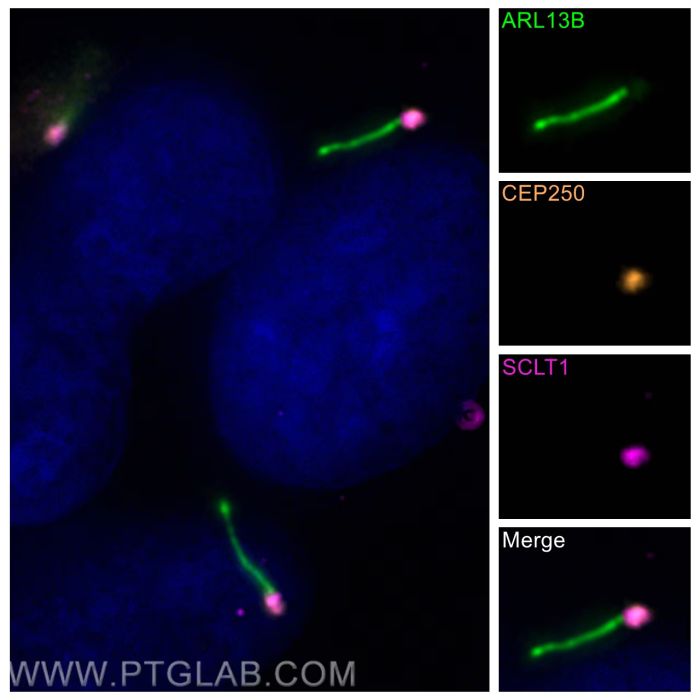
Tested Applications — Positive IF/ICC detected inhTERT-RPE1 cells
Recommended Dilutions — Western Blot (WB)WB : 1:500-1:3000
Recommended Dilutions — Immunoprecipitation (IP)IP : 0.5-4.0 ug for 1.0-3.0 mg of total protein lysate
Recommended Dilutions — Immunohistochemistry (IHC)IHC : 1:50-1:500
Recommended Dilutions — Immunofluorescence (IF)/ICCIF/ICC : 1:50-1:500
Positive WB detected inA431 cells, HEK-293T cells, HeLa cells
Positive IP detected inHEK-293 cells
Positive IHC detected inhuman placenta tissue Note: suggested antigen retrieval with TE buffer pH 9.0; (*) Alternatively, antigen retrieval may be performed with citrate buffer pH 6.0
Positive IF/ICC detected inhTERT-RPE1 cells
Western Blot (WB)WB : 1:500-1:3000
Immunoprecipitation (IP)IP : 0.5-4.0 ug for 1.0-3.0 mg of total protein lysate
Immunohistochemistry (IHC)IHC : 1:50-1:500
Immunofluorescence (IF)/ICCIF/ICC : 1:50-1:500
Tested Reactivityhuman
Cited Reactivityhuman, mouse
ClassPolyclonal
TypeAntibody
ImmunogenCatNo: Ag5925 Product name: Recombinant human CEP250,C-NAP1 protein Source: e coli. -derived, PET28a Tag: 6*His Domain: 40-293 aa of BC001433 Sequence: RKLKNSQEAQQRQATLVRKLQAKVLQYRSWCQELEKRLEATGGPIPQRWENVEEPNLDELLVRLEEEQQRCESLAEVNTQLRLHMEKADVVNKALREDVEKLTVDWSRARDELMRKESQWQMEQEFFKGYLKGEHGRLLSLWREVVTFRRHFLEMKSATDRDLMELKAEHVRLSGSLLTCCLRLTVGAQSREPNGSGRMDGREPAQLLLLLAKTQELEKEAHERSQELIQLKSQGDLEKAELQDRVTELSALLT Predict reactive species
Full Namecentrosomal protein 250kDa
Calculated Molecular Weight281 kDa
Observed Molecular Weight250 kDa
GenBank Accession NumberBC001433
Gene SymbolCEP250/CNAP1
Gene ID (NCBI)11190
RRIDAB_2076918
ConjugateUnconjugated
Purification MethodAntigen affinity purification
UNIPROT IDQ9BV73
Storage BufferPBS with 0.02% sodium azide and 50% glycerol, pH 7.3.
Storage ConditionsStore at -20°C. Stable for one year after shipment. Aliquoting is unnecessary for -20 o C storage. 20ul sizes contain 0.1% BSA.
IF protocol for CEP250/CNAP1 antibody 14498-1-APDownload protocol
IHC protocol for CEP250/CNAP1 antibody 14498-1-APDownload protocol
IP protocol for CEP250/CNAP1 antibody 14498-1-APDownload protocol
WB protocol for CEP250/CNAP1 antibody 14498-1-APDownload protocol
mouseIF Nat Commun Cytoplasmic E2f4 forms organizing centres for initiation of centriole amplification during multiciliogenesis. Authors - Munemasa Mori View Article
humanWB,IF Proc Natl Acad Sci U S A Dishevelled is a NEK2 kinase substrate controlling dynamics of centrosomal linker proteins. Authors - Igor Cervenka View Article
Karsten (Verified Customer) (12-22-2022)WB: 1:600 dilution in 5% Milch in 1xTBST over nigth at 4°C, 30µg Protein loaded: result show prominent band at a hight of 250 kDa. unspecific bands also visible, but not prominent. worked fine IFS: 1:100, MetOH (-20°) fixation for 5 min at RT , Permeabilisation with 0.3% PBST (Triton) for 5 min at RT, Blocking with 1% BSA in PBS for 1h at RT. Antibody dilution 1:100 in 1%BSA in PBS 1h RT, sek Ak 1h at RT- nice basal body stainings at cilia in hTERT-RPE1 cells, that were starved for 3 days. Applications: Western Blot, Immunofluorescence Primary Antibody Dilution: 1:600 Cell Tissue Type: hTERT-RPE1 cells, 3 days starved CEP250/CNAP1 Antibody Western Blot,Immunofluorescence validation (1:600 dilution) in hTERT-RPE1 cells, 3 days starved (Cat no:14498-1-AP)
Hairuo (Verified Customer) (12-16-2019)Used in IF in neonatal mouse testis cry-sections.Works well. Applications: Immunofluorescence, Primary Antibody Dilution: 1:500
Citations38
DilutionsWB : 1:500-1:3000 IP : 0.5-4.0 ug for IP and 0.5-4.0 ug for 1.0-3.0 mg of total protein lysate for WB IHC : 1:50-1:500 IF/ICC : 1:50-1:500
IsotypeIgG
ClonalityPolyclonal
Clone Number-
ConjugationUnconjugated

CEP250, also known as C-Nap1, is a 250 kDa coiled-coil protein that localizes to the proximal ends of mother and daughter centrioles. It is required for centriole-centriole cohesion during interphase of the cell cycle. It dissociates from the centrosomes when parental centrioles separate at the beginning of mitosis. The protein associates with and is phosphorylated by NIMA-related kinase 2, which is also associated with the centrosome. Protocols Product Specific Protocols IF protocol for CEP250/CNAP1 antibody 14498-1-AP Download protocol IHC protocol for CEP250/CNAP1 antibody 14498-1-AP Download protocol IP protocol for CEP250/CNAP1 antibody 14498-1-AP Download protocol WB protocol for CEP250/CNAP1 antibody 14498-1-AP Download protocol Standard Protocols Click here to view our Standard Protocols

Publications
  1. A liquid-like spindle domain promotes acentrosomal spindle assembly in mammalian oocytes.
    Journal: Science | Authors: Chun So | Species: mouse | Application: IF
  2. The DNA replication machinery transmits dual signals to prevent unscheduled licensing and execution of centrosome duplication
    Journal: Nat Commun | Authors: Kyohei Matsuhashi | Application: IF
  3. Microtubule asters anchored by FSD1 control axoneme assembly and ciliogenesis.
    Journal: Nat Commun | Authors: Hai-Qing Tu | Species: human | Application: IF
  4. Cytoplasmic E2f4 forms organizing centres for initiation of centriole amplification during multiciliogenesis.
    Journal: Nat Commun | Authors: Munemasa Mori | Species: mouse | Application: IF
  5. Stable centrosomal roots disentangle to allow interphase centriole independence.
    Journal: PLoS Biol | Authors: Robert Mahen | Species: human | Application: IF
  6. Dishevelled is a NEK2 kinase substrate controlling dynamics of centrosomal linker proteins.
    Journal: Proc Natl Acad Sci U S A | Authors: Igor Cervenka | Species: human | Application: WB,IF
  7. The TRIM69-MST2 signaling axis regulates centrosome dynamics and chromosome segregation
    Journal: Nucleic Acids Res | Authors: Yilin Wang | Species: human | Application: IF
  8. Hornerin mediates phosphorylation of the polo-box domain in Plk1 by Chk1 to induce death in mitosis
    Journal: Cell Death Differ | Authors: Haiyu Song
  9. The phosphorylation of PHF5A by TrkA-ERK1/2-ABL1 cascade regulates centrosome separation
    Journal: Cell Death Dis | Authors: Chen Song | Species: human | Application: WB,IF
  10. Dishevelled is a NEK2 kinase substrate controlling dynamics of centrosomal linker proteins.
    Journal: Proc Natl Acad Sci U S A | Authors: Igor Cervenka | Species: human | Application: WB,IF
  11. BAP1 loss induces mitotic defects in mesothelioma cells through BRCA1-dependent and independent mechanisms
    Journal: Oncogene | Authors: Anita Singh | Species: human | Application: IF
  12. c-Cbl Acts as an E3 Ligase Against DDA3 for Spindle Dynamics and Centriole Duplication during Mitosis.
    Journal: Mol Cells | Authors: Dasom Gwon | Species: human | Application: IF
  13. 3D nanoscale reconstruction of human airway multiciliogenesis reveals cellular architecture remodeling and cilia-mitochondria link via rootlets.
    Journal: Cell Rep | Authors: Aaran Vijayakumaran
  14. Stable centrosomal roots disentangle to allow interphase centriole independence.
    Journal: PLoS Biol | Authors: Robert Mahen | Species: human | Application: IF
  15. cNap1 bridges centriole contact sites to maintain centrosome cohesion
    Journal: PLoS Biol | Authors: Robert Mahen | Species: human | Application: IF
  16. Interactome analysis reveals a link of the novel ALMS1-CEP70 complex to centrosomal clusters
    Journal: Mol Cell Proteomics | Authors: Franziska Woerz | Species: human | Application: IF
  17. Uncoordinated centrosome cycle underlies the instability of non-diploid somatic cells in mammals.
    Journal: J Cell Biol | Authors: Kan Yaguchi | Application: IF
  18. Centrosome linker protein C-Nap1 maintains stem cells in mouse testes.
    Journal: EMBO Rep | Authors: Hairuo Dang | Species: mouse | Application: WB,IF
  19. Mitotic Maturation Compensates for Premature Centrosome Splitting and PCM Loss in Human cep135 Knockout Cells.
    Journal: Cells | Authors: Zhenzhen Chu | Species: human | Application: IF
  20. Arf-like Protein 2 (ARL2) Controls Microtubule Neogenesis during Early Postnatal Photoreceptor Development
    Journal: Cells | Authors: Cecilia D Gerstner | Species: mouse | Application: IHC
  21. Centrosome linker protein C-Nap1 maintains stem cells in mouse testes.
    Journal: EMBO Rep | Authors: Hairuo Dang | Species: mouse | Application: WB,IF
  22. RACK1 regulates centriole duplication through the activation of polo-like kinase 1 by Aurora A
    Journal: J Cell Sci | Authors: Yuki Yoshino | Species: human | Application: IF
  23. Chronic Exposure to Particulate Chromate Induces Premature Centrosome Separation and Centriole Disengagement in Human Lung Cells.
    Journal: Toxicol Sci | Authors: Julieta Martino | Species: human | Application: IF
  24. Cryo-Electron Tomography and Proteomics studies of centrosomes from differentiated quiescent thymocytes.
    Journal: Sci Rep | Authors: Johan Busselez
  25. Separation and Loss of Centrioles From Primordidal Germ Cells To Mature Oocytes In The Mouse.
    Journal: Sci Rep | Authors: Calvin Simerly | Species: mouse | Application: IF
  26. The Small-Molecule Inhibitor MRIA9 Reveals Novel Insights into the Cell Cycle Roles of SIK2 in Ovarian Cancer Cells.
    Journal: Cancers (Basel) | Authors: Monika Raab | Species: human | Application: IF
  27. Pathogenic LRRK2 regulates centrosome cohesion via Rab10/RILPL1-mediated CDK5RAP2 displacement.
    Journal: iScience | Authors: Elena Fdez | Species: human | Application: IF
  28. Centlein maintains centrosome cohesion by bridging an interaction between C-Nap1 and Cep68.
    Journal: J Cell Sci | Authors: Guoliang Fang | Species: human | Application: WB,IF
  29. RACK1 regulates centriole duplication through promoting the activation of polo-like kinase 1 by Aurora A.
    Journal: J Cell Sci | Authors: Yuki Yoshino | Species: human | Application: IF
  30. Characterization of Cep85: A novel antagonist of Nek2A that is involved in the regulation of centrosome disjunction.
    Journal: J Cell Sci | Authors: Canhe Chen | Application: IF
  31. RACK1 regulates centriole duplication through promoting the activation of polo-like kinase 1 by Aurora A.
    Journal: J Cell Sci | Authors: Yuki Yoshino | Species: human | Application: IF
  32. Postmitotic centriole disengagement and maturation leads to centrosome amplification in polyploid trophoblast giant cells
    Journal: Mol Biol Cell | Authors: Garrison Buss | Species: mouse | Application: IF
  33. Novel Candidate Genes and a Wide Spectrum of Structural and Point Mutations Responsible for Inherited Retinal Dystrophies Revealed by Exome Sequencing.
    Journal: PLoS One | Authors: Marta de Castro-Miró | Species: mouse | Application: IF
  34. Bisphenol A disrupts mitotic progression via disturbing spindle attachment to kinetochore and centriole duplication in cancer cell lines.
    Journal: Toxicol In Vitro | Authors: Seul Kim | Species: human
  35. hVFL3/CCDC61 is a component of mother centriole subdistal appendages required for centrosome cohesion and positioning.
    Journal: Biol Cell | Authors: Véronique Pizon | Species: human | Application: IF
  36. The tumor suppressor proteins ASPP1 and ASPP2 interact with C-Nap1 and regulate centrosome linker reassembly.
    Journal: Biochem Biophys Res Commun | Authors: Yuanyuan Zhang | Species: human | Application: WB,IF
  37. PPP1R35 is a novel centrosomal protein that regulates centriole length in concert with the microcephaly protein RTTN.
    Journal: Elife | Authors: Andrew Michael Sydor | Species: human | Application: IF
  38. TEIF associated centrosome activity is regulated by EGF/PI3K/Akt signaling.
    Journal: Biochim Biophys Acta | Authors: Jing Zhao | Species: human | Application: IF

Reviews

Write Your Own Review
You're reviewing:CEP250/CNAP1 Polyclonal antibody 14498-1-AP proteintech
Your Rating
Copyright © 2025 Biogege, Inc. All rights reserved.