Mouse CXCL12/SDF-1 ELISA Kit KE10049 proteintech
$299.00
In stock
SKU
KE10049
| Product name | Mouse CXCL12/SDF-1 ELISA Kit |
| Synonyms | AI174028, Cxcl12, PBSF, PBSF/SDF 1, Scyb12, SDF 1, Sdf1, Sdf1a, Sdf1b, TLSF, TLSF a, TLSF b, TPAR1 |
| Reactivity | Mouse |
| Host / Isotype | United States |
| Tests | 1 X 96 well plate |
| Sample type | Serum, Plasma |
| Assay type | Sandwich |
| Sensitivity | 25.8 pg/mL |
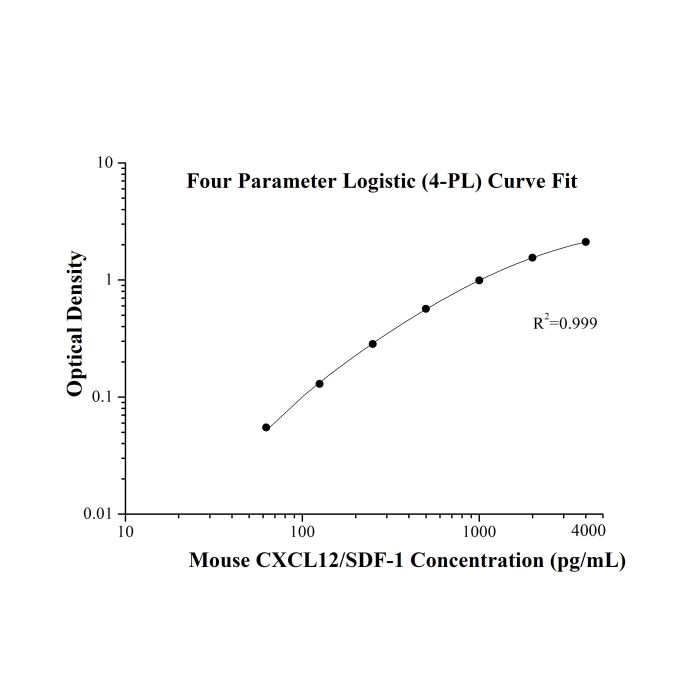
| Range | 62.5-4000 pg/mL |
| Tested applications | Sandwich ELISA |
| Gene ID (NCBI) | 20315 |
| Sample Type | Average Range |
| Mouse serum | 94% 73%-126% |
| Sample | n mean ( pg/mL ) SD CV% |
| 1 | 24 2,082.6 100.2 4.8 |
| 2 | 24 462.3 20.1 4.4 |
| 3 | 24 108.7 4.5 4.1 |
| Storage Instructions | All the reagents are stored at 2-8℃ for 6 months or -20℃ for 12 months. Refer to the protocol for further storage instructions. |
| mouse | cell culture supernatants J Biomed Res DEC1 promotes breast cancer bone metastasis through transcriptional activation of CXCR4 Authors - Ying Huo View Article |
The chemokine stroma-derived factor (SDF-1/CXCL12) plays multiple roles in tumor pathogenesis. CXCL12 plays an important role in angiogenesis by recruiting endothelial progenitor cells (EPCs) from the bone marrow through a CXCR4 dependent mechanism (PMID: 17878755). It is this function of CXCL12 that makes it a very important factor in carcinogenesis and the neovascularisation linked to tumour progression (PMID: 16943240). CXCL12 also has a role in tumor metastasis where cancer cells that express the receptor CXCR4 are attracted to metastasis target tissues that release the ligand, CXCL12 (PMID: 11242036 ). In breast cancer, however, increased expression of CXCL12 determines a reduced risk of distant metastasis (PMID: 19646861 ). Properties Storage Instructions All the reagents are stored at 2-8℃ for 6 months or -20℃ for 12 months. Refer to the protocol for further storage instructions. Synonyms AI174028, Cxcl12, PBSF, PBSF/SDF 1, Scyb12, SDF 1, Sdf1, Sdf1a, Sdf1b, TLSF, TLSF a, TLSF b, TPAR1 FAQ 1、I have limited sample diluent. How should I handle samples requiring high dilution factors? Answer: We recommend performing a serial dilution. For example, if human serum requires a 1,000,000-fold dilution, you can use a three-step 100× dilution method as follows: Step 1: Take 2 uL of human serum and add it to 198 uL of sample diluent, mix thoroughly to obtain a 100-fold diluted sample. Step 2: Take 2 uL of the 100-fold diluted sample and add it to 198 uL of sample diluent, mix thoroughly to obtain a 10,000-fold diluted sample. Step 3: Take 2 uL of the 10,000-fold diluted sample and add it to 198 uL of sample diluent, mix thoroughly to obtain a 1,000,000-fold diluted sample. If further dilution is required, additional serial steps can be used. We do not recommend using any other solutions or water for dilution, except for the sample diluent we suggest. If your sample diluent is still insufficient, please contact our customer service for more sample diluent.
Publications