Human NCAM1 ELISA Kit KE00349 proteintech
$299.00
In stock
SKU
KE00349
| Product name | Human NCAM1 ELISA Kit |
| Synonyms | CD56,NCAM1,MSK39,N CAM 1,NCAM |
| Reactivity | Human |
| Host / Isotype | United States |
| Tests | 1 X 96 well plate |
| Sample type | Serum, Plasma, Human cerebrospinal fluid (CSF) |
| Assay type | Sandwich |
| Sensitivity | 0.01 ng/mL |
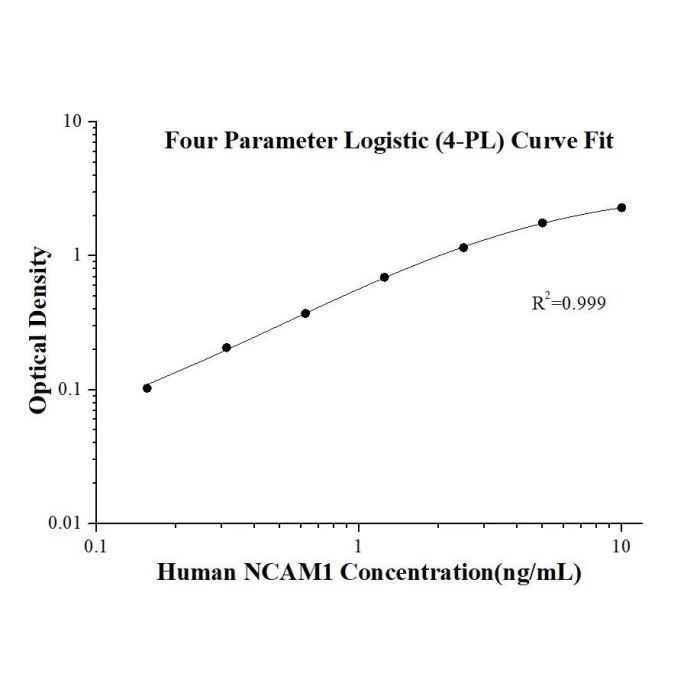
| Range | 0.156-10 ng/mL |
| Tested applications | Sandwich ELISA |
| Gene ID (NCBI) | 4684 |
| Sample Type | Average Range |
| Human serum | 98% 86%-117% |
| Human cerebrospinal fluid (CSF) | 94% 81%-113% |
| Sample | n mean ( ng/mL ) SD CV% |
| 1 | 24 5.84 0.44 7.59 |
| 2 | 24 1.11 0.08 7.60 |
| 3 | 24 0.27 0.02 7.61 |
| Storage Instructions | All the reagents are stored at 2-8℃ for 6 months or -20℃ for 12 months. Refer to the protocol for further storage instructions. |
Neural cell adhesion molecule 1 (NCAM1, also known as CD56) is a cell adhesion glycoprotein of the immunoglobulin (Ig) superfamily. It is a multifunction protein involved in synaptic plasticity, neurodevelopment, and neurogenesis. NCAM1 is expressed on human neurons, glial cells, skeletal muscle cells, NK cells and a subset of T cells, and the expression is observed in a wide variety of human tumors, including myeloma, myeloid leukemia, neuroendocrine tumors, Wilms' tumor, neuroblastoma, and NK/T cell lymphomas. Three major isoforms of NCAM1, with molecular masses of 120, 140, and 180 kDa, are generated by alternative splicing of mRNA. The glycosylphosphatidylinositol (GPI)-anchored NCAM120 and the transmembrane NCAM140 and NCAM180 consist of five Ig-like domains and two fibronection-type III repeats (FNIII). All three forms can be posttranslationally modified by addition of polysialic acid (PSA). Several other isofroms have also been described. Properties Storage Instructions All the reagents are stored at 2-8℃ for 6 months or -20℃ for 12 months. Refer to the protocol for further storage instructions. Synonyms CD56,NCAM1,MSK39,N CAM 1,NCAM FAQ 1、I have limited sample diluent. How should I handle samples requiring high dilution factors? Answer: We recommend performing a serial dilution. For example, if human serum requires a 1,000,000-fold dilution, you can use a three-step 100× dilution method as follows: Step 1: Take 2 uL of human serum and add it to 198 uL of sample diluent, mix thoroughly to obtain a 100-fold diluted sample. Step 2: Take 2 uL of the 100-fold diluted sample and add it to 198 uL of sample diluent, mix thoroughly to obtain a 10,000-fold diluted sample. Step 3: Take 2 uL of the 10,000-fold diluted sample and add it to 198 uL of sample diluent, mix thoroughly to obtain a 1,000,000-fold diluted sample. If further dilution is required, additional serial steps can be used. We do not recommend using any other solutions or water for dilution, except for the sample diluent we suggest. If your sample diluent is still insufficient, please contact our customer service for more sample diluent.