Recombinant Rat LCN2 / NGAL protein (Catalog#80058-R08B)
Preparation
Produced in rabbits immunized with purified, recombinant Rat LCN2 / NGAL (rR LCN2 / NGAL; Catalog#80058-R08B; P30152; Met1-Asn198). LCN2 / NGAL specific IgG was purified by Rat LCN2 / NGAL affinity chromatography.
Source
Polyclonal Rabbit IgG
Purification
Protein A & Antigen Affinity
Formulation
0.2 μm filtered solution in PBS
Conjugate
Unconjugated
Form
Liquid
Shipping
This antibody is shipped as liquid solution at ambient temperature. Upon receipt, store it immediately at the temperature recommended below.
Storage
This antibody can be stored at 2℃-8℃ for one month without detectable loss of activity. Antibody products are stable for twelve months from date of receipt when stored at -20℃ to -80℃. Preservative-Free. Avoid repeated freeze-thaw cycles.
Synonyms: Anti-Lcn2 Antibody; Anti-Sip24 Antibody
Image / Experimental Information
Image 1 Description
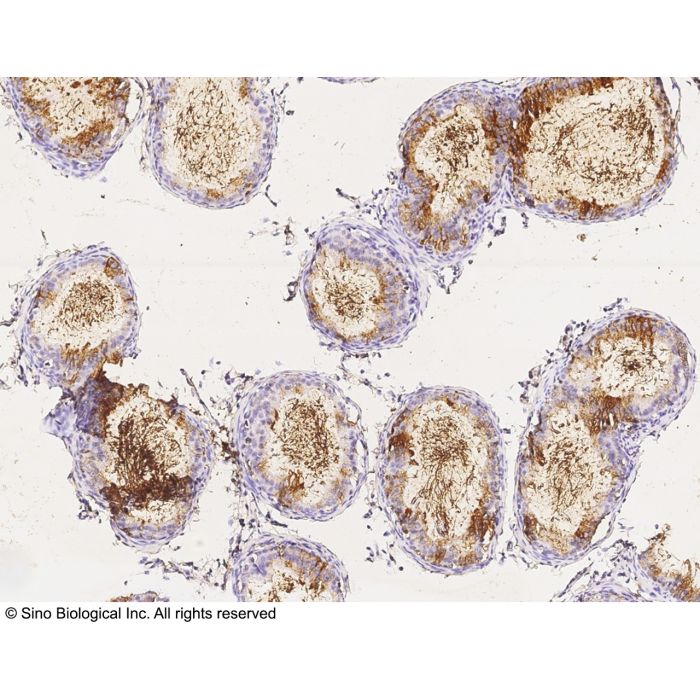
Immunochemical staining of rat LCN2 in rat epididymis with rabbit polyclonal antibody (1:1000, formalin-fixed paraffin embedded sections).
Image 1 Alt Text
Rat NGAL/LCN2/Lipocalin-2 Immunohistochemistry(IHC) 3111
Lipocalin-2 (LCN2), also known as neutrophil gelatinase-associated lipocalin (NGAL), is a 25 kDa protein belonging to the lipocalin superfamily. It was initially found in activated neutrophils, however, many other cells, like kidney tubular cells, may produce NGAL in response to various insults. This protein is released from injured tubular cells after various damaging stimuli, is already known by nephrologists as one of the most promising biomarkers of incoming Acute Kidney Injury (AKI). Recent evidence also suggests its role as a biomarker in a variety of other renal and non-renal conditions. Moreover, recent studies seem to suggest a potential involvement of this factor also in the genesis and progression of chronic kidney diseases. NGAL is the first known mammalian protein that specifically binds organic molecules called siderophores, which are high-affinity iron chelators. NGAL, first known as an antibacterial factor of natural immunity, and an acute-phase protein, is currently one of the most interesting and enigmatic proteins involved in the process of tumor development. acting as an intracellular iron carrier and protecting MMP9 from proteolytic degradation, NGAL has a clear pro-tumoral effect, as has already been observed in different tumors (e.g. breast, stomach, esophagus, brain) in humans. In thyroid carcinomas, NGAL is strongly induced by NF-kB, an important factor involved both in tumor growth and in the link between chronic inflammation and neoplastic development. Thus, Lipocalin-2 (LCN2/NGAL) has been implicated in a variety of processes including cell differentiation, proliferation, survival, and morphogenesis.
References
Schmidt-Ott KM, et al. (2006) Neutrophil gelatinase-associated lipocalin-mediated iron traffic in kidney epithelia. Curr Opin Nephrol Hypertens. 15(4): 442-9.
Bolignano D, et al. (2010) Neutrophil gelatinase-associated lipocalin (NGAL) in human neoplasias: a new protein enters the scene. Cancer Lett. 288(1): 10-6.
Soni SS, et al. (2010) NGAL: a biomarker of acute kidney injury and other systemic conditions. Int Urol Nephrol. 42(1): 141-50.
Bolignano D, et al. (2010) From kidney to cardiovascular diseases: NGAL as a biomarker beyond the confines of nephrology. Eur J Clin Invest. 40(3): 273-6.



-1ug-rat-epididymis.png)