Human M-CSFR/CSF1R ELISA Kit sinobiological KIT10161
$714.00
In stock
SKU
KIT10161
| Catalog No. | Size | Price (USD) |
| KIT10161-1 | 1 Kit (96 Tests) | $740.55 |
| Catalog No. | Size | Price (USD) |
| KIT10161-1 | 1 Kit (96 Tests) | $740.55 |
General Information
| Product name | Human M-CSFR/CSF1R ELISA Kit |
| Specificity | This assay recognizes both recombinant and natural Human MCSFR. |
| Conjugate | HRP |
| Shipping | This ELISA Kit is shipped at ambient temperature. |
| Storage | Unopened Kit: Store at 2 - 8℃ Opened/Reconstituted Reagents: Please refer to CoA |
| Assay type | Solid Phase Sandwich ELISA (quantitative) |
| Sample type | Serum,Cell supernatant,Plasma |
| Sensitivity | 2.26 pg/mL |
| Assay range | 31.25-2000 pg/mL |
| Materials provided | 1. 96 well microplate coated with Capture Antibody 2. Detection Antibody conjugated to HRP 3. Standards 4. Wash Buffer Concentrate 5. Dilution Buffer Concentrate 6. Color Reagent A 7. Color Reagent B 8. Stop Solution |
| Product overview | This Human M-CSFR/CSF1R ELISA Kit is an enzyme-linked immunosorbent assay for the quantitative measurement of Human M-CSFR/CSF1R protein in Serum,Cell supernatant,Plasma . It contains recombinant Human M-CSFR/CSF1R, and antibodies raised against the recombinant protein. This ELISA kit is complete and ready-to-use. |
| Interference | Preparations of the factors listed below at 50 ng/mL in a mid-range recombinant human MCSFR control were assayed for interference. No significant interference was observed. |
Synonyms: BANDDOS ELISA Kit, Human; C-FMS ELISA Kit, Human; CD115 ELISA Kit, Human; CSF-1R ELISA Kit, Human; CSFR ELISA Kit, Human; FIM2 ELISA Kit, Human; FMS ELISA Kit, Human; GPSC ELISA Kit, Human; HDLS ELISA Kit, Human; HDLS1 ELISA Kit, Human; M-CSF-R ELISA Kit, Human
Image / Experimental Information
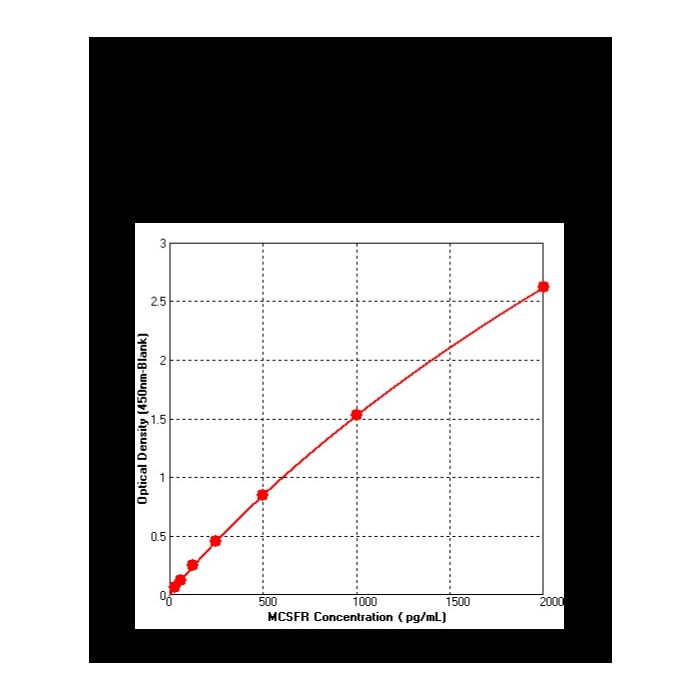
| Image 1 Description | This standard curve is only for demonstration purposes. A standard curve should be generated for each assay. |
| Image 1 Alt Text | Human MCSF Receptor/CSF1R/CD115 ELISA Kit Standard Curve 41 |
| Image 1 URL | Source image |
| Image 2 Description | This standard curve is only for demonstration purposes. A standard curve should be generated for each assay. |
| Image 2 Alt Text | Human MCSF Receptor/CSF1R/CD115 ELISA Kit Specificity 206 |
| Image 2 URL | Source image |
Background Information
| Full Name | colony stimulating factor 1 receptor |
| Description | M-CSFR encoded by the proto-oncogene c-fms is the receptor for colony stimulating factor 1 (CSF1R), a cytokine involved in the proliferation, differentiation, and activation of macrophages. This cell surface glycoprotein is consisted by an extracellular ligand-binding domain, a single membrane-spanning segment, and an intracellular tyrosine kinase domain. Binding of CSF1 activates the receptor kinase, leading to "autophosphorylation" of receptor subunits and the concomitant phosphorylation of a series of cellular proteins on tyrosine residues. CSF1R is a tyrosine kinase receptor that is absolutely required for macrophage differentiation and thus occupies a central role in hematopoiesis. CSF1 and its receptor (CSF1R, product of c-fms proto-oncogene) were initially implicated as essential for normal monocyte development as well as for trophoblastic implantation. This apparent role for CSF1/CSF1R in normal mammary gland development is very intriguing because this receptor/ligand pair has also been found to be important in the biology of breast cancer in which abnormal expression of CSF1 and its receptor correlates with tumor cell invasiveness and adverse clinical prognosis. Tumor cell expression of CSF1R is under the control of several steroid hormones (glucocorticoids and progestins) and the binding of several bHLH transcription factors, while tumor cell expression of CSF-1 appears to be regulated by other hormones, some of which are involved in normal lactogenic differentiation. However, studies have demonstrated that CSF1 and CSF1R have additional roles in mammary gland development during pregnancy and lactation. The role of CSF1 and CSF1R in normal and neoplastic mammary development that may elucidate potential relationships of growth factor-induced biological changes in the breast during pregnancy and tumor progression. |
| Research Areas |
|
| Related Pathways |
|
| References |
|