Recombinant Mouse CD59a Protein (Catalog#50724-M08H)
Preparation
This antibody was obtained from a rabbit immunized with purified, recombinant Mouse CD59a (rM CD59a; Catalog#50724-M08H; NP_001104530.1; Met1-Lys95) and conjugated with APC under optimum conditions, the unreacted APC was removed.
Source
Monoclonal Rabbit IgG Clone #108
Purification
Protein A
Formulation
PBS solution containing 0.5% BSA and 0.03%ProClin300
Concentration
5 μl/Test, 0.1 mg/ml
Conjugate
APC
Form
Liquid
Shipping
This antibody is shipped as liquid solution at ambient temperature. Upon receipt, store it immediately at the temperature recommended below.
Storage
This antibody can be stored at 2℃-8℃ for twelve months without detectable loss of activity. Protected from prolonged exposure to light. Do not freeze !
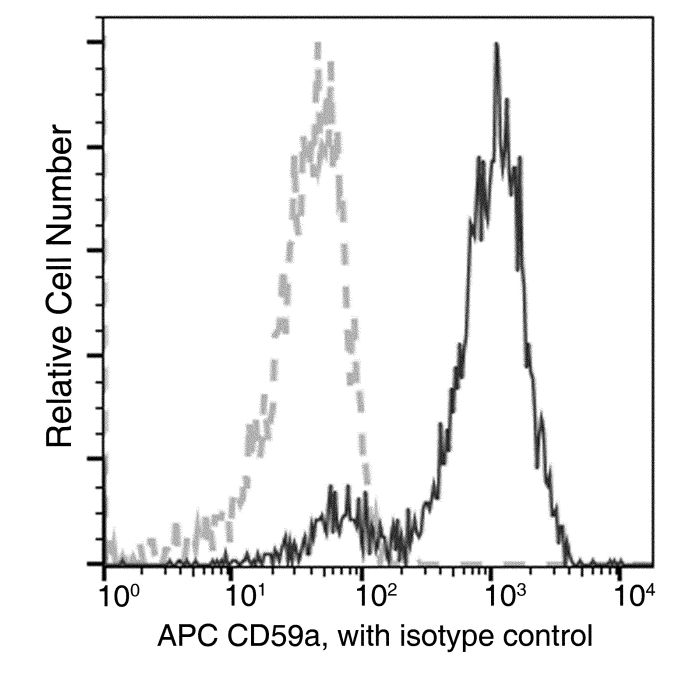
Flow cytometric analysis of Mouse CD59a expression on BABL/c bone marrow erythroid cells. Cells were stained with APC-conjugated anti-Mouse CD59a. The fluorescence histograms were derived from gated events with the forward and side light-scatter characteristics of erythroid cells.
Protectin, a complement regulatory protein, also known as CD59, or MIRL (membrane inhibitor of reactive lysis) is a small protein that inhibits the complement membrane attack complex by binding C5b678 and preventing C9 from binding and polymerizing. The amino-terminal 25 amino acids represented a typical signal peptide sequence and the carboxy-terminal hydrophobic amino acids were characteristic for phosphatidylinositol-anchored proteins. It was found that the CD59/Protectin antigen is a small protein sometimes associated with larger components (45 and 80 kD) in urine. CD59/Protectin antigen was released from the surface of transfected COS cells by phosphatidylinositol-specific phospholipase C, demonstrating that it is attached to the cell membrane by means of a glycolipid anchor; it is therefore likely to be absent from the surface of affected erythrocytes in the disease paroxysmal nocturnal hemoglobinuria.
References
Huang Y, et al. (2006) Defining the CD59-C9 binding interaction. J Biol Chem. 281 (37): 27398-404.
Sawada R, et al. (1990) Isolation and expression of the full-length cDNA encoding CD59 antigen of human lymphocytes. DNA Cell Biol. 9(3): 213-20.
Philbrick WM, et al. (1990) The CD59 antigen is a structural homologue of murine Ly-6 antigens but lacks interferon inducibility. Eur J Immunol. 20(1): 87-92.