Recombinant Human CD68 Protein (Catalog#11192-H08B1)
Preparation
This antibody was produced from a hybridoma resulting from the fusion of a mouse myeloma with B cells obtained from a mouse immunized with purified, recombinant Human CD68 (rh CD68; Catalog#11192-H08B1; P34810-1; Met1-Ser319). The IgG fraction of the cell culture supernatant was purified by Protein A affinity chromatography, and conjugated with PE under optimum conditions, the unreacted PE was removed.
Source
Monoclonal Mouse IgG1 Clone #11
Purification
Protein A
Formulation
PBS solution containing 0.5% BSA and 0.03%ProClin300
Concentration
10 μl/Test, 0.1 mg/ml
Conjugate
PE
Form
Liquid
Shipping
This antibody is shipped as liquid solution at ambient temperature. Upon receipt, store it immediately at the temperature recommended below.
Storage
This antibody can be stored at 2℃-8℃ for twelve months without detectable loss of activity. Protected from prolonged exposure to light. Do not freeze !
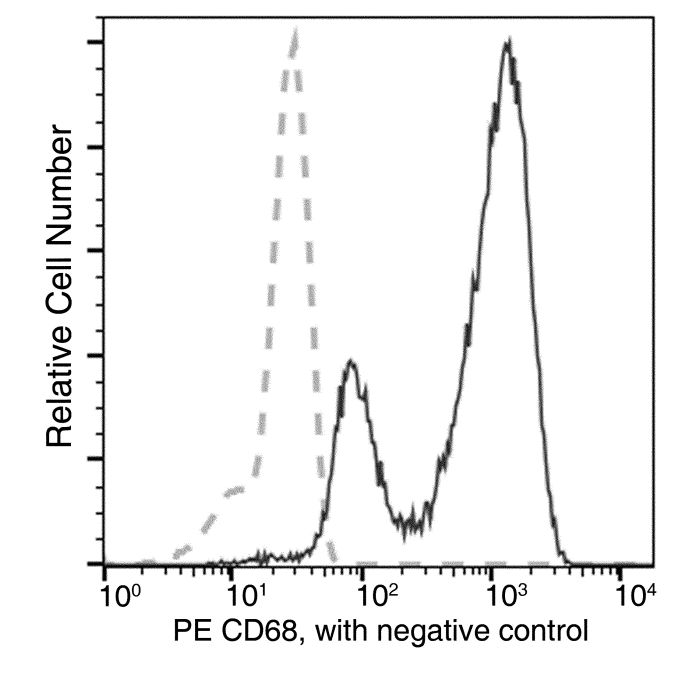
Flow cytometric analysis of human CD68 expression on human whole blood monocytes.The cells were treated according to manufacturer’s manual (BD Pharmingen™ Cat. No. 554714), stained with PE-conjugated anti-Human CD68. The fluorescence histograms were derived from gated events with the forward and side light-scatter characteristics of viable monocytes.
Macrosialin, also known as CD68 and Gp11, is a single-pass type I membrane protein which belongs to theLAMP family. CD68 is highly expressed by blood monocytes and tissue macrophages. It is also expressed in lymphocytes, fibroblasts and endothelial cells. CD68 is expressed in many tumor cell lines which could allow them to attach to selectins on vascular endothelium, facilitating their dissemination to secondary sites. CD68 plays a role in phagocytic activities of tissue macrophages, both in intracellular lysosomal metabolism and extracellular cell-cell and cell-pathogen interactions. It is a commonly used marker for macrophages. However, a number of studies have shown that CD68 antibodies react with other hematopoietic and non-hematopoietic cell types, suggesting that CD68 may not be a macrophage-specific antigen. CD68 binds to tissue- and organ-specific lectins or selectins, allowing homing of macrophage subsets to particular sites. Rapid recirculation of CD68 from endosomes and lysosomes to the plasma membrane may allow macrophages to crawl over selectin-bearing substrates or other cells.
References
Strobl H. et al., 1995, Br J Haematol. 90 (4): 774-82.
Ogawa Y. et al., 1995, Pathol Int. 45 (9): 698-701.
Sadovnikova E. et al., 2002,Leukemia. 16 (10): 2019-26.
Gottfried E. et al., 2008, Scand J Immunol. 67 (5): 453-63.
Strojnik T. et al., 2009, Anticancer Res. 29 (8): 3269-79.