Chinese hamster PLBL2 / PLBD2 ELISA Kit sinobiological KIT5A7664
$1,000.00
In stock
SKU
KIT5A7664
| Catalog No. | Size | Price (USD) |
| KIT5A7664-1 | 1 Kit (96 Tests) | $1,036.78 |
| Catalog No. | Size | Price (USD) |
| KIT5A7664-1 | 1 Kit (96 Tests) | $1,036.78 |
General Information
| Product name | Chinese hamster PLBL2 / PLBD2 ELISA Kit |
| Specificity | Recognizes recombinant Chinese Hamster (CHO) PLBL2/PLBD2 |
| Conjugate | HRP |
| Shipping | This ELISA Kit is shipped at ambient temperature. |
| Storage | Unopened Kit: Store at 2 - 8℃ Opened/Reconstituted Reagents: Please refer to CoA |
| Assay type | Solid Phase Sandwich ELISA (quantitative) |
| Sample type | Cell supernatant |
| Sensitivity | 43.5 pg/mL |
| Assay range | 390.63-25000 pg/mL |
| Materials provided | 1. 96 well microplate coated with Capture Antibody 2. Detection Antibody conjugated to HRP 3. Standards 4. Wash Buffer Concentrate 5. Dilution Buffer Concentrate 6. Color Reagent A 7. Color Reagent B 8. Stop Solution |
| Product overview | This Chinese hamster PLBL2 / PLBD2 ELISA Kit is an enzyme-linked immunosorbent assay for the quantitative measurement of Chinese hamster PLBL2 / PLBD2 protein in Cell supernatant . It contains recombinant Chinese hamster PLBL2 / PLBD2, and antibodies raised against the recombinant protein. This ELISA kit is complete and ready-to-use. |
Image / Experimental Information
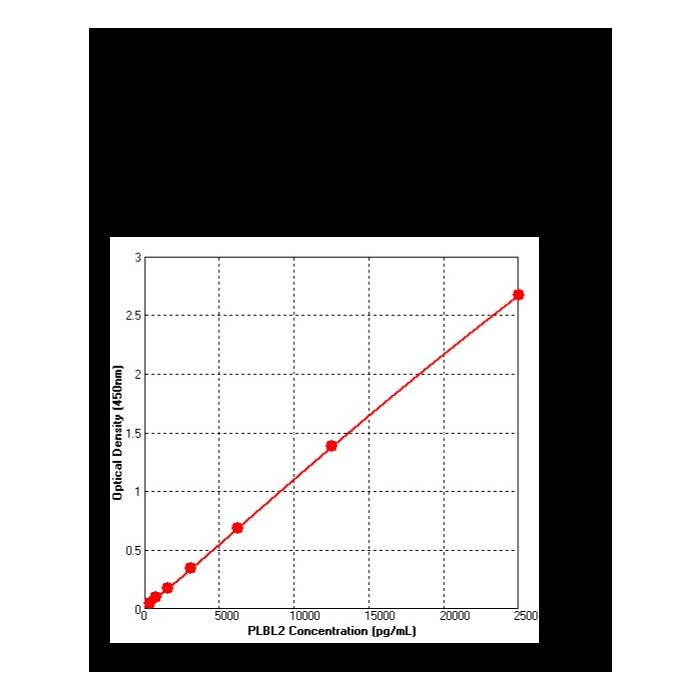
| Image 1 Description | This standard curve is only for demonstration purposes. A standard curve should be generated for each assay. |
| Image 1 Alt Text | Chinese hamster PLBL2 / PLBD2 ELISA Kit Standard Curve 37295 |
| Image 1 URL | Source image |
Background Information
| Full Name | phospholipase B domain containing 2 |
| Description | PLBD2 localizes to the lysosome, as its absence could plausibly lead to a serious yet unrecognized lysosomal storage disease. PLBD1 and PLBD2 are semi-orphans in the sense of being probable phospholipases of B class but with uncertain physiological substrates and thus functionalities. PLBD1 and PLBD2 constitute a small gene family (sequence homology class) within vertebrates though one that occurs expanded in some early diverging eukaryotes. PLBD2 presents a special difficulty in that a sequence of post-translational steps are apparently necessary for its activation. Without these, potential substrates can hardly be assayed. These steps include removal of the signal peptide, mannosylation appropriate to the lysosome targeting receptor, and self-catalytic proteolytic activation to expose the substrate binding site as this becomes appropriate. |
| References |
|