Recombinant Canine PD-1 Protein (hFc Tag), HPLC-verified sinobiological 70109-D02H
| Catalog No. | Size | Price (USD) |
| 70109-D02H-100 | 100 µg | $573.19 |
| 70109-D02H-200 | 200 µg | $573.19 |
| Catalog No. | Size | Price (USD) |
| 70109-D02H-100 | 100 µg | $573.19 |
| 70109-D02H-200 | 200 µg | $573.19 |
General Information
| Formulation | Lyophilized from sterile PBS, pH 7.4. Please contact us for any concerns or special requirements. Normally 5 % - 8 % trehalose, mannitol and 0.01% Tween80 are added as protectants before lyophilization. Please refer to the specific buffer information in the hardcopy of datasheet or the lot-specific COA. |
| Endotoxin | < 1.0 EU per μg protein as determined by the LAL method. |
| Shipping | In general, recombinant proteins are provided as lyophilized powder which are shipped at ambient temperature. Bulk packages of recombinant proteins are provided as frozen liquid. They are shipped out with blue ice unless customers require otherwise. |
| Stability & Storage | Samples are stable for up to twelve months from date of receipt at -20℃ to -80℃. Store it under sterile conditions at -20℃ to -80℃. It is recommended that the protein be aliquoted for optimal storage. Avoid repeated freeze-thaw cycles. |
| Reconstitution | To find reconstitution info, click on 'COA' at the top of the page, enter the lot number and product size for the lot-specific COA. |
| Purity | ≥ 95 % as determined by SDS-PAGE. ≥ 95 % as determined by SEC-HPLC. |
| Activity | 1.Immobilized PD-1 Protein, Canine, Recombinant (hFc Tag)(Cat:70109-D02H) at 2 μg/mL (100 μL/well) can bind PD-L1 Protein, Canine, Recombinant (hFc Tag), Biotinylated(Cat:70110-D02H-B),the EC 50 is 300-1200 ng/mL. (Routinely tested) 2. Loaded Recombinant Canine PD-L1/B7-H1 Protein, His Tag (Cat. No. 70110-D08H) on NTA Biosensor, can bind Recombinant Canine PD-1 Protein, hFc Tag (Cat. No. 70109-D02H) with an affinity constant of 44.1 nM as determined in BLI assay (Sartorius Octet RED384) (QC tested). |
| Protein Construction | A DNA sequence encoding the canine PDCD1 (XP_543338.3) (Met1-Leu169) was expressed with the Fc region of human IgG1 at the C-terminus. |
| Accession# | XP_543338.3 |
| Expressed Host | HEK293 Cells |
| Species | Canine |
| Predicted N Terminal | Leu 25 |
| Molecule Mass | The recombinant canine PDCD1 consists 383 amino acids and predicts a molecular mass of 43 kDa. |
Image / Experimental Information
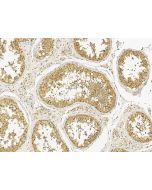
| Image 1 Alt Text | Canine PD1/PDCD1/CD279 Protein 12299 |
| Image 1 URL | Source image |
| Image 2 Alt Text | Canine PD-1 Protein 28206 |
| Image 2 URL | Source image |
| Image 3 Alt Text | Canine PD-1 Protein 39767 |
| Image 3 URL | Source image |
| Image 4 Alt Text | Canine PD-1 Protein 43360 |
| Image 4 URL | Source image |
Background Information
| Full Name | programmed cell death 1 |
| Description | Programmed cell death 1, also known as PDCD1, is a type I transmembrane glycoprotein, and is an immunoreceptor belonging to the CD28/CTLA-4 family negatively regulates antigen receptor signaling by recruiting protein tyrosine phosphatase, SHP-2 upon interacting with either of two ligands, PD-L1 or PD-L2. PD1 inhibits the T-cell proliferation and production of related cytokines including IL-1, IL-4, IL-10 and IFN-γ by suppressing the activation and transduction of PI3K/AKT pathway. In addition, coligation of PD1 inhibits BCR-mediating signal by dephosphorylating key signal transducer. PD1 has been suggested to be involved in lymphocyte clonal selection and peripheral tolerance, and thus contributes to the prevention of autoimmune diseases. Furthermore, PD1 is shown to be a regulator of virus-specific CD8+ T cell survival in HIV infection. As a cell surface molecule, PDCD1 regulates the adaptive immune response. Engagement of PD-1 by its ligands PD-L1 or PD-L2 transduces a signal that inhibits T-cell proliferation, cytokine production, and cytolytic function. |
| Research Areas |
|
| Tags |
|
| References |
|
title: Characterization of a Potential Therapeutic Anti-Canine PD-1 Single Domain Antibody Produced in Yeast.
authors: Kartikeya Vijayasimha; Andrew J Annalora; ...; Christopher K Cebra
journal: Veterinary sciences
date: 2025-07-08
pmid: 40711309
doi: 10.3390/vetsci12070649
cited_by_count: 0
techniques: Cell Culture; Clone Assay; Incubation; Isolation; Plasmid Preparation; Saline; Sequencing
bioz_score: 94
title: The development of a canine single-chain phage antibody library to isolate recombinant antibodies for use in translational cancer research.
authors: Małgorzata Lisowska; Erin G Worrall; ...; Ted R Hupp
journal: Cell Reports Methods
date: 2025-03-25
pmid: 40132540
cited_by_count: 0
techniques: Reverse Transcription
bioz_score: 93
title: Development and pharmacokinetic assessment of a fully canine anti-PD-1 monoclonal antibody for comparative translational research in dogs with spontaneous tumors
authors: Sho Yoshimoto; Nicholas Chester; ...; Nicola J. Mason
journal: mAbs
date: 2023-12-04
pmid: 38047502
pmcid: 10793675
cited_by_count: 11
techniques: Binding Assay; Cell Culture; Co-Culture Assay; Enzyme-linked Immunosorbent Assay; Expressing; Flow Cytometry; Incubation; Inhibition; Labeling; Virus
bioz_score: 91
title: Development of Monoclonal Antibodies Targeting Canine PD-L1 and PD-1 and Their Clinical Relevance in Canine Apocrine Gland Anal Sac Adenocarcinoma.
authors: Lucia Minoli; Luca Licenziato; ...; Luca Aresu
journal: Cancers
date: 2022-12-14
pmid: 36551672
cited_by_count: 9
techniques: Dot Blot; Enzyme-linked Immunosorbent Assay; Flow Cytometry; Generated; Membrane; Recombinant; Western Blot
bioz_score: 94
title: Cross-Reactivity and Functionality of Approved Human Immune Checkpoint Blockers in Dogs
authors: Stanislav Pantelyushin; Elisabeth Ranninger; ...; Kentaro Inamura
journal: Cancers
date: 2021-02-13
pmid: 33668625
doi: 10.3390/cancers13040785
pmcid: 7918463
cited_by_count: 28
techniques: Recombinant
bioz_score: 91