Supplied as sterile PBS, pH 7.4. Please contact us for any concerns or special requirements. Please refer to the specific buffer information in the hardcopy of datasheet or the lot-specific COA.
Endotoxin
< 0.5 EU per mg protein.
Shipping
It is supplied and shipped as liquid with dry ice.
Stability & Storage
Samples are stable for up to twelve months from date of receipt at -20℃ to -80℃. Store it under sterile conditions at -20℃ to -80℃. It is recommended that the protein be aliquoted for optimal storage. Avoid repeated freeze-thaw cycles.
Purity
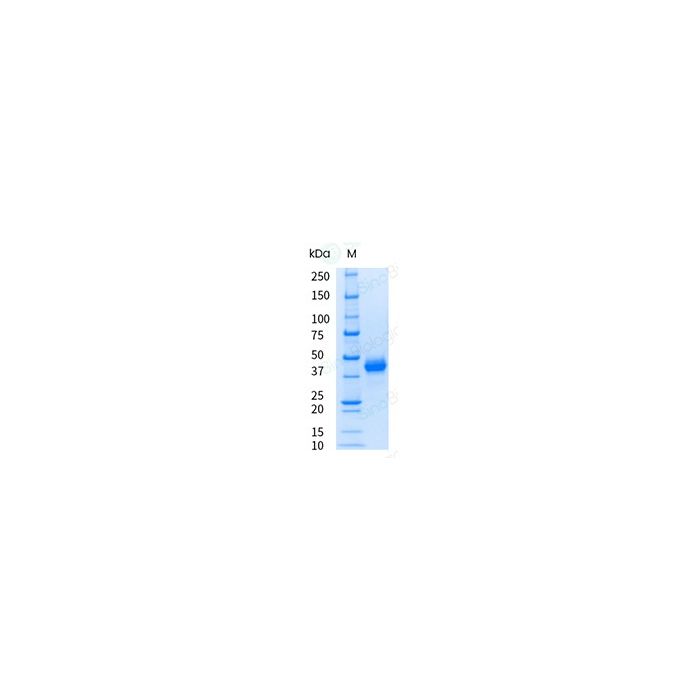
≥ 95 % as determined by SDS-PAGE. ≥ 95 % as determined by SEC-HPLC.
Activity
1.Immobilized Recombinant Cynomolgus CD3 epsilon/CD3e Protein (ECD, Fc Tag)(Cat: 90857-C02H-UE) at 2 μg/mL (100 μL/well) can bind biotinylated SP34, Human IgG1, the EC 50 is 1-3 ng/mL (Routinely tested).
Protein Construction
A DNA sequence encoding the Cynomolgus CD3E (Q95LI5-1) (Met1-Asp117) was expressed with the Fc region of human IgG1 at the C-terminus.
Expressed Host
HEK293 Cells
Species
Cynomolgus
Predicted N Terminal
Gln 22
Molecule Mass
The recombinant Cynomolgus CD3E consists of 334 amino acids and predicts a molecular mass of 37.56 kDa. As a result of glycosylation, it migrates as an approximately 39-48 kDa band in SDS-PAGE under reducing conditions.
T-cell surface glycoprotein CD3 epsilon chain, also known as CD3E, is a single-pass type I membrane protein. CD3E contains 1 Ig-like (immunoglobulin-like) domain and 1 ITAM domain. CD3E, together with CD3-gamma, CD3-delta and CD3-zeta, and the T-cell receptor alpha/beta and gamma/delta heterodimers, forms the T cell receptor-CD3 complex. The CD3 epsilon subunit of the T cell receptor (TCR) complex contains two defined signaling domains, a proline-rich sequence and an immune tyrosine activation motifs (ITAMs), and this complex undergoes a conformational change upon ligand binding that is thought to be important for the activation of T cells. In the CD3 epsilon mutant mice, all stages of T cell development and activation that are TCR-dependent were impaired, but not eliminated, including activation of mature naïve T cells with the MHCII presented superantigen, staphylococcal enterotoxin B, or with a strong TCR cross-linking antibody specific for either TCR-Cbeta or CD3 epsilon. T cell receptor-CD3 complex plays an important role in coupling antigen recognition to several intracellular signal-transduction pathways. This complex is critical for T-cell development and function, and represents one of the most complex transmembrane receptors. CD3E plays an essential role in T-cell development, and defects in CD3E gene cause severe immunodeficiency. Homozygous mutations in CD3D and CD3E genes lead to a complete block in T-cell development and thus to an early-onset severe combined immunodeficiency phenotype.
Research Areas
ITIM/ITAM Immunoreceptors and Related Molecules
Related Pathways
T Cell Receptor Signaling Pathway
Tags
Cancer Immunotherapy
Immune Checkpoint
Immunotherapy
Targeted Therapy
References
Fischer A, et al. (2005) CD3 deficiencies. Curr Opin Allergy Clin Immunol. 5(6): 491-5.
Wang Y, et al. (2009) A conserved CXXC motif in CD3epsilon is critical for T cell development and TCR signaling. PLoS Biol. 7(12): e1000253.
Martnez-Martn N, et al. (2009) Cooperativity between T cell receptor complexes revealed by conformational mutants of CD3epsilon. Sci Signal. 2(83): ra43.
Deford-Watts LM, et al. (2009) The cytoplasmic tail of the T cell receptor CD3 epsilon subunit contains a phospholipid-binding motif that regulates T cell functions. J Immunol. 183(2): 1055-64.