Supplied as sterile 50 mM Hepes, 150 mM NaCl, 10% Trehalose, pH 7.2. Please contact us for any concerns or special requirements. Please refer to the specific buffer information in the hardcopy of datasheet or the lot-specific COA.
Endotoxin
< 1.0 EU per μg protein as determined by the LAL method.
Shipping
It is supplied and shipped as liquid with dry ice.
Stability & Storage
Samples are stable for up to twelve months from date of receipt at -70℃. Store it under sterile conditions at -70℃ or lower. It is recommended that the protein be aliquoted for optimal storage. Avoid repeated freeze-thaw cycles.
Activity
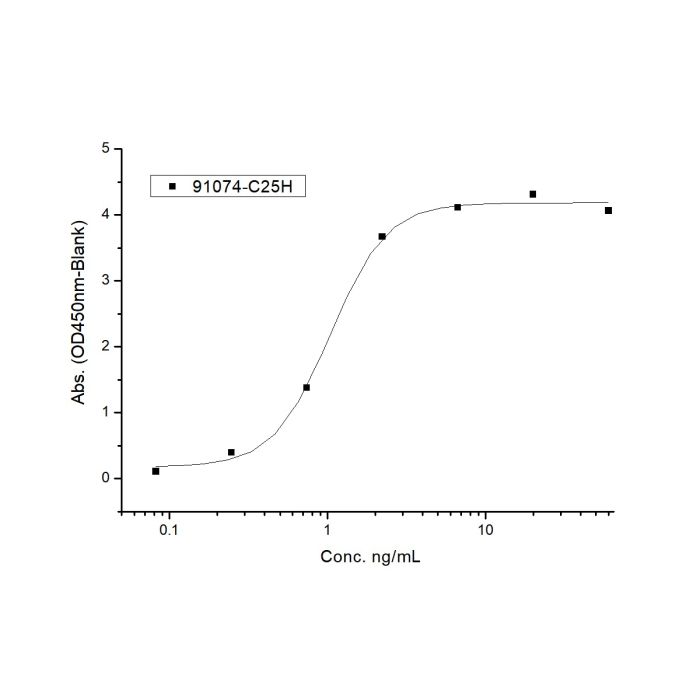
Immobilized Recombinant Cynomolgus Claudin-6 Protein (VLP, Full-Length, Flag Tag) (Cat: 91074-C25H) at 5 μg/mL (100 μL/well) can bind Anti-Claudin 6 (Research Grade Clone 202010370074X-64H), the EC 50 is 0.5-5 ng/mL (QC tested).
Protein Construction
A DNA sequence encoding the Cynomolgus Claudin-6-VLP (Full Length) (G7Q0B0) (Met1-Val220) was fused with a signal peptide at the N-terminus and a flag tag at the C-terminus. This protein was prepared using our VLP platform. As an innovative technology platform, VLPs are generated through the self-assembly of viral proteins in HEK293 cells. This process efficiently integrates membrane proteins onto the VLP surface, preserving their native conformation and yielding soluble, high-concentration proteins that are ideally suited for immunization and antibody screening.
Expressed Host
HEK293 Cells
Species
Cynomolgus
Predicted N Terminal
Met 1
Molecule Mass
The recombinant Cynomolgus Claudin-6-VLP comprises 233 amino acids and has a predicted molecular mass of 24.63 kDa.
Image / Experimental Information
Image 1 Description
Immobilized Recombinant Cynomolgus Claudin-6 Protein (VLP, Full-Length, Flag Tag) (Cat: 91074-C25H) at 5 μg/mL (100 μL/well) can bind Anti-Claudin 6 (Research Grade Clone 202010370074X-64H), the EC 50 is 0.5-5 ng/mL (QC tested).
Claudin-6 (CLDN6) belongs to the claudins family and is a transmembrane protein found in tight junctions with two extracellular loops and intracellular N and C tails. CLDN6 modulates the ion- and charge-specific permeability of the paracellular pathway in most epithelial tissues. It regulates the paracellular flux of cations in the kidney through forming heterotypic strands with other claudins and has a role in maintaining the lung epithelial barrier function. The CLDN6 gene is adjacent to another family member, CLDN9, on chromosome 16. Certain CLDN6-positive cancers, encompassing ovarian, endometrial, and testicular malignancies, have been shown to have their proliferation and invasiveness suppressed upon CLDN6 silencing.