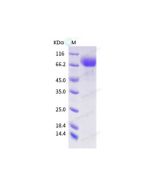
Recombinant Human TrkA Protein (G667C, GST Tag), Active sinobiological N16-12CG

$483.00
In stock
SKU
N16-12CG
Catalog No.SizePrice (USD)
N16-12CG-1010 µg$500.61
N16-12CG-5050 µg$1,715.12
N16-12CG-500500 µg$3,788.68

General Information

Validated applicationsKinase Assay
FormulationSupplied as sterile 50 mM Tris-HCl, pH 7.5, 50-300mM NaCl, 10mM glutathione, 0.1mM EDTA, 0.25-1.0mM DTT, 0-0.1mM PMSF, 10-25% glycerol Please contact us for any concerns or special requirements. Please refer to the specific buffer information in the hardcopy of datasheet or the lot-specific COA.
ShippingEnzymes are highly recommended to be shipped at frozen temperature with dry ice. Shipment made at ambient temperature may seriously affect the activity of the ordered products.
Stability & StorageStore product at –70°C. For optimal storage, aliquot target into smaller quantities after centrifugation and store at recommended temperature. For most favorable performance, avoid repeated handling and multiple freeze/thaw cycles.
PurityFor specific information on a given lot, see related technical data sheet.
ActivityFor specific information on a given lot, see related technical data sheet.
Protein ConstructionRecombinant human TRKA (G667C) (440-end) was expressed by baculovirus in Sf9 insect cells using an N-terminal GST tag.
Expressed HostBaculovirus-Insect Cells
SpeciesHuman
Molecule Mass~66 kDa
Technical Data Sheet by Lot #B2180-7 C1875-5 L5144-11

Synonyms: MTC Protein, Human; p140-TrkA Protein, Human; TRK Protein, Human; Trk-A Protein, Human; TRK1 Protein, Human; TRKA Protein, Human

Background Information

Full Nameneurotrophic tyrosine kinase, receptor, type 1
DescriptionTRKA is a member of the neurotrophic tyrosine kinase receptor (NTKR) family. It is a membrane-bound receptor that, upon neurotrophin binding, phosphorylates itself and members of the MAPK pathway. Isoform TrkA-III promotes angiogenesis and has oncogenic activity when overexpressed. Isoform TrkA-I is found in most non-neuronal tissues. Isoform TrkA-II is primarily expressed in neuronal cells. TrkA-III is specifically expressed by the pluripotent neural stem and neural crest progenitors. The presence of NTRK1 leads to cell differentiation and may play a role in specifying sensory neuron subtypes. Mutations in the TRKA gene have been associated with congenital insensitivity to pain, anhidrosis, self-mutilating behavior, mental retardation, and cancer. It was originally identified as an oncogene as it is commonly mutated in cancers, particularly colon and thyroid carcinomas. TRKA is required for high-affinity binding to , neurotrophin-3 and neurotrophin-4/5 but not brain-derived neurotrophic factor (BDNF). Known substrates for the Trk receptors are SHC1, PI 3-kinase, and PLC-gamma-1. NTRK1 has a crucial role in the development and function of the nociceptive reception system as well as the establishment of thermal regulation via sweating. It also activates ERK1 by either SHC1- or PLC-gamma-1-dependent signaling pathway. Defects in NTRK1 are a cause of congenital insensitivity to pain with anhidrosis and thyroid papillary carcinoma.
Research Areas
  • Cancer Drug Targets
  • Receptor Tyrosine Kinases (RTKs)
Tags
  • Cancer Immunotherapy
  • Immune Checkpoint
  • Immunotherapy
  • Targeted Therapy
References
  1. Lambiase A, et al. (2005) Molecular basis for keratoconus: lack of TrkA expression and its transcriptional repression by Sp3. Natl Acad Sci. 102 (46):16795-800.
  2. Benito-Gutiérrez E, et al. (2006) Origin and evolution of the Trk family of neurotrophic receptors. Mol Cell Neurosci. 31(2):179-92.
  3. Martin-Zanca D, et al. (1986) A human oncogene formed by the fusion of truncated tropomyosin and protein tyrosine kinase sequences. Nature. 319(6056):743-8.

title: Five-and-six-membered heterocyclic compound and use thereof as protein receptor kinase inhibitor
authors: Lei Jiang; Zhiyong Feng; ...; Yuxing Zhang
date: 2025-08-19
cited_by_count: 0
techniques: Recombinant
bioz_score: 93

title: Discovery of novel indazole derivatives as second-generation TRK inhibitors.
authors: Qiaohua Qin; Shuyu Lu; ...; Maosheng Cheng
journal: European Journal of Medicinal Chemistry
date: 2024-08-09
pmid: 39033612
doi: 10.1016/j.ejmech.2024.116640
cited_by_count: 1
techniques: Concentration Assay; HTRF Assay; Purification
bioz_score: 92

title: Heterocyclic compound as TRK inhibitor
authors: Norman Xianglong Kong; Chao Zhou; Zhixiang Zheng
date: 2024-01-23
cited_by_count: 0
techniques: Activity Assay; Concentration Assay; Control; In Vitro; Inhibition; Kinase Assay; Labeling; Negative Control; Serial Dilution; Software
bioz_score: 93

title: Discovery of novel 3-(1H-pyrazol-4-yl)-1H-indazole derivatives as potent type II TRK inhibitors against acquired resistance.
authors: Qiaohua Qin; Zhiqiang Guo; ...; Maosheng Cheng
journal: European Journal of Medicinal Chemistry
date: 2024-01-01
pmid: 38029466
doi: 10.1016/j.ejmech.2023.115953
cited_by_count: 5
techniques: Concentration Assay; HTRF Assay; Purification
bioz_score: 93

title: Design, synthesis and biological evaluation of novel indolin-2-one derivatives as potent second-generation TRKs inhibitors.
authors: Qiaohua Qin; Qinglin Fu; ...; Maosheng Cheng
journal: European Journal of Medicinal Chemistry
date: 2023-04-25
pmid: 37030091
doi: 10.1016/j.ejmech.2023.115291
cited_by_count: 7
techniques: Concentration Assay; HTRF Assay; Purification
bioz_score: 93

title: Selective TRK Inhibitor CH7057288 against TRK Fusion-Driven Cancer.
authors: Hiroshi Tanaka; Hitoshi Sase; ...; Toshiyuki Mio
journal: Molecular Cancer Therapeutics
date: 2019-09-10
pmid: 30242093
doi: 10.1158/1535-7163.MCT-17-1180
cited_by_count: 7
techniques: Activity Assay; Binding Assay; Fluorescence; Protein Kinase Assay
bioz_score: 93

title: TRK xDFG Mutations Trigger a Sensitivity Switch from Type I to II Kinase Inhibitors
authors: Emiliano Cocco; Ji Eun Lee; ...; Maurizio Scaltriti
journal: SSRN Electronic Journal
date: 2019-01-01
doi: 10.2139/ssrn.3501844
cited_by_count: 0
techniques: Clinical Proteomics; Formalin-fixed Paraffin-Embedded; Injection; RNA Sequencing; Recombinant; Sequencing; Software; Virus
bioz_score: 93

MDSD

MSDS

Reviews

Write Your Own Review
You're reviewing:Recombinant Human TrkA Protein (G667C, GST Tag), Active sinobiological N16-12CG
Your Rating
Copyright © 2025 Biogege, Inc. All rights reserved.