Influenza B (B/Washington/02/2019) Neuraminidase / NA (His Tag) sinobiological 40790-V08B

$739.00
In stock
SKU
40790-V08B
Catalog No.SizePrice (USD)
40790-V08B-100100 µg$765.73

General Information

FormulationLyophilized from sterile 20 mM Tris, 150 mM NaCl, 10 % glycerol, pH 7.5. Please contact us for any concerns or special requirements. Normally 5 % - 8 % trehalose, mannitol and 0.01% Tween80 are added as protectants before lyophilization. Please refer to the specific buffer information in the hardcopy of datasheet or the lot-specific COA.
Endotoxin< 1.0 EU per μg protein as determined by the LAL method.
ShippingIn general, recombinant proteins are provided as lyophilized powder which are shipped at ambient temperature. Bulk packages of recombinant proteins are provided as frozen liquid. They are shipped out with blue ice unless customers require otherwise.
Stability & StorageSamples are stable for up to twelve months from date of receipt at -20℃ to -80℃. Store it under sterile conditions at -20℃ to -80℃. It is recommended that the protein be aliquoted for optimal storage. Avoid repeated freeze-thaw cycles.
ReconstitutionTo find reconstitution info, click on 'COA' at the top of the page, enter the lot number and product size for the lot-specific COA.
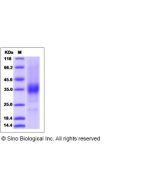
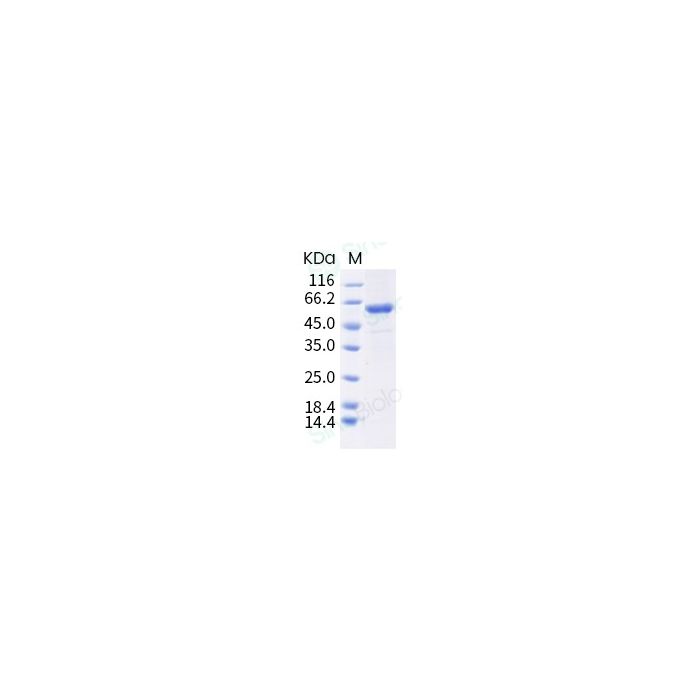
Purity> 90 % as determined by SDS-PAGE.
ActivityMeasured by its ability to cleave a fluorogenic substrate, 2'-(4-Methylumbelliferyl)-α-D-N-acetylneuraminic acid.
Protein ConstructionA DNA sequence encoding the Influenza B virus (B/Washington/02/2019) neuraminidase (translated amino acids of EPI1394969) (Leu32-Leu466) was expressed with a vasodilator-stimulated phosphoprotein tetramerization domain at the N-terminus and a polyhistidine tag at the C-terminus.
Accession#EPI1394969
Expressed HostBaculovirus-Insect Cells
SpeciesInfluenza B
Predicted N TerminalAsp
Molecule MassThe recombinant Influenza B virus (B/Washington/02/2019) NA consists of 481 amino acids and predicts a molecular mass of 53.6 kDa. It migrates as an approximately 59.5 kDa band in SDS-PAGE under reducing conditions.

Image / Experimental Information

Image 1 Alt TextInfluenza B Neuraminidase/NA Protein 32030
Image 1 URLSource image

Background Information

DescriptionNeuraminidases are enzymes that cleave sialic acid groups from glycoproteins. Influenza neuraminidase is a type of neuraminidase found on the surface of influenza viruses that enables the virus to be released from the host cell. Influenza neuraminidase is composed of four identical subunits arranged in a square. It is normally attached to the virus surface through a long protein stalk. The active sites are in a deep depression on the upper surface. They bind to polysaccharide chains and clip off the sugars at the end. The surface of neuraminidase is decorated with several polysaccharide chains that are similar to the polysaccharide chains that decorate our cell surface proteins. Neuraminidase (NA) and hemagglutinin (HA) are major membrane glycoproteins found on the surface of the influenza virus. Hemagglutinin binds to the sialic acid-containing receptors on the surface of host cells during initial infection and at the end of an infectious cycle. Neuraminidase, on the other hand, cleaves the HA-sialic acid bondage from the newly formed virions and the host cell receptors during budding. Neuraminidase thus is described as a receptor-destroying enzyme that facilitates virus release and efficient spread of the progeny virus from cell to cell. Influenza antibody and influenza antibodies are very important research tools for influenza diagnosis, influenza vaccine development, and anti-influenza virus therapy development. The monoclonal or polyclonal antibody can be raised with protein based antigen or peptide-based antigen. Antibodies raised with protein-based antigen could have better specificity and/or binding affinity than antibodies raised with peptide based antigen, but the cost associated with the recombinant protein antigen is usually higher. Anti-influenza virus hemagglutinin (HA) monoclonal antibody or polyclonal antibody can be used for ELISA assay, western blotting detection, Immunohistochemistry (IHC), flow cytometry, neutralization assay, hemagglutinin inhibition assay, and early diagnosis of influenza viral infection. Sino Biological has developed state-of-the-art monoclonal antibody development technology platforms: mouse monoclonal antibody and rabbit monoclonal antibody. Our rabbit monoclonal antibody platform is one of a kind and offers some unique advantages over mouse monoclonal antibodies, such as high affinity, low cross-reactivity with rabbit polyclonal antibodies.
References
  1. Sardet C., et al. ,(1989), Molecular cloning, primary structure, and expression of the human growth factor-activatable Na+/H+ antiporter. Cell 56:271-280.
  2. Sardet C., et al. , (1990), Growth factors induce phosphorylation of the Na+/H+ antiporter, glycoprotein of 110 kD.Science 247:723-726.
  3. Tse C.-M., et al. ,(1991), Molecular cloning and expression of a cDNA encoding the rabbit ileal villus cell basolateral membrane Na+/H+ exchanger.EMBO J. 10:1957-1967.

title: Development of an ELISA-Based Pulldown Approach for Functional Analysis of Antigen-Specific Antibodies
authors: Steventon Rebecca; Stolle Lucas; ...; Thompson Craig P
journal: bioRxiv
date: 2026-02-20
doi: 10.64898/2026.02.19.706726
cited_by_count: 0
techniques: Control; Enzyme-linked Immunosorbent Assay; Purification; Virus
bioz_score: 94

title: Single-domain antibodies directed against hemagglutinin and neuraminidase protect against influenza B viruses
authors: Arne Matthys; Jan Felix; ...; Xavier Saelens
journal: Nature Communications
date: 2025-07-01
pmid: 40593518
cited_by_count: 7
techniques: Construct; Enzyme-linked Immunosorbent Assay; Recombinant
bioz_score: 93

title: Binding antibody titers against the hemagglutinin and neuraminidase correlate with protection against medically attended influenza A and B disease
authors: Marios Koutsakos; Arnold Reynaldi; ...; Paul G. Thomas
journal: Journal of virology
date: 2025-06-01
pmid: 40358209
doi: 10.1128/jvi.00391-25
cited_by_count: 7
techniques: Blocking Assay; Clinical Proteomics; Enzyme-linked Immunosorbent Assay; Negative Control; Virus
bioz_score: 93

title: Baseline innate and T cell populations are correlates of protection against symptomatic influenza virus infection independent of serology
authors: Robert C. Mettelman; Aisha Souquette; ...; Paul G. Thomas
journal: Nature immunology
date: 2024-09-01
pmid: 37592015
doi: 10.1038/s41590-023-01590-2
pmcid: 10566627
cited_by_count: 63
techniques: Blocking Assay; Derivative Assay; Enzyme-linked Immunosorbent Assay; Incubation; Purification; Recombinant; Virus
bioz_score: 93

Reviews

Write Your Own Review
You're reviewing:Influenza B (B/Washington/02/2019) Neuraminidase / NA (His Tag) sinobiological 40790-V08B
Your Rating
Copyright © 2025 Biogege, Inc. All rights reserved.