Produced in rabbits immunized with E. coli-derived Human ADRA1B fragment, and purified by antigen affinity chromatography.
Source
Polyclonal Rabbit IgG
Purification
Protein A & Antigen Affinity
Formulation
PBS, pH7.0 with 0.03% Proclin300
Conjugate
Unconjugated
Form
Liquid
Shipping
This antibody is shipped as liquid solution at ambient temperature. Upon receipt, store it immediately at the temperature recommended below.
Storage
This antibody can be stored at 2℃-8℃ for one month without detectable loss of activity. Antibody products are stable for twelve months from date of receipt when stored at -20℃ to -80℃. Avoid repeated freeze-thaw cycles.
Adrenergic receptor α1 (ADRA1) receptor is classified into three different subtypes ADRA1A, ADRA1B and ADRA1D, that differ in their tissue distribution, cell signalling, pharmacology and physiological roles. ADRA1 receptors are ubiquitous in the majority of human tissues; ADRA1B is predominantly expressed on the cell surface, ADRA1A is mainly expressed on the cell surface and intracellularly, and ADRA1D is primarily localized perinuclear. It is well-known that ADRA1 is a member of the GPCR family, which interacts with a heterotrimeric G protein containing the Gαq/11/14/16 subunits. The Gαq subunit is the main activator of phospholipase CE, which promotes the cleavage of phosphatidylinositol-4,5-diphosphate into diacylglycerol and inositol-1,4,5-triphosphate. This subsequently promotes the release of Ca2+ from intracellular stores to activate protein kinase C (PKC).
References
Wang T, et al. (2019) The prognostic value of adra1 subfamily genes in gastric carcinoma. Oncol Lett 18 (3): 3150-3158.
Adefurin A, et al. (2017) Genetic variation in the alpha(1b)-adrenergic receptor and vascular response. Pharmacogenomics J 17 (4): 366-371.

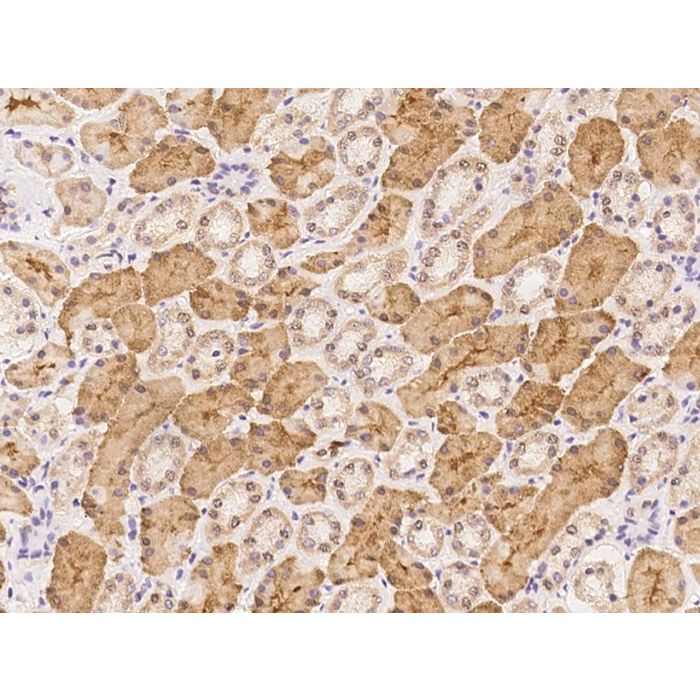

-HD13MA3045-100-human-kidney-IHC-P.png)
-HD13MA3045-100-human-breast-carcinoma-IHC-P.png)