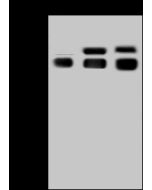
Recombinant Human EpCAM protein (Catalog#10694-H08H)
Preparation
This antibody was obtained from a rabbit immunized with purified, recombinant Human EpCAM / TROP1 (rh EpCAM; Catalog#10694-H08H; NP_002345.1; Met 1-Lys 265) and then biotinylated.
Source
Monoclonal Rabbit IgG Clone #28
Purification
Protein A
Formulation
0.2 μm filtered solution in PBS
Conjugate
Biotin
Form
Liquid
Shipping
This antibody is shipped as liquid solution at ambient temperature. Upon receipt, store it immediately at the temperature recommended below.
Storage
This antibody can be stored at 2℃-8℃ for one month without detectable loss of activity. Antibody products are stable for twelve months from date of receipt when stored at -20℃ to -80℃. Preservative-Free. Avoid repeated freeze-thaw cycles.
Epithelial Cell Adhesion Molecule (EpCAM), also known as GA733-2 antigen, is a type I transmembrane glycoprotein composed of an extracellular domain with two EGF-Like repeats and a cystenin-rich region, a transmembrane domain and a cytoplasmic domain. It modulates cell adhesion and proliferation. Its overexpression has been detected in many epithelial tumours and has been associated with high stage, high grade and a worse survival in some tumour types. EpCAM has been shown to function as a calcium-independent homophilic cell adhesion molecule that does not exhibit any obvious relationship to the four known cell adhesion molecule superfamilies. However, recent insights have revealed that EpCAM participates in not only cell adhesion, but also in proliferation, migration and differentiation of cells. In addition, recent study revealed that EpCAM is the Wnt-beta-catenin signaling target gene and may be used to facilitate prognosis. It has oncogenic potential and is activated by release of its intracellular domain, which can signal into the cell nucleus by engagement of elements of the wnt pathway.
Tags
Cancer Immunotherapy
Immune Checkpoint
Immunotherapy
Targeted Therapy
References
Brunner A, et al. (2008) EpCAM is predominantly expressed in high grade and advanced stage urothelial carcinoma of the bladder. J Clin Pathol. 61(3):307-10.
Trzpis M, et al. (2008) EpCAM in morphogenesis. Front Biosci. 13: 5050-5.
Munz M, et al. (2009) The emerging role of EpCAM in cancer and stem cell signaling. Cancer Res. 69(14): 5627-9.
Carpenter G, et al. (2009) EpCAM: another surface-to-nucleus missile. Cancer Cell. 15(3): 165-6.
title: A novel conditional active biologic anti-EpCAM x anti-CD3 bispecific antibody with synergistic tumor selectivity for cancer immunotherapy authors: Gerhard Frey; Ana Paula G. Cugnetti; ...; Jay M. Short journal: mAbs date: 2024-03-06 pmid: 38445633 doi: 10.1080/19420862.2024.2322562 pmcid: 10936661 cited_by_count: 13 techniques: Activation Assay; Binding Assay; Clone Assay; Concentration Assay; Expressing; Functional Assay; Generated; In Vitro; Incubation; Luciferase; Mutagenesis; Recombinant; Stable Transfection bioz_score: 92
title: IgG-like Bispecific Antibody CD3×EpCAM Generated by Split Intein Against Colorectal Cancer authors: Lei Wang; Yu Qiao; ...; Jianwei Zhu journal: Frontiers in Pharmacology date: 2022-02-23 pmid: 35281893 doi: 10.3389/fphar.2022.803059 pmcid: 8905292 cited_by_count: 8 techniques: Activation Assay; Activity Assay; Binding Assay; Comparison; Concentration Assay; Control; Cytotoxicity Assay; Expressing; Flow Cytometry; Generated; In Vitro; In Vivo; Incubation; Inhibition; Injection; Lactate Dehydrogenase Assay; SDS Page bioz_score: 92