Recombinant Mouse Factor IX/F9 Protein (Catalog#50362-M08H)
Preparation
Produced in rabbits immunized with purified, recombinant Mouse Factor IX/F9 (rM Factor IX/F9; Catalog#50362-M08H; P16294; Met1-Thr471). Factor IX/F9 specific IgG was purified by Mouse Factor IX/F9 affinity chromatography.
Source
Polyclonal Rabbit IgG
Purification
Protein A & Antigen Affinity
Formulation
PBS, pH7.0 with 0.03% Proclin300
Conjugate
Unconjugated
Form
Liquid
Shipping
This antibody is shipped as liquid solution at ambient temperature. Upon receipt, store it immediately at the temperature recommended below.
Storage
This antibody can be stored at 2℃-8℃ for one month without detectable loss of activity. Antibody products are stable for twelve months from date of receipt when stored at -20℃ to -80℃. Avoid repeated freeze-thaw cycles.
Synonyms: Anti-Cf-9 Antibody; Anti-Cf9 Antibody
Image / Experimental Information
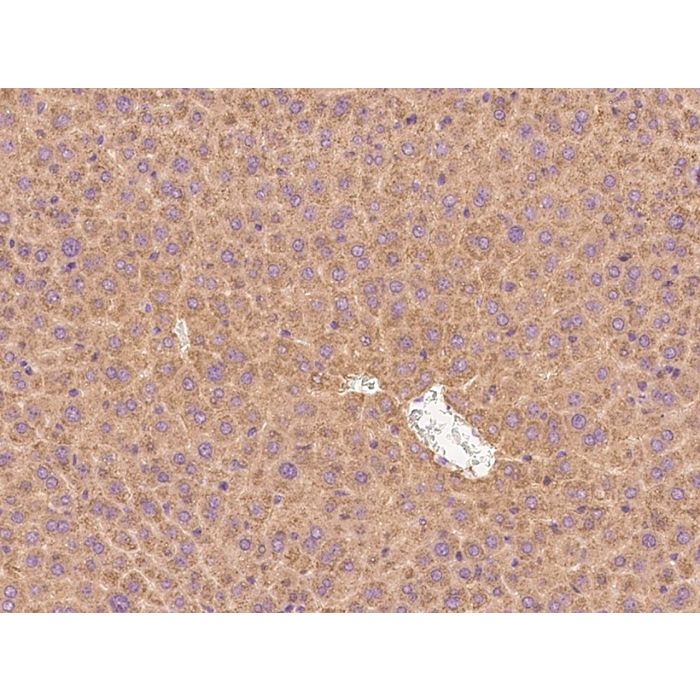
Image 1 Description
Immunochemical staining of mouse F9 in mouse liver with rabbit polyclonal antibody at 1:300 dilution, formalin-fixed paraffin embedded sections.
Coagulation factor IX, also known as Christmas factor, Plasma thromboplastin component and PTC, is a secreted protein which belongs to the peptidase S1 family. Coagulation factor IX / F9 contains two EGF-like domains, one Gla (gamma-carboxy-glutamate) domain and one?peptidase S1 domain. Coagulation factor IX / F9 is a vitamin K-dependent plasma protein that participates in the intrinsic pathway of blood coagulation by converting factor X to its active form in the presence of Ca ons, phospholipids, and factor VIIIa. Defects in Coagulation factor IX / F9 are the cause of thrombophilia due to factor IX defect which is a hemostatic disorder characterized by a tendency to thrombosis. Defects in Coagulation factor IX / F9 are also the cause of recessive X-linked hemophilia B ( HEMB ) which also known as Christmas disease.
References
Onay U.V., et al., 2003, Br. J. Haematol. 120:656-659.
Vidal F., et al., 2000, Br. J. Haematol. 111:549-551.
Simioni P., et al., 2009, N. Engl. J. Med. 361:1671-1675.
Espinos C., et al., 2009, Haematologica 88:235-236.

-HD12MY2530-300-mouse-liver-IHC-P.png)
-HD12MY2530-300-mouse-kidney-IHC-P.png)