Produced in rabbits immunized with E. coli-derived Human GOLPH2 / GOLM1 fragment, and purified by antigen affinity chromatography.
Source
Polyclonal Rabbit IgG
Purification
Protein A & Antigen Affinity
Formulation
PBS, pH7.0 with 0.03% Proclin300
Conjugate
Unconjugated
Form
Liquid
Shipping
This antibody is shipped as liquid solution at ambient temperature. Upon receipt, store it immediately at the temperature recommended below.
Storage
This antibody can be stored at 2℃-8℃ for one month without detectable loss of activity. Antibody products are stable for twelve months from date of receipt when stored at -20℃ to -80℃. Avoid repeated freeze-thaw cycles.
Golgi membrane protein 1, also known as Golgi membrane protein GP73, Golgi phosphoprotein 2, and GOLM1, is a protein that belongs to the GOLM1 / CASC4 family. GOLM1 is widely expressed. It is highly expressed in the colon, prostate, trachea, and stomach. It is expressed at a lower level in testis, muscle, lymphoid tissues, white blood cells, and spleen. It is predominantly expressed by cells of the epithelial lineage. GOLM1 is expressed at a low level in the normal liver. Expression significantly increases in virus (HBV, HCV) infected liver. Expression of GOLM1 does not increase in liver disease due to non-viral causes (alcohol-induced liver disease, autoimmune hepatitis). Increased expression in hepatocytes appears to be a general feature of advanced liver disease. In liver tissue from patients with adult giant-cell hepatitis (GCH), GOLM1 is strongly expressed in hepatocyte-derived syncytial giant cells. GOLM1 is constitutively expressed by biliary epithelial cells but not by hepatocytes.
References
Kladney R.D., et al. ,(2000), GP73, a novel Golgi-localized protein upregulated by viral infection. Gene 249:53-65.
Clark H.F., et al. , (2003), The secreted protein discovery initiative (SPDI), a large-scale effort to identify novel human secreted and transmembrane proteins: a bioinformatics assessment.Genome Res. 13:2265-2270.
Puri S., et al. ,(2002), Cycling of early Golgi proteins via the cell surface and endosomes upon lumenal pH disruption.Traffic 3:641-653.

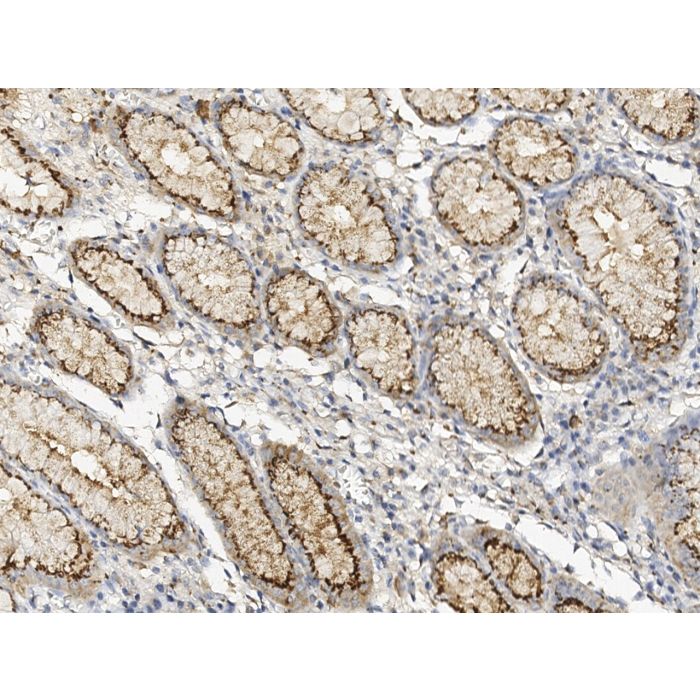

-HD14SE1128-100-human-stomach-IHC-P.png)
-HD14SE1128-100-human-gallbladder-IHC-P.png)
-HD14SE1128-200-A431-IF.png)