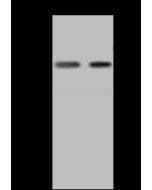
Recombinant Mouse Progranulin / Granulin Protein (Catalog#50396-M08H)
Preparation
This antibody was obtained from a rabbit immunized with purified, recombinant Mouse Progranulin / Granulin (rM Progranulin / Granulin; Catalog#50396-M08H; NP_032201.2; Met1-Leu589), and conjugated with horseradish-peroxidase (HRP).
Source
Monoclonal Rabbit IgG Clone #019
Purification
Protein A
Formulation
0.2 μm filtered solution in PBS
Conjugate
HRP
Form
Liquid
Shipping
This antibody is shipped as liquid solution at ambient temperature. Upon receipt, store it immediately at the temperature recommended below.
Storage
This antibody can be stored at 2℃-8℃ for one month without detectable loss of activity. Antibody products are stable for twelve months from date of receipt when stored at -20℃ to -80℃. Protected from prolonged exposure to light. Preservative-Free. Avoid repeated freeze-thaw cycles.
Granulins are a family of secreted, glycosylated peptides that are cleaved from a single precursor protein with 7.5 repeats of a highly conserved 12-cysteine granulin/epithelin motif. The precursor protein, progranulin, is also called Proepithelin and PC cell-derived growth factor. Cleavage of the signal peptide produces mature granulin which can be further cleaved into a variety of active, 6 kDa peptides. These smaller cleavage products are named granulin A, granulin B, granulin C, etc. Epithelins 1 and 2 are synonymous with granulins A and B, respectively. Both the peptides and intact granulin protein regulate cell growth. However, different members of the granulin protein family may act as inhibitors, stimulators, or have dual actions on cell growth. Granulin family members are important in normal development, wound healing, and tumorigenesis. Granulins have possible cytokine-like activity. They may play a role in inflammation, wound repair, and tissue remodeling. Granulin-4 promotes proliferation of the epithelial cell line A431 in culture while granulin-3 acts as an antagonist to granulin-4, inhibiting the growth. Granulin expression inhibited Tat transactivation, and tethering experiments showed that this effect was due, at least in part, to a direct action on cyclin T1 in the absence of Tat.
References
Hoque M, et al . (2003) The growth factor granulin interacts with cyclin T1 and modulates P-TEFb-dependent transcription. Mol Cell Biol. 23(5): 1688-702.
Bateman A, et al . (1990) Granulins, a novel class of peptide from leukocytes. Biochem Biophys Res Commun. 173(3): 1161-8.
Trinh DP, et al . (1999) Epithelin/granulin growth factors: extracellular cofactors for HIV-1 and HIV-2 Tat proteins. Biochem Biophys Res Commun. 256(2): 299-306.