Produced in rabbits immunized with E. coli-derived Human HIF-1 alpha/HIF1A fragment, and purified by antigen affinity chromatography.
Source
Polyclonal Rabbit IgG
Purification
Protein A & Antigen Affinity
Formulation
PBS, pH7.0 with 0.03% Proclin300
Conjugate
Unconjugated
Form
Liquid
Shipping
This antibody is shipped as liquid solution at ambient temperature. Upon receipt, store it immediately at the temperature recommended below.
Storage
This antibody can be stored at 2℃-8℃ for one month without detectable loss of activity. Antibody products are stable for twelve months from date of receipt when stored at -20℃ to -80℃. Avoid repeated freeze-thaw cycles.
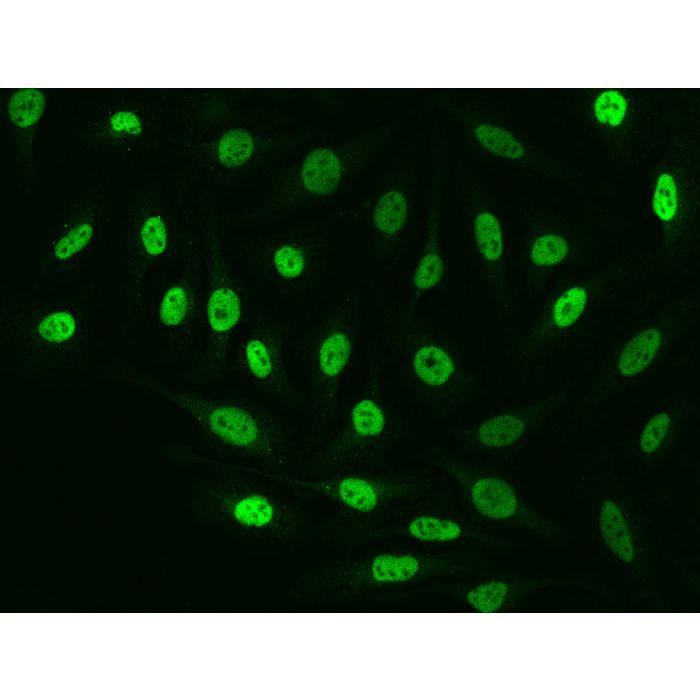
Immunofluorescence staining of HIF1A in HeLa(500uM CoCl for 24hr) cells. Cells were fixed with 4% PFA, permeabilzed with 0.1% Triton X-100 in PBS,blocked with 10% serum, and incubated with rabbit anti-Human HIF1A polyclonal antibody (dilution ratio 1:200) at 4℃ overnight. Then cells were stained with the Alexa Fluor®488-conjugated Goat Anti-rabbit IgG secondary antibody (green). Positive staining was localized to Nucleus.
HIF-1 alpha, also known as HIF1A, contains 1 basic helix-loop-helix (bHLH) domain, 1 PAC (PAS-associated C-terminal) domain, and 2 PAS (PER-ARNT-SIM) domains. It is one of the two subunits of Hypoxia-inducible factor-1 (HIF1). HIF1 is a transcription factor found in mammalian cells cultured under reduced oxygen tension that plays an essential role in cellular and systemic homeostatic responses to hypoxia. HIF1 is a heterodimer composed of an alpha subunit and a beta subunit. The beta subunit has been identified as the aryl hydrocarbon receptor nuclear translocator (ARNT). HIF-1 alpha is expressed in most tissues with the highest levels in the kidney and heart. It is overexpressed in the majority of common human cancers and their metastases, due to the presence of intratumoral hypoxia and as a result of mutations in genes encoding oncoproteins and tumor suppressors. HIF-1 alpha functions as a master transcriptional regulator of the adaptive response to hypoxia. Under hypoxic conditions, it activates the transcription of over 40 genes, including erythropoietin, glucose transporters, glycolytic enzymes, vascular endothelial growth factor, HILPDA, and other genes whose protein products increase oxygen delivery or facilitate metabolic adaptation to hypoxia. HIF1A plays an essential role in embryonic vascularization, tumor angiogenesis, and the pathophysiology of ischemic disease. HIF-1 alpha binds to core DNA sequence 5'-[AG]CGTG-3' within the hypoxia response element (HRE) of target gene promoters. Activation requires the recruitment of transcriptional coactivators such as CREBPB and EP300.
Research Areas
Cancer Drug Targets
Related Pathways
p53 Pathway
References
Zhou Q, et al. (2011) Loss of either hypoxia inducible factor 1 or 2 promotes lung cancer cell colonization. Cell Cycle. 10(13):2233-4.
Krishnan J, et al. (2012) Dietary obesity-associated Hif1 alpha activation in adipocytes restricts fatty acid oxidation and energy expenditure via suppression of the Sirt2-NAD+ system. Genes Dev. 26(3):259-70.
Novo E, et al. (2012) The biphasic nature of hypoxia-induced directional migration of activated human hepatic stellate cells. J Pathol. 226(4):588-97.
Dungwa JV, et al. (2011) Overexpression of carbonic anhydrase and HIF-1 in Wilms tumours. BMC Cancer. 11:390.


-HD12NO0205-200-HeLa(500uM CoCl for 24hr)-IF.png)