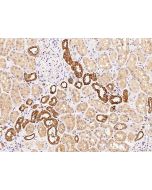
Recombinant Human HPGD / 15-PGDH protein (Catalog#11205-H08E)
Preparation
This antibody was obtained from a rabbit immunized with purified, recombinant Human HPGD / 15-PGDH (rh HPGD / 15-PGDH; Catalog#11205-H08E; NP_000851.2; Met1-Gln266) and conjugated with FITC under optimum conditions, the unreacted FITC was removed.
Source
Monoclonal Rabbit IgG Clone #016
Purification
Protein A
Formulation
PBS solution containing 0.5% BSA and 0.09% sodium azide
Concentration
5 μl/Test, 0.1 mg/ml
Conjugate
FITC
Form
Liquid
Shipping
This antibody is shipped as liquid solution at ambient temperature. Upon receipt, store it immediately at the temperature recommended below.
Storage
This antibody can be stored at 2℃-8℃ for twelve months without detectable loss of activity. Protected from prolonged exposure to light. Do not freeze ! Sodium azide is toxic to cells and should be disposed of properly. Flush with large volumes of water during disposal.
15-hydroxyprostaglandin dehydrogenase [NAD+], also known as Prostaglandin dehydrogenase 1, HPGD, and PGDH1, is a member of the short-chain dehydrogenases/reductases (SDR) family. Prostaglandins (PGs) play a key role in the onset of labor in many species and regulate uterine contractility and cervical dilatation. Therefore, the regulation of prostaglandin output by PG synthesizing and metabolizing enzymes in the human myometrium may determine uterine activity patterns in human labor both at preterm and at term. Prostaglandin dehydrogenase (PGDH) metabolizes prostaglandins (PGs) to render them inactive. HPGD is down-regulated by cortisol, dexamethasone, and betamethasone and down-regulated in colon cancer. It is up-regulated by TGFB1. HPGD contributes to the regulation of events that are under the control of prostaglandin levels. HPGD catalyzes the NAD-dependent dehydrogenation of lipoxin A4 to form 15-oxo-lipoxin A4. and inhibits in vivo proliferation of colon cancer cells. Defects in HPGD are the cause of primary hypertrophic osteoarthropathy autosomal recessive (PHOAR), cranio-osteoarthropathy (COA), and isolated congenital nail clubbing.
References
Patel, FA. et al., 2003, J. Clin. Endocrinol. Metab. 88: 2922-33.
McKeown KJ, et al.,2003, J. Clin. Endocrinol. Metab. 88 (4): 1737-41.
Yan, M. et al., 2004, Proc. Natl. Acad. Sci. USA. 101: 17468-73.
Tariq, M. et al., 2009, J Med Genet. 46 (1): 14-20.