Recombinant Human ADAM12 protein (Catalog#10896-H08H)
Preparation
This antibody was obtained from a rabbit immunized with purified, recombinant Human ADAM12 (rh ADAM12; Catalog#10896-H08H; NP_003465.3; Met1-Ser513).
Source
Monoclonal Rabbit IgG Clone #737
Purification
Protein A
Formulation
0.2 μm filtered solution in PBS
Conjugate
Unconjugated
Form
Liquid
Shipping
This antibody is shipped as liquid solution at ambient temperature. Upon receipt, store it immediately at the temperature recommended below.
Storage
This antibody can be stored at 2℃-8℃ for one month without detectable loss of activity. Antibody products are stable for twelve months from date of receipt when stored at -20℃ to -80℃. Preservative-Free. Avoid repeated freeze-thaw cycles.
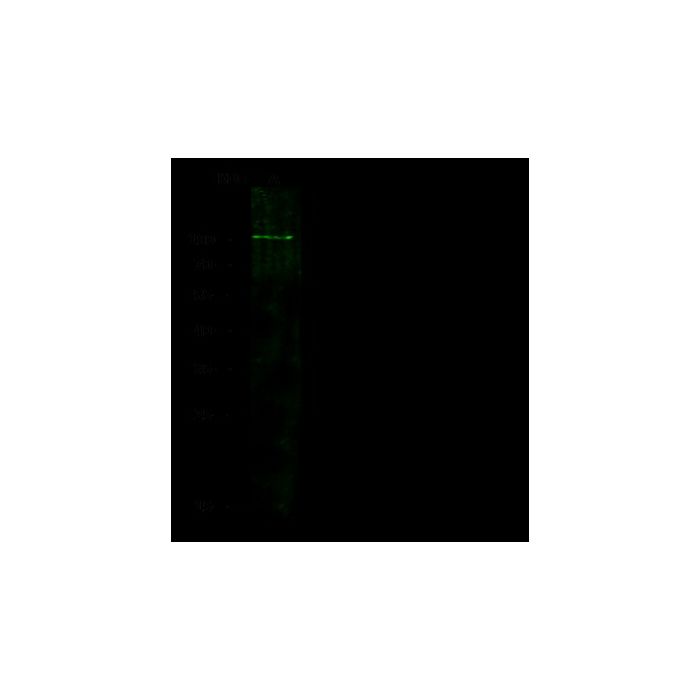
Anti-ADAM12 rabbit monoclonal antibody at 1:500 dilution Lane A: A431 Whole Cell Lysate Lysates/proteins at 30 μg per lane. Secondary Goat Anti-Rabbit IgG H&L (Dylight800) at 1/10000 dilution. Developed using the Odyssey technique. Performed under reducing conditions. Predicted band size:100 kDa Observed band size:100 kDa
The ADAMs (a disintegrin and metalloprotease) comprise a family of multidomain proteins with metalloprotease, cell adhesion, and signaling activities. Human ADAM12, which is implicated in diseases such as cancer, is expressed in two splice forms, the transmembrane ADAM12-L and the shorter and soluble ADAM12-S. ADAM12, also known as and Meltrin alpha, is a member of the ADAM protein family, which contains one disintegrin domain, one EGF-like domain and one peptidase M12B domain. ADAM12 is synthesized as a zymogen with the prodomain keeping the metalloprotease inactive through a cysteine-switch mechanism. Maturation and activation of the protease involves the cleavage of the prodomain in the trans-Golgi or possibly at the cell surface by a furin-peptidase. It is a membrane-anchored metalloprotease, which has been implicated in activation-inactivation of growth factors that play an important role in wound healing, including heparin-binding epidermal growth factor (EGF)-like growth factor (HB-EGF) and IGF binding proteins. ADAM12 may also regulate cell-cell and cell-extracellular matrix contacts through interactions with cell surface receptors - integrins and syndecans - potentially influencing the actin cytoskeleton. Moreover, ADAM12 interacts with several cytoplasmic signaling and adaptor molecules through its intracellular domain, thereby directly transmitting signals to or from the cell interior. These ADAM12-mediated cellular effects appear to be critical events in both biological and pathological processes. In addition to protease activity, ADAM12 possesses cell binding and cell signaling properties. In many studies, ADAM12 overexpression has been correlated with disease, and ADAM12 has been shown to promote tumor growth and progression in cancer. On the other hand, protective effects of ADAM12 in disease have also been reported.
Related Pathways
Notch Signaling
Actin Dynamics Signaling Pathway
MAPK-Erk Pathway
Autophagy Pathway
References
Wewer UM, et al. (2006) ADAM12 is a four-leafed clover: the excised prodomain remains bound to the mature enzyme. J Biol Chem. 281(14): 9418-22.
Kveiborg M, et al. (2008) Cellular roles of ADAM12 in health and disease. Int J Biochem Cell Biol. 40(9): 1685-702.
Harsha A, et al. (2008) ADAM12: a potential target for the treatment of chronic wounds. J Mol Med. 86(8): 961-9.
Jacobsen J, et al. (2009) Targeting ADAM12 in human disease: head, body or tail? Curr Pharm Des. 15(20): 2300-10.
Baertling F, et al. (2010) ADAM12 is expressed by astrocytes during experimental demyelination. Brain Res. 1326: 1-14.