Recombinant Human AKR1B1 Protein (Catalog#11294-H07E)
Preparation
This antibody was obtained from a rabbit immunized with purified, recombinant Human AKR1B1 (rh AKR1B1; Catalog#11294-H07E; P15121; Met1-Phe316).
Source
Monoclonal Rabbit IgG Clone #101
Purification
Protein A
Formulation
0.2 μm filtered solution in PBS
Conjugate
Unconjugated
Form
Liquid
Shipping
This antibody is shipped as liquid solution at ambient temperature. Upon receipt, store it immediately at the temperature recommended below.
Storage
This antibody can be stored at 2℃-8℃ for one month without detectable loss of activity. Antibody products are stable for twelve months from date of receipt when stored at -20℃ to -80℃. Preservative-Free. Avoid repeated freeze-thaw cycles.
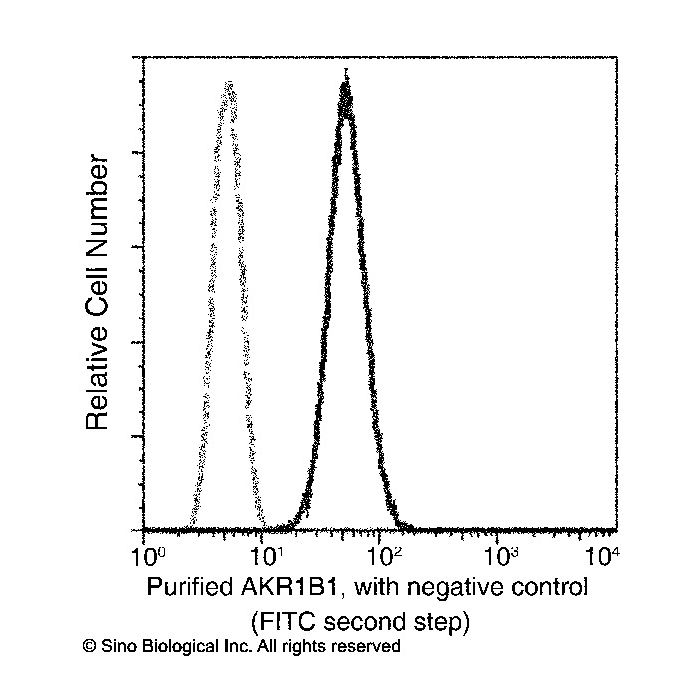
Flow cytometric analysis of Human AKR1B1 expression on HeLa cells. The cells were treated according to manufacturer’s manual (BD Pharmingen™ Cat. No. 554714), stained with purified anti-Human AKR1B1, then a FITC-conjugated second step antibody. The fluorescence histograms were derived from gated events with the forward and side light-scatter characteristics of intact cells.
aldo-keto reductase family 1, member B1 (aldose reductase)
Description
Aldose reductase (AKR1B1) belongs to the aldo/keto reductase superfamily. AKR1B1 is a NADPH-dependent aldo-keto reductase best known as the rate-limiting enzyme of the polyol pathway. Expression of AKR1B1 was the highest in lens and retina. It is the first enzyme in the polyol pathway through which glucose is converted to sorbitol which is important for the function of various organs in the body, and has been implicated in the etiology of diabetic complications. AKR1B1 is quite abundant in the collecting tubule cells and thought to provide protection against hypertonic environment. Some human tissues contain AKR1B1 as well as AKR1B10, a closely related member of the aldo-keto reductase superfamily.
References
Huang SP, et al . (2010) Aldo-Keto Reductases in the Eye. Journal of Ophthalmology. 326 (3): 625-36.
Aida K, et al . (2000) Disruption of Aldose Reductase Gene (Akr1b1) Causes Defect in Urinary Concentrating Ability and Divalent Cation Homeostasis. Biochemical and Biophysical Research Communications.277 (2): 281-6.
Liao CS, et al . (2009) Regulation of AKR1B1 by thyroid hormone and its receptors. Molecular and Cellular Endocrinology. 307 (1-2): 109-17.
Baba SP, et al . (2009) Posttranslational glutathiolation of aldose reductase (AKR1B1): A possible mechanism of protein recovery from S-nitrosylation. Chemico-Biological Interactions. 178 (1-3): 250-8.