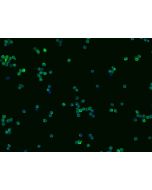
Recombinant Human Angiopoietin-2 / ANG 2 protein (Catalog#10691-H08H)
Preparation
Produced in rabbits immunized with purified, recombinant Human Angiopoietin-2 / ANG 2 (rh Angiopoietin-2 / ANG 2; Catalog#10691-H08H; NP_001138.1; Met 1-Phe 496). Total IgG was purified by Protein A affinity chromatography.
Source
Polyclonal Rabbit IgG
Purification
Protein A
Formulation
0.2 μm filtered solution in PBS
Conjugate
Unconjugated
Form
Liquid
Shipping
This antibody is shipped as liquid solution at ambient temperature. Upon receipt, store it immediately at the temperature recommended below.
Storage
This antibody can be stored at 2℃-8℃ for one month without detectable loss of activity. Antibody products are stable for twelve months from date of receipt when stored at -20℃ to -80℃. Preservative-Free. Avoid repeated freeze-thaw cycles.
Anti-Ang2 rabbit polyclonal antibody at 1:500 dilution Lane A: HepG2 Whole Cell Lysate Lane B: A549 Whole Cell Lysate Lysates/proteins at 30 μg per lane. Secondary Goat Anti-Rabbit IgG H&L (Dylight800) at 1/10000 dilution. Developed using the Odyssey technique. Performed under reducing conditions. Predicted band size:57 kDa Observed band size:70 kDa
Angiopoietin-2 (ANG 2, or ANGPT2), is a member of the ANG family, which plays an important role in angiogenesis during the development and growth of human cancers. Both ANGPT-1 and ANGPT-2 appear to bind to the tyrosine kinase receptor, Tie-2, found primarily on the luminal surface of endothelial cells. ANG-2's role in angiogenesis generally is considered as an antagonist for ANG1, inhibiting ANG1-promoted Tie2 signaling, which is critical for blood vessel maturation and stabilization. ANG-2 modulates angiogenesis in a cooperative manner with another important angiogenic factor, vascular endothelial growth factor A. Genetic studies have revealed that ANG-2 also is critical in lymphangiogenesis during development. ANG-2 has multiple physiologic effects that regulate vascular tone, hormone secretion, tissue growth and neural activity. Several reports indicate that ANG-2 can induce neovascularization in experimental systems due to the expression of different growth factors such as angiopoietin 2, vascular endothelial factor, and its receptor, fibroblast growth factor, platelet derived growth factor, transforming growth factor beta and epidermal growth factor. In addition, ANG-2 is strongly expressed in the vasculature of many tumors and it has been suggested that ANG-2 may act synergistically with other cytokines such as vascular endothelial growth factor to promote tumor-associated Angiogenesis and tumor progression.
Research Areas
Cancer Drug Targets
References
Thomas M, et al. (2009) The role of the Angiopoietins in vascular morphogenesis. Angiogenesis. 12(2): 125-37.
Hu B, et al. (2009) Angiopoietin-2: development of inhibitors for cancer therapy. Curr Oncol Rep. 11(2): 111-6.
Fiedler U, et al. (2006) Angiopoietins: a link between angiogenesis and inflammation. Trends Immunol. 27: 552-8.
Escobar E, et al. (2004) Angiotensin II, cell proliferation and angiogenesis regulator: biologic and therapeutic implications in cancer. Curr Vasc Pharmacol. 2(4): 385-99.