Beta-Actin Loading Control Antibody, Chimeric Rabbit MAb
Validated applications
WB (FAQ Protocol), IP (FAQ Protocol)
Species reactivity
Reacts with: Human
Specificity
Human beta-Actin
Immunogen
A synthetic peptide corresponding to the N-terminus of the Human beta Actin / ACTB
Preparation
It is a chimeric monoclonal antibody combining the constant domains of the rabbit IgG molecule with mouse variable regions. The variable region was obtained from a mouse immunized with A synthetic peptide corresponding to the N-terminus of the Human beta Actin / ACTB. The antibody was produced using recombinant antibody technology.
Source
Monoclonal Rabbit IgG Clone #10
Purification
Protein A
Formulation
0.2 μm filtered solution in PBS
Conjugate
Unconjugated
Form
Liquid
Shipping
This antibody is shipped as liquid solution at ambient temperature. Upon receipt, store it immediately at the temperature recommended below.
Storage
This antibody can be stored at 2℃-8℃ for one month without detectable loss of activity. Antibody products are stable for twelve months from date of receipt when stored at -20℃ to -80℃. Preservative-Free. Avoid repeated freeze-thaw cycles.
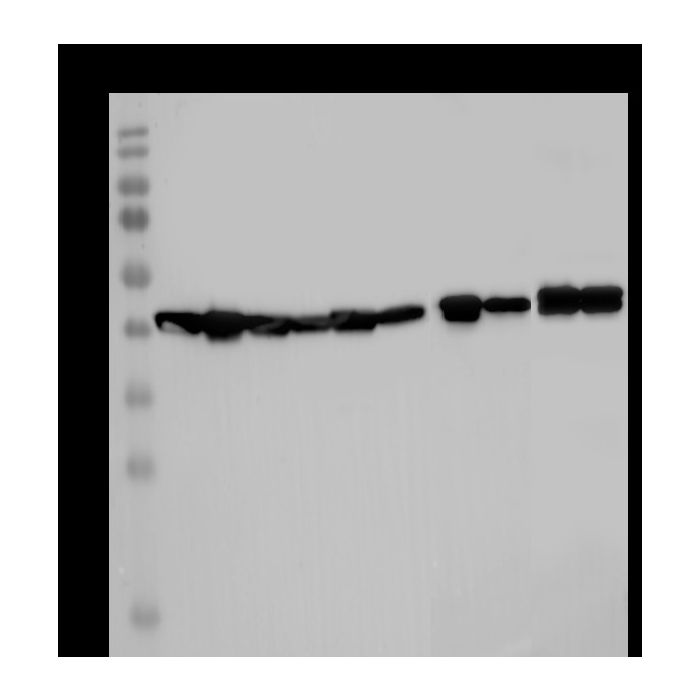
Anti-beta-Actin rabbit monoclonal antibody at 1:20000 dilution Lane A: Jurkat Whole Cell Lysate Lane B: HeLa Whole Cell Lysate Lane C: HepG2 Whole Cell Lysate Lane D: A549 Whole Cell Lysate Lane E: Mouse brain tissue lysate Lane F: Mouse skeletal muscle tissue lysate Lane G: Mouse kidney tissue lysate Lane H: Rat brain tissue lysate Lane I: Rat lung tissue lysate Lane J: Rat kidney tissue lysate Lysates/proteins at 30 μg per lane. Secondary Goat Anti-Rabbit IgG (H+L)/HRP at 1/10000 dilution. Developed using the ECL technique. Performed under reducing conditions. Predicted band size:42 kDa Observed band size:42 kDa
Anti-beta-Actin rabbit monoclonal antibody at 1:20000 dilution Lane A: Jurkat Whole Cell Lysate Lane B: HeLa Whole Cell Lysate Lane C: HepG2 Whole Cell Lysate Lane D: A549 Whole Cell Lysate Lane E: Mouse brain tissue lysate Lane F: Mouse skeletal muscle tissue lysate Lane G: Mouse kidney tissue lysate Lane H: Rat brain tissue lysate Lane I: Rat lung tissue lysate Lane J: Rat kidney tissue lysate Lysates/proteins at 30 μg per lane. Secondary Goat Anti-Rabbit IgG (H+L)/HRP at 1/10000 dilution. Developed using the ECL technique. Performed under reducing conditions. Predicted band size:42 kDa Observed band size:42 kDa
ACTB (Actin Beta) is a Protein Coding gene. Diseases associated with ACTB include Dystonia, Juvenile-Onset and Baraitser-Winter Syndrome 1. Among its related pathways are Salivary secretion and Development Slit-Robo signaling. Gene Ontology (GO) annotations related to this gene include identical protein binding and RNA polymerase II proximal promoter sequence-specific DNA binding. An important paralog of this gene is ACTG1. TUBB, HPRT and ACTB were the most stably expressed genes for all analysis groups across meningioma and non-pathological meningeal tissue combined. ACTB, a significant upregulated gene in abdominal aortic aneurysm samples, could be regulated by CLIC4, which was significantly enriched in cell motions. Dystonia-deafness syndrome is a well-known clinical entity, with sensorineural deafness typically manifesting earlier than dystonia. ACTB p.Arg183Trp heterozygosity has been reported in six patients to cause combined infant-onset deafness and dystonia manifesting in adolescence or young adulthood.
title: LncRNA PELATON regulates Th2 cell differentiation by miR-10b-5p/GATA3 axis in allergic rhinitis authors: Zhen Liu; Yumei Li; ...; Xicheng Song journal: The World Allergy Organization Journal date: 2025-09-01 doi: 10.1016/j.waojou.2025.101108 cited_by_count: 0 techniques: Incubation; Protein Extraction; Western Blot bioz_score: 93
title: Downregulation of exosomal miR-let-7e-5p induces macrophage M2 polarization by targeting Rictor/AKT1 signal pathway in brucellosis patients authors: Shuling Li; Xiaoyu Zhu; ...; Zhiwei Li journal: European Journal of Medical Research date: 2025-07-09 doi: 10.1186/s40001-025-02867-y cited_by_count: 0 techniques: Activity Assay; BIA-KA; Binding Assay; Cell Culture; Control; Electrophoresis; Expressing; Imaging; Incubation; Luciferase; Lysis; Membrane; Quantitative RT-PCR; Reporter Assay; SDS Page; Transfection; Western Blot bioz_score: 93
title: Qian Yang Yu Yin Granule-containing serum inhibits angiotensin II-induced proliferation, reactive oxygen species production, and inflammation in human mesangial cells via an NADPH oxidase 4-dependent pathway authors: Kang Ding; Yan Wang; ...; Zhuyuan Fang journal: BMC Complementary and Alternative Medicine date: 2015-03-25 pmid: 25886843 doi: 10.1186/s12906-015-0619-2 pmcid: 4387585 cited_by_count: 14 techniques: Incubation; Software; Western Blot bioz_score: 93


-HA18JU1202-WB.png)
