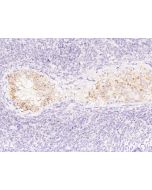
Recombinant Human beta-Catenin / CTNNB1 protein (Catalog#11279-H20B)
Preparation
Produced in rabbits immunized with purified, recombinant Human beta-Catenin / CTNNB1 (rh CTNNB1; Catalog#11279-H20B; P35222-1; Met1-Leu781). Total IgG was purified by Protein A affinity chromatography.
Source
Polyclonal Rabbit IgG
Purification
Protein A
Formulation
0.2 μm filtered solution in PBS
Conjugate
Unconjugated
Form
Liquid
Shipping
This antibody is shipped as liquid solution at ambient temperature. Upon receipt, store it immediately at the temperature recommended below.
Storage
This antibody can be stored at 2℃-8℃ for one month without detectable loss of activity. Antibody products are stable for twelve months from date of receipt when stored at -20℃ to -80℃. Preservative-Free. Avoid repeated freeze-thaw cycles.
beta-Catenin, also known as CTNNB1, is a member of the armadillo family of proteins. These proteins have multiple copies of the so-called armadillo repeat domain, which is specialized for protein-protein binding. It is part of a complex of proteins that constitute adherens junctions (AJs). AJs are necessary for the creation and maintenance of epithelial cell layers by regulating cell growth and adhesion between cells. CTNNB1 also anchors the actin cytoskeleton and may be responsible for transmitting the contact inhibition signal that causes cells to stop dividing once the epithelial sheet is complete. Finally, beta-Catenin binds to the product of the APC gene, which is mutated in adenomatous polyposis of the colon. Defects in beta-Catenin can cause colorectal cancer, pilomatrixoma (PTR), medulloblastoma, and ovarian cancer. CTNNB1 is a key dowstream component of the canonical Wnt signaling pathway. In the absence of Wnt, it forms a complex with AXIN1, AXIN2, APC, CSNK1A1 and GSK3B that promotes phosphorylation on N-terminal Ser and Thr residues and ubiquitination of CTNNB1 via BTRC and its subsequent degradation by the proteasome. In the presence of Wnt ligand, beta-Catenin is not ubiquitinated and accumulates in the nucleus, where it acts as a coactivator for transcription factors of the TCF/LEF family, leading to activate Wnt responsive genes. CTNNB1 is involved in the regulation of cell adhesion. The majority of beta-catenin is localized to the cell membrane and is part of E-cadherin/catenin adhesion complexes which are proposed to couple cadherins to the actin cytoskeleton.
Related Pathways
Canonical Wnt Pathway
EGFR Signaling Pathway
Non-Canonical Wnt Pathway
References
Yang, et al. (2002) Linking β-catenin to androgen-signaling pathway. J Biol Chem. 277(13):11336-44.
Hino S, et al. (2005) Phosphorylation of β-Catenin by Cyclic AMP-Dependent Protein Kinase Stabilizes β-Catenin through Inhibition of Its Ubiquitination. Mol Cell Biol. 25(20):9063-72.
Liu X, et al. (2005) Rapid, Wnt-induced changes in GSK3beta associations that regulate beta-catenin stabilization are mediated by Galpha proteins. Curr Biol. 15(22):1989-97.
Kraus C, et al. (1994) Localization of the human β-catenin gene (CTNNB1) to 3p21: a region implicated in tumor development. Genomics. 23(1):272-4.