Recombinant Human ALK-6 / BMPR1B Protein (Catalog#10460-H20B)
Preparation
Produced in rabbits immunized with purified, recombinant Human ALK-6 / BMPR1B (rh ALK-6 / BMPR1B; Catalog#10460-H20B; NP_001194.1; Arg149-Leu502). ALK-6 / BMPR1B specific IgG was purified by Human ALK-6 / BMPR1B affinity chromatography.
Source
Polyclonal Rabbit IgG
Purification
Protein A & Antigen Affinity
Formulation
0.2 μm filtered solution in PBS
Conjugate
Unconjugated
Form
Liquid
Shipping
This antibody is shipped as liquid solution at ambient temperature. Upon receipt, store it immediately at the temperature recommended below.
Storage
This antibody can be stored at 2℃-8℃ for one month without detectable loss of activity. Antibody products are stable for twelve months from date of receipt when stored at -20℃ to -80℃. Preservative-Free. Avoid repeated freeze-thaw cycles.
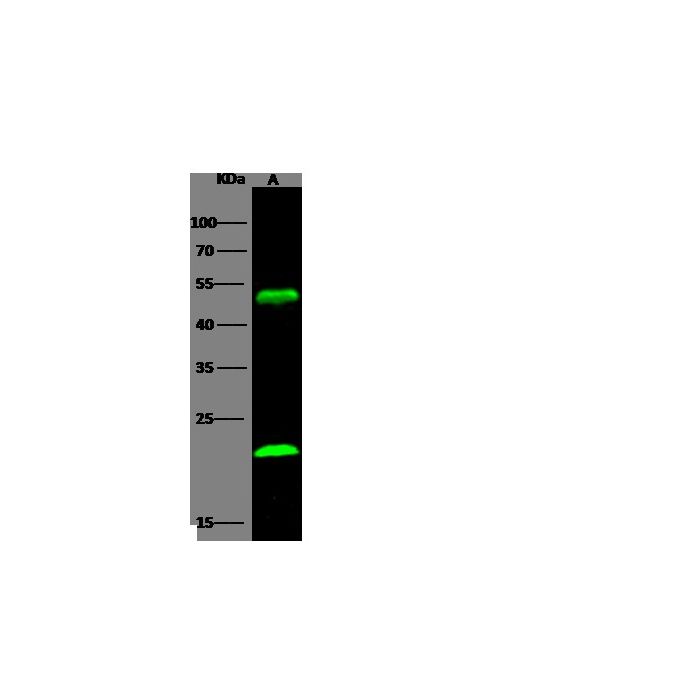
Anti-ALK6(149-502) rabbit polyclonal antibody at 1:500 dilution Lane A: U87MG Whole Cell Lysate Lysates/proteins at 30 μg per lane. Secondary Goat Anti-Rabbit IgG H&L (Dylight800) at 1/10000 dilution. Developed using the Odyssey technique. Performed under reducing conditions. Predicted band size:57 kDa Observed band size:50 kDa (We are unsure as to the identity of these extra bands.)
BMPR1B(bone morphogenetic protein receptor, type IB), also known as ALK6, is a member of the bone morphogenetic protein (BMP) receptor family. BMPs are involved in endochondral bone formation and embryogenesis. These proteins transduce their signals through the formation of heteromeric complexes of 2 different types of serine (threonine) kinase receptors: type I receptors of about 50-55 kD and type II receptors of about 70-80 kD. Type II receptors bind ligands in the absence of type I receptors, but they require their respective type I receptors for signaling, whereas type I receptors require their respective type II receptors for ligand binding. BMPR1B is the major transducer of signals in precartilaginous condensations as demonstrated in experiments using constitutively active BMPR1B receptors. BMPR1B is a more effective transducer of GDF5 than BMPR1A. Unlike BMPR1A null mice, which die at an early embryonic stage, BMPR1B null mice are viable.
References
Ide H, et al. (1998) Assignment of the BMPR1A and BMPR1B genes to human chromosome 10q22.3 and 4q23--q24 byin situ hybridization and radiation hybrid map ping. Cytogenet. Cell Genet. 81(3-4): 285-6.
Mishina Y, et al. (2004) Bone morphogenetic protein type IA receptor signaling regulates postnatal osteoblast function and bone remodeling. J Biol Chem. 279(26): 27560-6.
Yoon BS, et al. (2005) Bmpr1a and Bmpr1b have overlapping functions and are essential for chondrogenesis in vivo. Proc Natl Acad Sci. 102(14): 5062-7.


-pAb(A)-HB08AU2935-WB.png)