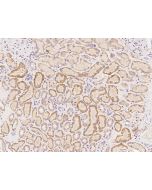
Recombinant Human Complement Component C2 Protein (Catalog#10154-H08H)
Preparation
This antibody was produced from a hybridoma resulting from the fusion of a mouse myeloma with B cells obtained from a mouse immunized with purified, recombinant Human Complement Component C2 (rh Complement Component C2; Catalog#10154-H08H; NP_000054.2; Met1-Leu752). The IgG fraction of the cell culture supernatant was purified by Protein A affinity chromatography.
Source
Monoclonal Mouse IgG1 Clone #06
Purification
Protein A
Formulation
0.2 μm filtered solution in PBS
Conjugate
Unconjugated
Form
Liquid
Shipping
This antibody is shipped as liquid solution at ambient temperature. Upon receipt, store it immediately at the temperature recommended below.
Storage
This antibody can be stored at 2℃-8℃ for one month without detectable loss of activity. Antibody products are stable for twelve months from date of receipt when stored at -20℃ to -80℃. Preservative-Free. Avoid repeated freeze-thaw cycles.
Synonyms: Anti-ARMD14 Antibody; Anti-CO2 Antibody
Background Information
Full Name
complement component 2
Description
Complement component C2 is part of the classical complement pathway which plays a major role in innate immunity against infection. C2 is a glycoprotein synthesized in liver hepatocytes and several other cell types in extrahepatic tissues. This pathway is triggered by a multimolecular complex C1, and subsequently the single-chain form of C2 is cleaved into two chains referred to C2a and C2b by activated C1. The second component of complement (C2) is a multi-domain serine protease that provides catalytic activity for the C3 and C5 convertases of the classical and lectin pathways of human complement. C4b and C2 was investigated by surface plasmon resonance. C2a containing a serine protease domain combines with complement component C4b to form the C3 convertase C4b2a which is responsible for C3 activation, and leads to the stimulation of adaptive immune responses via Lectin pathway. C2 bound to C4b is cleaved by classical (C1s) or lectin (MASP2) proteases to produce C4bC2a. C2 has the same serine protease domain as C4bC2a but in an inactive zymogen-like conformation, requiring cofactor-induced conformational change for activity. Deficiency of C2 (C2D) is the most common genetic deficiency of the complement system, and two types of C2D have been recognized in the context of specific MHC haplotypes. C2D in human is reported to increase susceptibility to infection, and is associated with certain autoimmune diseases, such as rheumatological disorders.
Research Areas
Serine Proteases and Regulators
Related Pathways
Complement Activation Pathways
References
Laich A, et al. (2002) Complement C4bC2 complex formation: an investigation by surface plasmon resonance. Biochim Biophys Acta. 1544(1-2): 96-112.
Halili MA, et al. (2009) Complement component C2, inhibiting a latent serine protease in the classical pathway of complement activation. Biochemistry. 48(35): 8466-72.
Krishnan V, et al. (2009) The structure of C2b, a fragment of complement component C2 produced during C3 convertase formation. Acta Crystallogr D Biol Crystallogr. 65(Pt 3): 266-74.