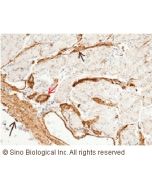
Human Cadherin-17 No cross-reactivity in ELISA with Human Cadherin-5 Human Cadherin-8 Human E-Cadherin Human cell lysate (293 cell line)
Immunogen
Recombinant Human CDH17 / Cadherin-17 Protein (Catalog#11360-H08H)
Preparation
This antibody was produced from a hybridoma resulting from the fusion of a mouse myeloma with B cells obtained from a mouse immunized with purified, recombinant Human CDH17 / Cadherin-17 (rh CDH17 / Cadherin-17; Catalog #11360-H08H; Met 1-Met 787; Q12864-1). The IgG fraction of the cell culture supernatant was purified by Protein A affinity chromatography.
Source
Monoclonal Mouse IgG2a Clone #4F6H5
Purification
Protein A
Formulation
0.2 μm filtered solution in PBS
Conjugate
Unconjugated
Form
Liquid
Shipping
This antibody is shipped as liquid solution at ambient temperature. Upon receipt, store it immediately at the temperature recommended below.
Storage
This antibody can be stored at 2℃-8℃ for one month without detectable loss of activity. Antibody products are stable for twelve months from date of receipt when stored at -20℃ to -80℃. Preservative-Free. Avoid repeated freeze-thaw cycles.
Cadherin-17 or LI-cadherin is a member of the cadherin superfamily, genes encoding calcium-dependent, membrane-associated glycoproteins. Cadherin-17/LI-cadherin is a cadherin-like protein consisting of an extracellular region, 7 cadherin domains, and a transmembrane region but lacking the conserved cytoplasmic domain. The protein is a component of the gastrointestinal tract and pancreatic ducts, acting as an intestinal proton-dependent peptide transporter in the first step in oral absorption of many medically important peptide-based drugs. The protein may also play a role in the morphological organization of liver and intestine. Alternative splicing of the encoding gene results in multiple transcript variants. Cadherin-17/LI-cadherin preferentially interact with themselves in a homophilic manner in connecting cells. Cadherin-17 may thus contribute to the sorting of heterogeneous cell types and have a role in the morphological organization of liver and intestine. It's also involved in intestinal peptide transport. Experiments have reported the association between Cadherin-17/LI-cadherin and gastric cancer. Cadherin-17/LI-cadherin expression was detected in 63/94 of gastric adenocarcinomas in addition to intestinal metaplasia. The expression of Cadherin-17 tended to be associated with intestinal type carcinoma, and carcinomas with Cadherin-17 expression was significantly more frequent in advanced stage cases than in early stage. Cadherin-17 is also a useful immunohistochemical marker for diagnosis of adenocarcinomas of the digestive system.
Related Pathways
Canonical Wnt Pathway
References
Liu LX, et al . (2009) Targeting cadherin-17 inactivates Wnt signaling and inhibits tumor growth in liver carcinoma. Hepatology. 50(5): 1453-63.
Ito R, et al . (2005) Clinicopathological significant and prognostic influence of cadherin-17 expression in gastric cancer. Virchows Arch. 447(4): 717-22.
Horsfield J, et al . (2002) Cadherin-17 is required to maintain pronephric duct integrity during zebrafish development. Mech Dev. 115(1-2): 15-26.