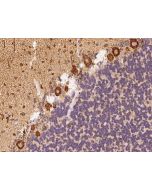
Anti-Carbonic Anhydrase VII Antibody, Rabbit Polyclonal
Validated applications
ELISA (FAQ Protocol)
Species reactivity
Reacts with: Human
Specificity
Human Carbonic Anhydrase VII
Immunogen
Recombinant Human Carbonic Anhydrase VII protein (Catalog#12147-H08E)
Preparation
Produced in rabbits immunized with purified, recombinant Human Carbonic Anhydrase VII (rh Carbonic Anhydrase VII; Catalog#12147-H08E; P43166; Met1-Ala264). Carbonic Anhydrase VII specific IgG was purified by Human Carbonic Anhydrase VII affinity chromatography.
Source
Polyclonal Rabbit IgG
Purification
Protein A & Antigen Affinity
Formulation
0.2 μm filtered solution in PBS
Conjugate
Unconjugated
Form
Liquid
Shipping
This antibody is shipped as liquid solution at ambient temperature. Upon receipt, store it immediately at the temperature recommended below.
Storage
This antibody can be stored at 2℃-8℃ for one month without detectable loss of activity. Antibody products are stable for twelve months from date of receipt when stored at -20℃ to -80℃. Preservative-Free. Avoid repeated freeze-thaw cycles.
Carbonic anhydrase 7, also known as carbonate dehydratase VII, carbonic anhydrase VII, CA-VII and CA7, is a cytoplasm protein which belongs to thealpha-carbonic anhydrase family. Carbonic anhydrases are a large family of zinc metalloenzymes that catalyze the reversible hydration of carbon dioxide. They participate in a variety of biological processes, including respiration, calcification, acid-base balance, bone resorption, and the formation of aqueous humor, cerebrospinal fluid, saliva, and gastric acid. Carbonic anhydrases show extensive diversity in tissue distribution and in their subcellular localization. CA7 / CA-VII is predominantly expressed in the salivary glands. Alternative splicing in the coding region results in multiple transcript variants encoding different isoforms.
References
Montgomery J.C., et al., 1991, Genomics 11:835-848.
Temperini C., et al., 2006, Chemistry 12:7057-7066.
Temperini C., et al., 2007, Bioorg. Med. Chem. Lett. 17:628-635.
Maresca A., et al., 2009, J. Am. Chem. Soc. 131:3057-3062.