A synthetic peptide corresponding to the C-terminus of the human CD3E.
Preparation
Produced in rabbits immunized with a synthetic peptide corresponding to the C-terminus of the human CD3E., and purified by antigen affinity chromatography.
Source
Polyclonal Rabbit IgG
Purification
Protein A & Antigen Affinity
Formulation
0.2 μm filtered solution in PBS
Conjugate
Unconjugated
Form
Liquid
Shipping
This antibody is shipped as liquid solution at ambient temperature. Upon receipt, store it immediately at the temperature recommended below.
Storage
This antibody can be stored at 2℃-8℃ for one month without detectable loss of activity. Antibody products are stable for twelve months from date of receipt when stored at -20℃ to -80℃. Preservative-Free. Avoid repeated freeze-thaw cycles.
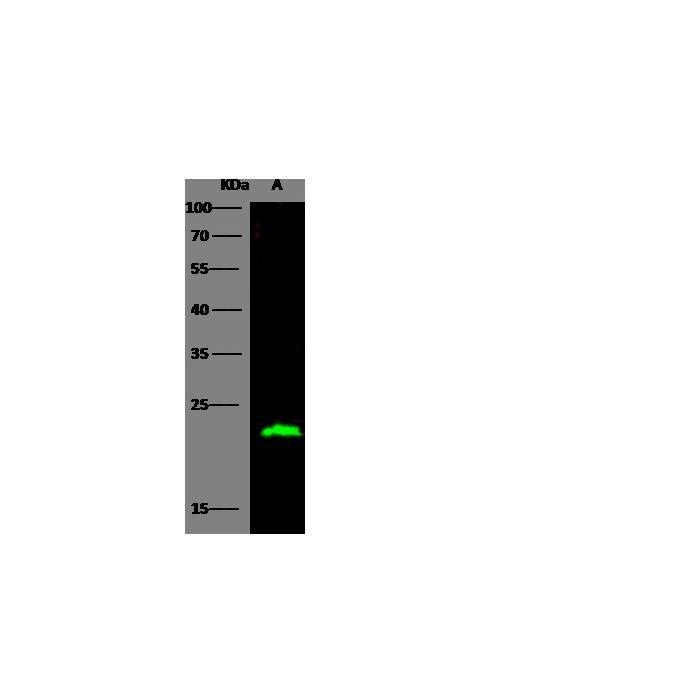
Anti-CD3E rabbit polyclonal antibody at 1:500 dilution Lane A: Jurkat Whole Cell Lysate Lysates/proteins at 30 μg per lane. Secondary Goat Anti-Rabbit IgG H&L (Dylight800) at 1/10000 dilution. Developed using the Odyssey technique. Performed under reducing conditions. Predicted band size:23 kDa Observed band size:23 kDa
T-cell surface glycoprotein CD3 epsilon chain, also known as CD3E, is a single-pass type I membrane protein. CD3E contains 1 Ig-like (immunoglobulin-like) domain and 1 ITAM domain. CD3E, together with CD3-gamma, CD3-delta and CD3-zeta, and the T-cell receptor alpha/beta and gamma/delta heterodimers, forms the T cell receptor-CD3 complex. The CD3 epsilon subunit of the T cell receptor (TCR) complex contains two defined signaling domains, a proline-rich sequence and an immune tyrosine activation motifs (ITAMs), and this complex undergoes a conformational change upon ligand binding that is thought to be important for the activation of T cells. In the CD3 epsilon mutant mice, all stages of T cell development and activation that are TCR-dependent were impaired, but not eliminated, including activation of mature naïve T cells with the MHCII presented superantigen, staphylococcal enterotoxin B, or with a strong TCR cross-linking antibody specific for either TCR-Cbeta or CD3 epsilon. T cell receptor-CD3 complex plays an important role in coupling antigen recognition to several intracellular signal-transduction pathways. This complex is critical for T-cell development and function, and represents one of the most complex transmembrane receptors. CD3E plays an essential role in T-cell development, and defects in CD3E gene cause severe immunodeficiency. Homozygous mutations in CD3D and CD3E genes lead to a complete block in T-cell development and thus to an early-onset severe combined immunodeficiency phenotype.
Research Areas
ITIM/ITAM Immunoreceptors and Related Molecules
Related Pathways
T Cell Receptor Signaling Pathway
Tags
Cancer Immunotherapy
Immune Checkpoint
Immunotherapy
Targeted Therapy
References
Fischer A, et al. (2005) CD3 deficiencies. Curr Opin Allergy Clin Immunol. 5(6): 491-5.
Wang Y, et al. (2009) A conserved CXXC motif in CD3epsilon is critical for T cell development and TCR signaling. PLoS Biol. 7(12): e1000253.
Martnez-Martn N, et al. (2009) Cooperativity between T cell receptor complexes revealed by conformational mutants of CD3epsilon. Sci Signal. 2(83): ra43.
Deford-Watts LM, et al. (2009) The cytoplasmic tail of the T cell receptor CD3 epsilon subunit contains a phospholipid-binding motif that regulates T cell functions. J Immunol. 183(2): 1055-64.


-HB07AU1603-WB.png)