Recombinant Human CD33 / Siglec-3 Protein (Catalog#12238-H08H)
Preparation
This antibody was obtained from a rabbit immunized with purified, recombinant Human CD33 / Siglec-3 (rh CD33 / Siglec-3; Catalog#12238-H08H; AAH28152.1; Met1-His259) and conjugated with FITC under optimum conditions, the unreacted FITC was removed.
Source
Monoclonal Rabbit IgG Clone #001
Purification
Protein A
Formulation
PBS solution containing 0.5% BSA and 0.09% sodium azide
Concentration
5 μl/Test, 0.1 mg/ml
Conjugate
FITC
Form
Liquid
Shipping
This antibody is shipped as liquid solution at ambient temperature. Upon receipt, store it immediately at the temperature recommended below.
Storage
This antibody can be stored at 2℃-8℃ for twelve months without detectable loss of activity. Protected from prolonged exposure to light. Do not freeze ! Sodium azide is toxic to cells and should be disposed of properly. Flush with large volumes of water during disposal.
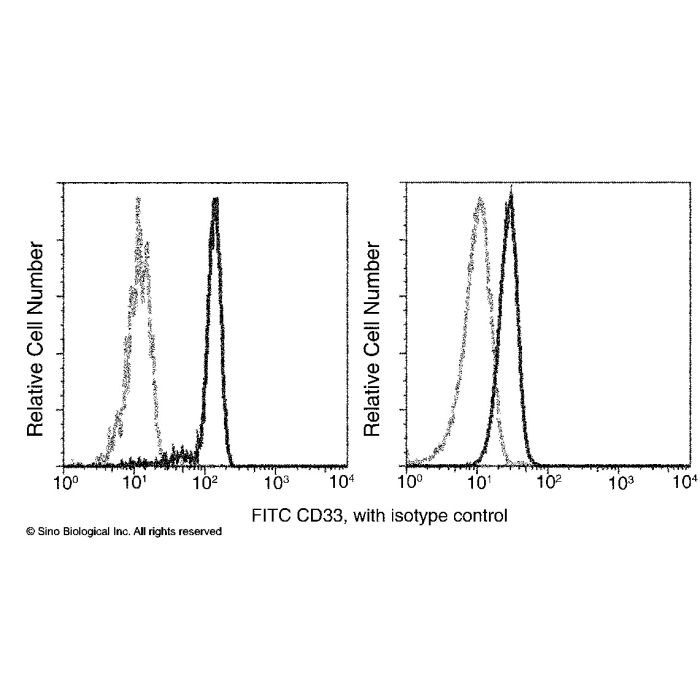
Flow cytometric analysis of Human CD33 expression on human whole blood monocytes (left panel) and granulocytes (right panel). Cells were stained with FITC conjugated anti-Human CD33. The histograms were derived from gated events with the forward and side light-scatter characteristics of viable monocytes and granulocytes.
Myeloid cell surface antigen CD33 also known as Sialic acid binding Ig-like lectin 3, CD33 antigen or Siglec-3, is a member of the immunoglobulin superfamily and SIGLEC (sialic acid binding Ig-like lectin) family. This Single-pass type I membrane protein contains 1 Ig-like C2-type (immunoglobulin-like) domain and 1 Ig-like V-type (immunoglobulin-like) domain. CD33 /Siglec-3 is a putative adhesion molecule of myelomonocytic-derived cells that mediates sialic-acid dependent binding to cells. CD33 /Siglec-3 preferentially binds to alpha-2,6-linked sialic acid. The sialic acid recognition site may be masked by cis interactions with sialic acids on the same cell surface. In the immune response, may act as an inhibitory receptor upon ligand induced tyrosine phosphorylation by recruiting cytoplasmic phosphatase(s) via their SH2 domain(s) that block signal transduction through dephosphorylation of signaling molecules. CD33/Siglec-3 induces apoptosis in acute myeloid leukemia (in vitro). CD33/Siglec-3 can function as a sialic acid-dependent cell adhesion molecule and that binding can be modulated by endogenous sialoglycoconjugates when CD33 is expressed in a plasma membrane.
Research Areas
Cancer Drug Targets
ITIM/ITAM Immunoreceptors and Related Molecules
Tags
Cancer Immunotherapy
Immune Checkpoint
Immunotherapy
Targeted Therapy
References
Simmons D, et al. (1988) Isolation of a cDNA encoding CD33, a differentiation antigen of myeloid progenitor cells. J Immunol. 141(8): 2797-800.
Ulyanova T, et al. (1999) The sialoadhesin CD33 is a myeloid-specific inhibitory receptor. Eur J Immunol. 29(11): 3440-9.
Freeman SD, et al. (1995) Characterization of CD33 as a new member of the sialoadhesin family of cellular interaction molecules. Blood. 85(8): 2005-12.