Recombinant Human CEACAM3 / CD66d protein (Catalog#11933-H08H)
Preparation
This antibody was produced from a hybridoma resulting from the fusion of a mouse myeloma with B cells obtained from a mouse immunized with purified, recombinant Human CEACAM3 / CD66d (rh CEACAM3 / CD66d; Catalog#11933-H08H; NP_001806.2; Met 1-Gly 155) and conjugated with PE under optimum conditions, the unreacted PE was removed.
Source
Monoclonal Mouse IgG1 Clone #06
Purification
Protein A
Formulation
PBS solution containing 0.5% BSA and 0.03%ProClin300
Concentration
10 μl/Test, 0.1 mg/ml
Conjugate
PE
Form
Liquid
Shipping
This antibody is shipped as liquid solution at ambient temperature. Upon receipt, store it immediately at the temperature recommended below.
Storage
This antibody can be stored at 2℃-8℃ for twelve months without detectable loss of activity. Protected from prolonged exposure to light. Do not freeze !
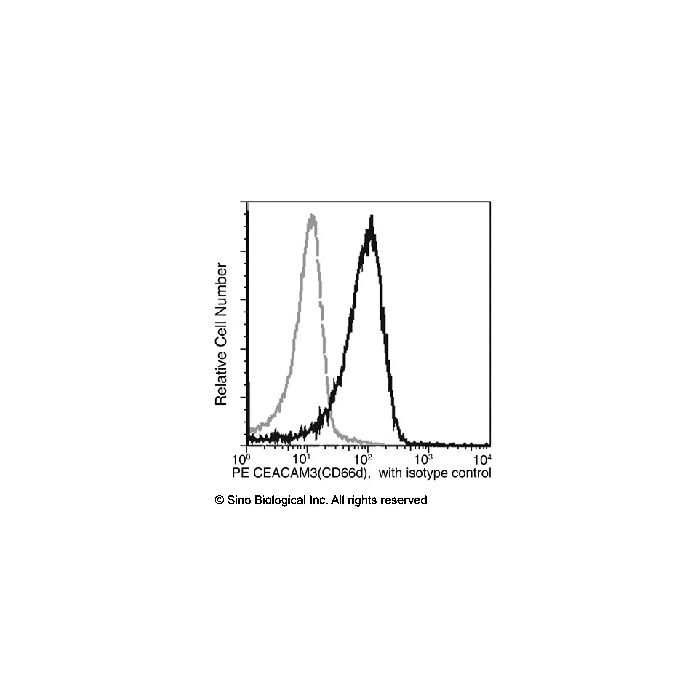
Flow cytometric analysis of anti-human CEACAM3 (CD66d) on human whole blood granulocytes. The fluorescence histograms were derived from events with the forward and side light-scatter characteristics of viable granulocytes.
carcinoembryonic antigen related cell adhesion molecule 3
Description
CeACAM3 (CD66d), a member of carcinoembryonic antigen family, is a granulocyte-specific receptor involved in the opsonin-independent recognition of several bacterial pathogens. There are four members in this family: CD66a, CD66b, CD66c, and CD66d. Members of CEACAM family are widely expressed especially on human neutrophils, and, depending on the tissue, capable of regulating diverse functions including tumor promotion, tumor suppression, angiogenesis, and neutrophil activation. Abnormal overexpression and downregulation of some CEACAMs have been described in tumor cells. Monoclonal antibodies grouped in the CD66 cluster recognize CEACAM members. Ectopic CD66 expression is commonly detected in B-cell lineage acute lymphoblastic leukemia (ALL). CEACAM3 mediates phagocytosis depends on the integrity of an ITAM-like sequence within the cytoplasmic domain of CEACAM3. CEACAM3 is characterized by rapid stimulation of the GTPase Rac.
Research Areas
ITIM/ITAM Immunoreceptors and Related Molecules
References
Schmitter T, et al. (2007) The Granulocyte Receptor Carcinoembryonic Antigen-Related Cell Adhesion Molecule 3 (CEACAM3) Directly Associates with Vav to Promote Phagocytosis of Human Pathogens. The journal of immunology. 178: 3797-805.
Swanson KV, et al. (2001) CEACAM is not necessary for Neisseria gonorrhoeae to adhere to and invade female genital epithelial cells. Cellular Microbiology. 3 (10): 681-91.
Hasselbalch HC, et al. (2011) High expression of carcinoembryonic antigen-related cell adhesion molecule (CEACAM) 6 and 8 in primary myelofibrosis. Leukemia Research.


-MM06-PE-Granulocytes.png)